PRESS RELEASE
May 13, 2026
Contact: Sam Stockwell
samuel_stockwell@gse.harvard.edu
617.495.0342
Minnesota Ranks 17th in Math Recovery and 8th in Reading Among States, with Districts on the Rise Emerging Across the State
Despite solid recovery gains, students remain nearly .75 grade equivalents below 2019 levels in math.
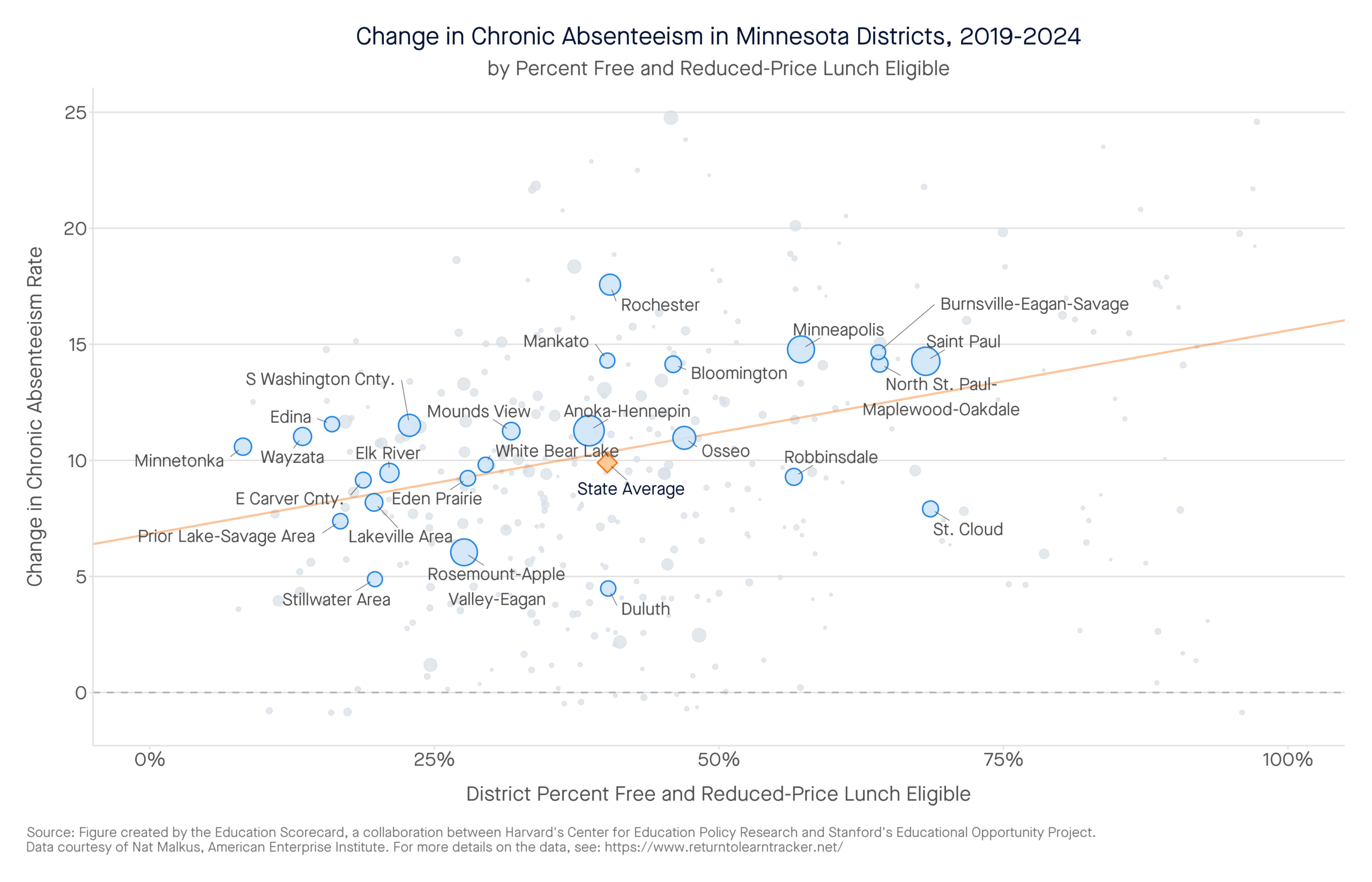
Chronic absenteeism remains more than 10 percentage points above pre-pandemic levels.
Chisago Lakes and Edina Public are outperforming their peers in both math and reading, while Saint Paul Public is a leader in reading recovery.
(May 13, 2026) In its fourth year, the Education Scorecard (a collaboration between the Center for Education Policy Research at Harvard University, The Educational Opportunity Project at Stanford University, and faculty at Dartmouth College) is issuing its annual report on district-level student growth in math and reading.
The latest report provides a high-resolution picture of where Minnesota students’ academic recovery stands, combining state test results for roughly 35 million grade 3–8 students nationwide with national assessment data to describe changes in local communities. Here’s what we found:
Minnesota:
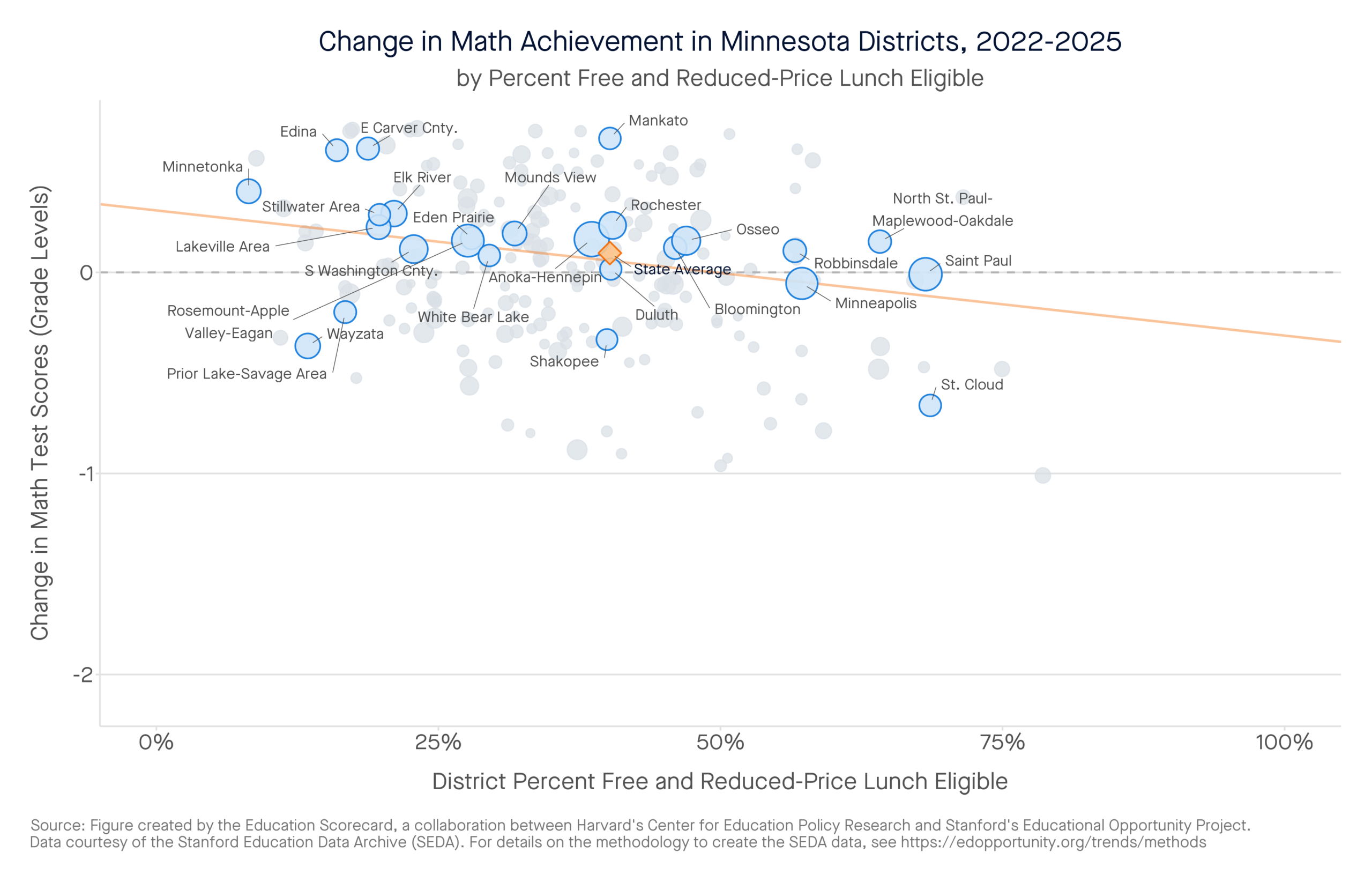
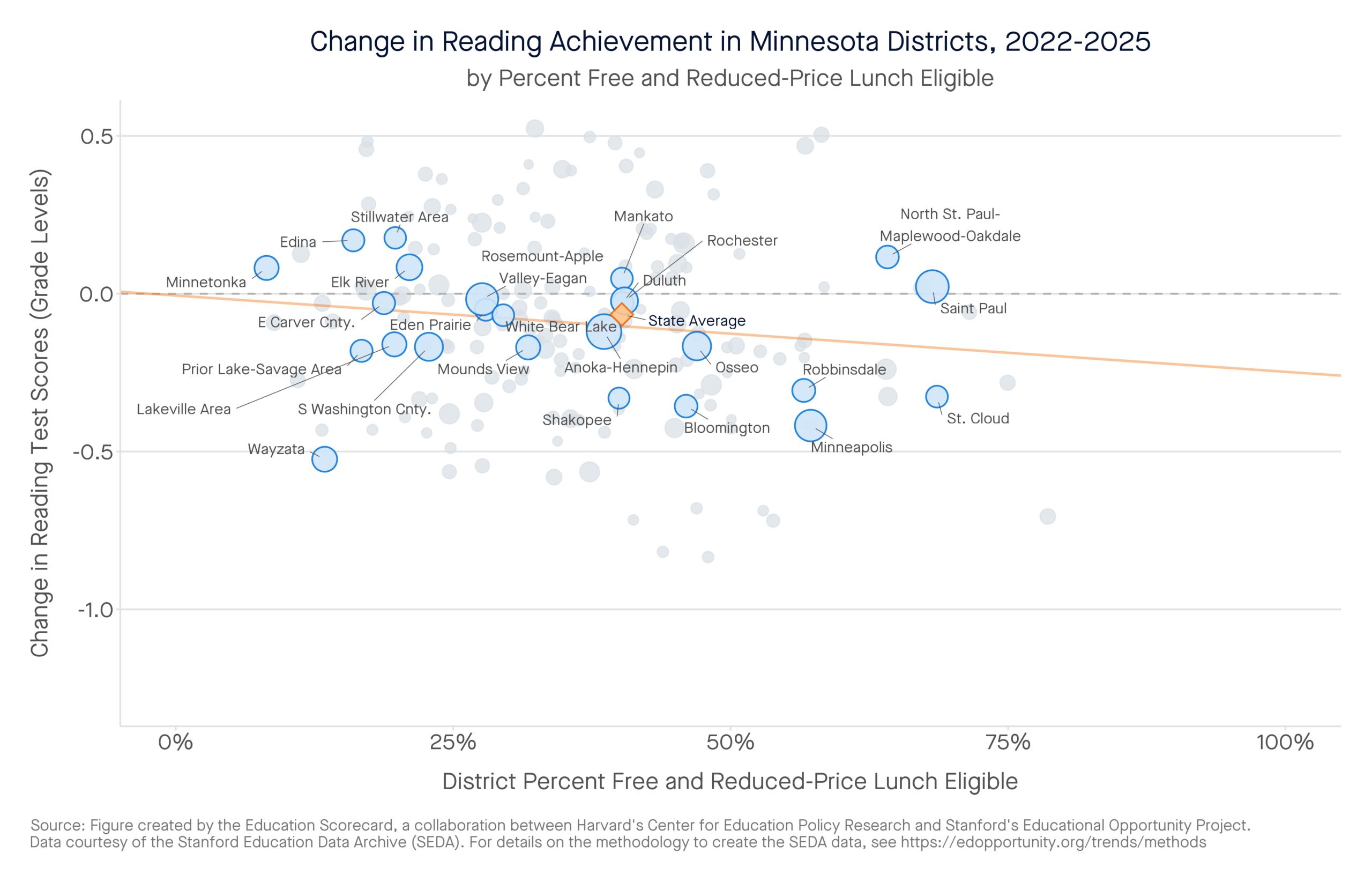
- Minnesota ranks 17th out of 38 states in academic growth in math and 8th out of 35 states in reading between 2022 and 2025.
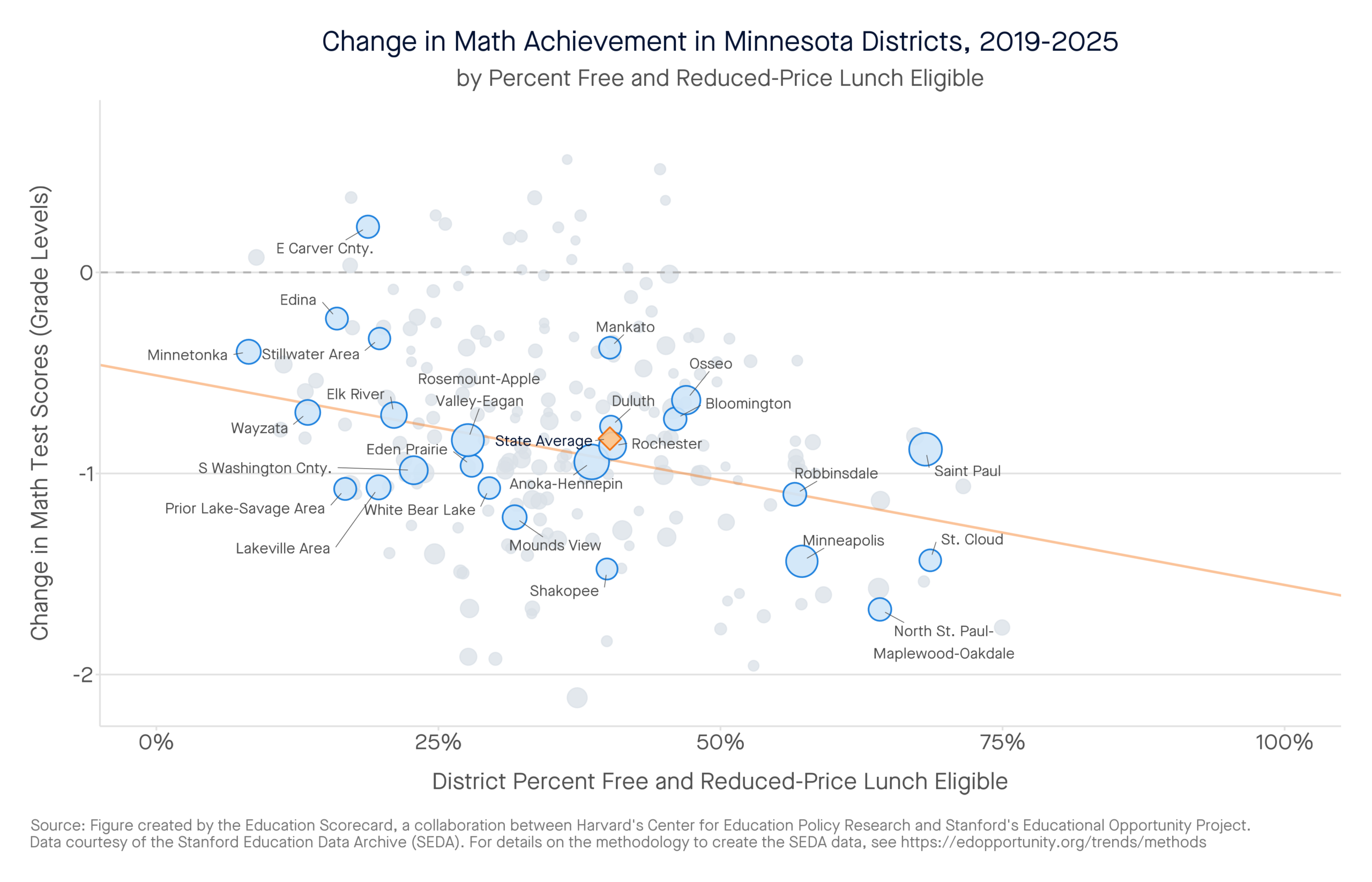
- In math, the average student is performing about .19 grade equivalents above their 2022 level, but around .73 grade equivalents below 2019 levels. Some districts like North St. Paul–Maplewood Oakdale, Minneapolis, and Mounds View continue to lag over a full grade equivalent behind 2019 levels.
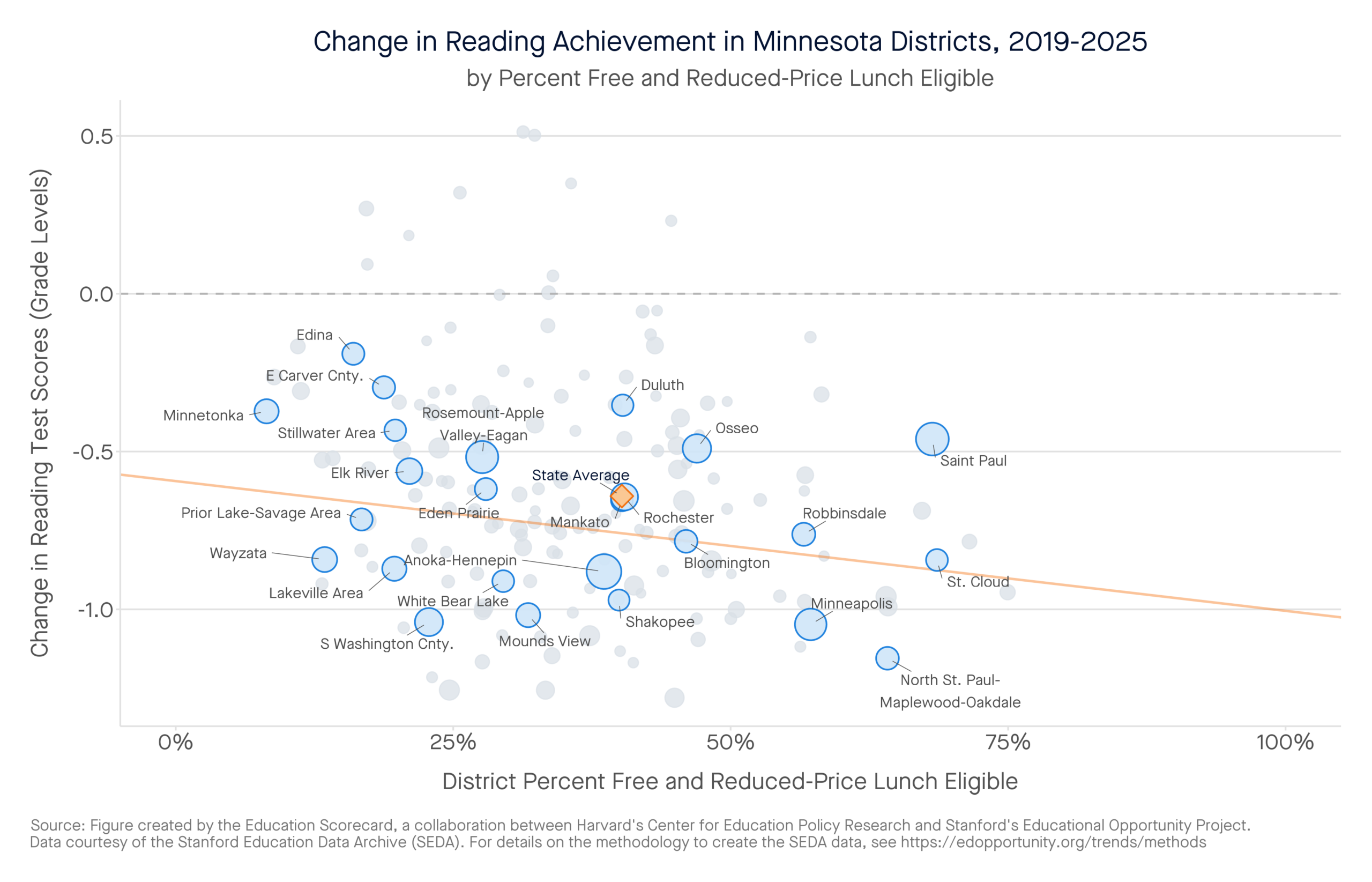
- In reading, the average student is performing essentially at their 2022 level (+.006 grade equivalents), but around .57 grade equivalents below 2019 levels. A number of districts like North St. Paul–Maplewood Oakdale, Minneapolis, and South Washington County continue to slip and remain significantly behind their 2019 levels.
- Several Minnesota districts are emerging as Districts on the Rise. These districts have shown unusual progress relative to similar districts in their own state. A core group of districts is excelling in both math and reading, with districts like Chisago Lakes and Edina Public outperforming their peers.
- Several other districts are rising relative to their peers in one subject—either math or reading. Sartell-St. Stephen, Mankato Public, and Owatonna are leading the way in math performance, while Richfield Public, Saint Paul Public, and St. Francis Area are leading the way in reading.
- Statewide, there is some good news on chronic absenteeism (students missing more than 10% of a school year), which has fallen from almost 30% in 2022 to around 24% in 2024. However, chronic absence rates still remain over 10 percentage points above pre-pandemic levels.
- Minnesota received about $2.05 billion in federal pandemic relief for K–12 schools—roughly $2,400 per student. Our analysis finds that the gains in many high-poverty districts were driven by this federal support. Unfortunately, many middle-poverty districts (those with 30 to 70 percent of students receiving federal lunch subsidies) received little federal aid. Now that the federal relief is gone, Minnesota should focus school improvement dollars on the middle and higher poverty districts that remain behind their pre-pandemic levels.
“The pandemic was the mudslide that followed seven years of erosion in student achievement,” said Professor Tom Kane, faculty director of the Center for Education Policy Research at Harvard University. “The ‘learning recession’ started a decade ago, after policymakers switched off the early warning system of test-based accountability and social media took over children’s lives. In this report, we highlight the work of a small group of state leaders who have started digging out by changing how students learn to read, and 108 local school districts that are finding ways to get students learning again. The recovery of U.S. education has begun. But it’s up to the rest of us to spread it.”
District on the Rise: Eastern Carver County Public Schools
Among Minnesota’s Districts on the Rise excelling in both math and reading, Eastern Carver County Public Schools (ECCS) stands out for redefining what school improvement means at every level of the system. The district redesigned the principalship around instructional leadership as primary work—not an add-on to operations—and replaced standard “2% growth” targets with specific goals for all students alongside accelerated targets of 2–3x growth for students farthest from opportunity, including students of color and multilingual learners. Principal meetings focus on improving adult practice through learning walks, consultancy protocols around data, and coaching conversation practice. In middle school math, the district deliberately disrupted the assumption that incremental growth from a low starting point was sufficient, establishing a universal expectation of grade-level proficiency for every student, shifting back to full state standard language, and requiring common unit assessments across middle schools. Teachers at one middle school introduced Building Thinking Classrooms, and the district funded professional development and planning time to allow the model to spread organically without mandates. On attendance, the district launched its Attendance Matters campaign over three years ago, giving every educator a shared goal and a consistent visual identity across schools. The Research Evaluation and Assessment team sends bi-weekly disaggregated attendance data to principals and developed an in-house heat map disaggregating absence patterns by race, school, and day—enabling the district to identify specific drivers and anticipate future patterns. Family-facing communications before every break remind families in their preferred language why attendance matters academically. Equity and belonging are treated as academic foundations: a team of multicultural liaisons supports family relationships in their preferred language and cultural context, and student focus groups are embedded into major curriculum and pedagogy decisions, so changes are co-shaped by students’ lived classroom experiences. For the full case study, click here.
“Our gains reflect a relentless commitment to serving every child regardless of their background, zip code, or school,” said Dr. Erin Rathke, Superintendent of Eastern Carver County Public Schools. “At the center of this work are our students and the experiences they have every day in our district. We take a holistic, student-centered approach, using data to stay nimble, make adjustments, and better support our leaders, teachers, and students. I often say that data is a comma, not a period; it helps guide our next steps, not define our students. While there is still more work to do, there is also a great deal to be proud of.”