PRESS RELEASE
May 13, 2026
Contact: Sam Stockwell
samuel_stockwell@gse.harvard.edu
617.495.0342
Connecticut Ranks 13th in Math Recovery and 9th in Reading Among States, with Districts on the Rise Emerging Across the State
Despite solid recovery gains, students remain more than half a grade level below 2019 levels in both math and reading.
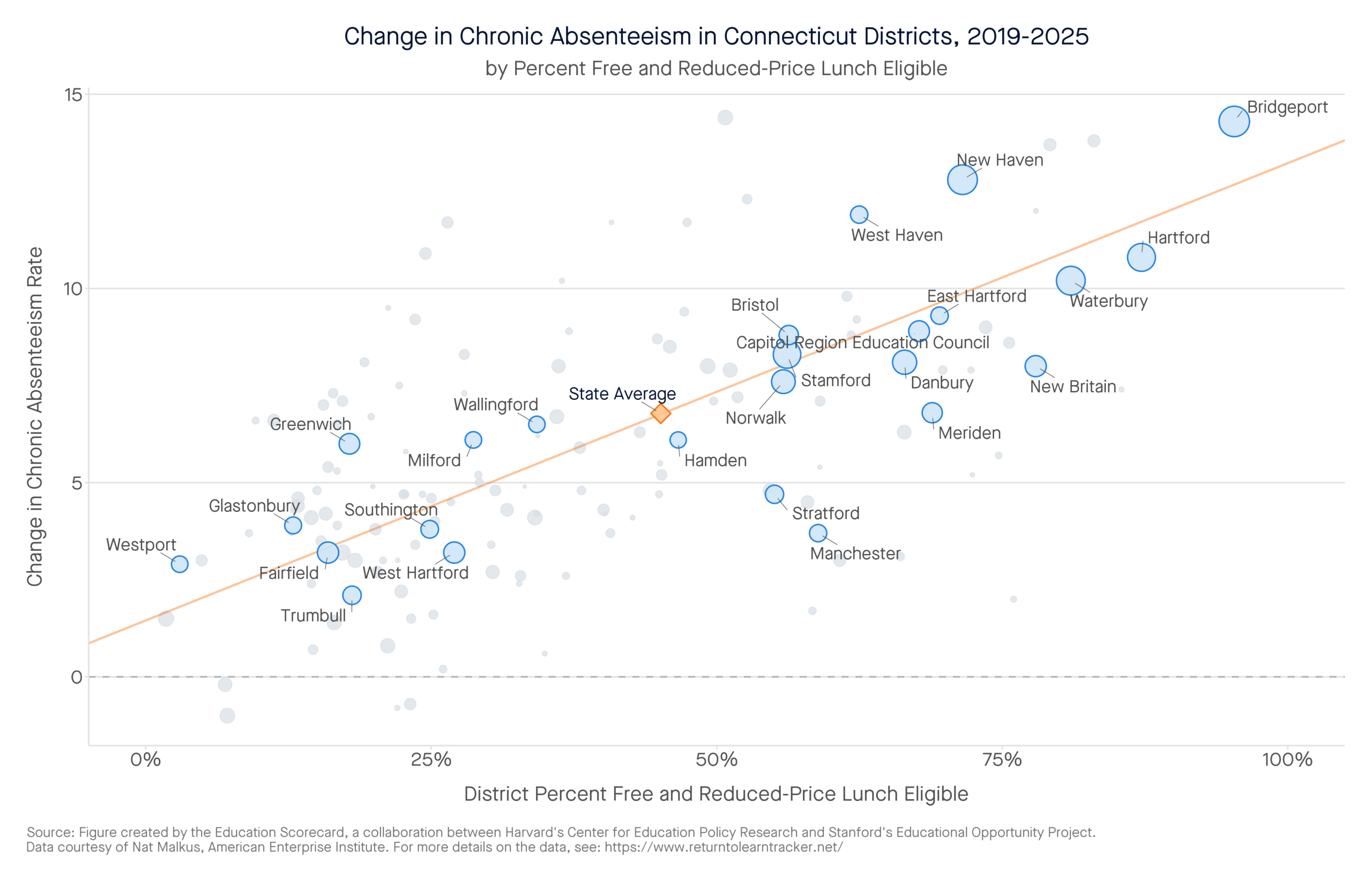
Chronic absenteeism has fallen significantly but remains nearly 7 percentage points above pre-pandemic levels.
Districts like East Hartford, Greenwich, Manchester, and Meriden are outperforming their peers in both math and reading.
(May 13, 2026) In its fourth year, the Education Scorecard (a collaboration between the Center for Education Policy Research at Harvard University, The Educational Opportunity Project at Stanford University, and faculty at Dartmouth College) is issuing its annual report on district-level student growth in math and reading.
The latest report provides a high-resolution picture of where Connecticut students’ academic recovery stands, combining state test results for roughly 35 million grade 3–8 students nationwide with national assessment data to describe changes in local communities. Here’s what we found:
Connecticut:
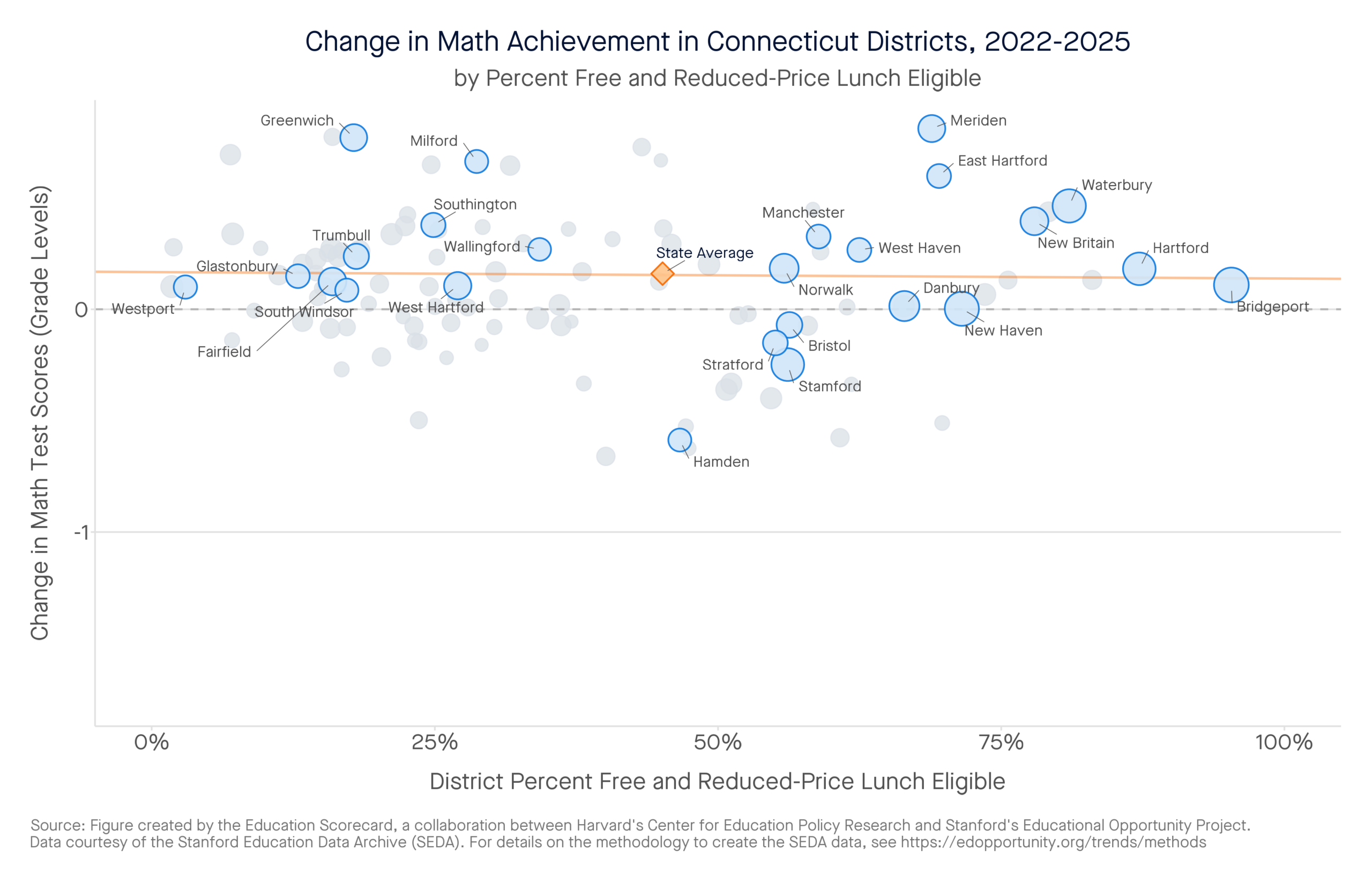
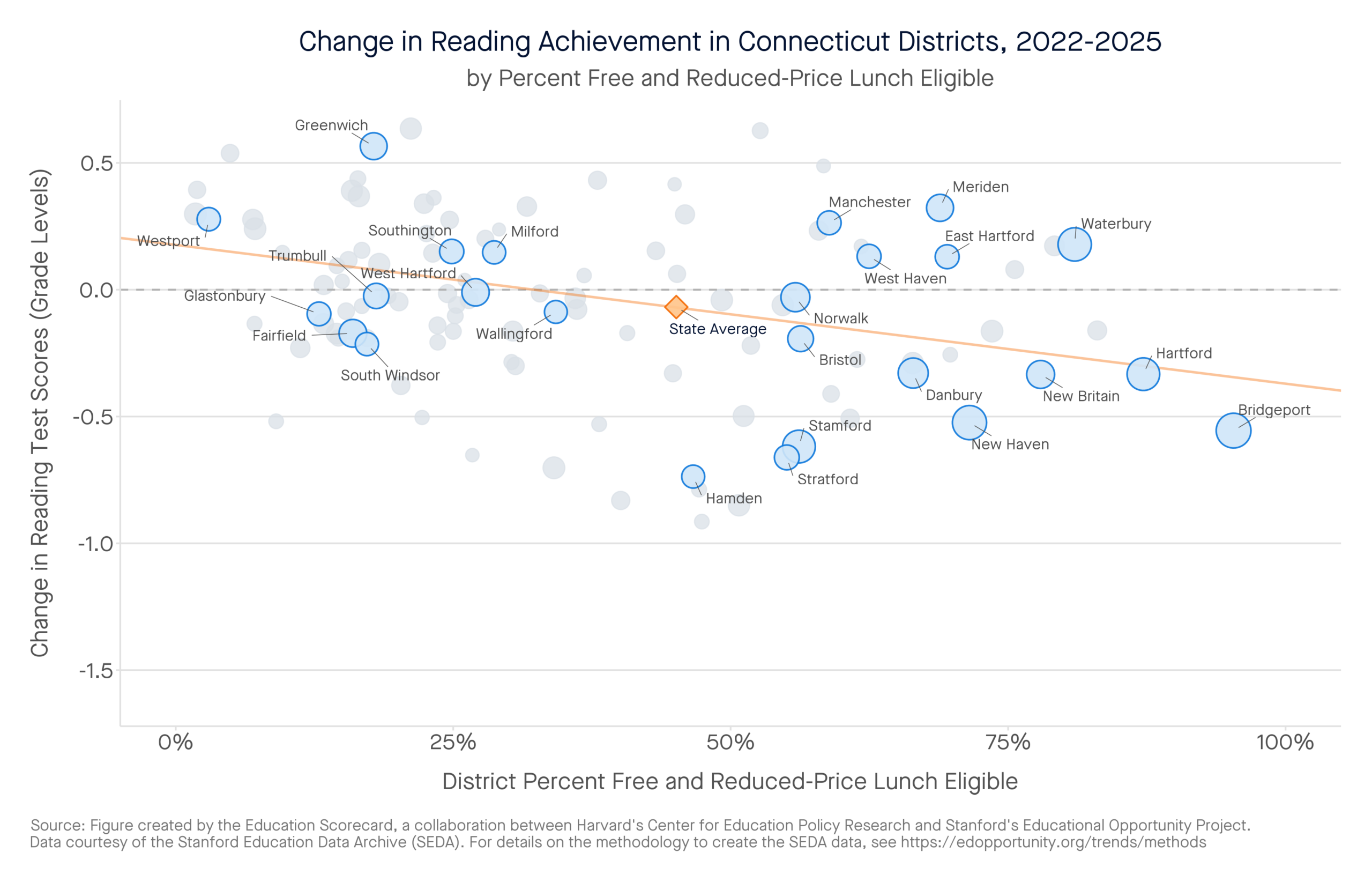
- Connecticut ranks 13th out of 38 states in academic growth in math and 9th out of 35 states in reading between 2022 and 2025.
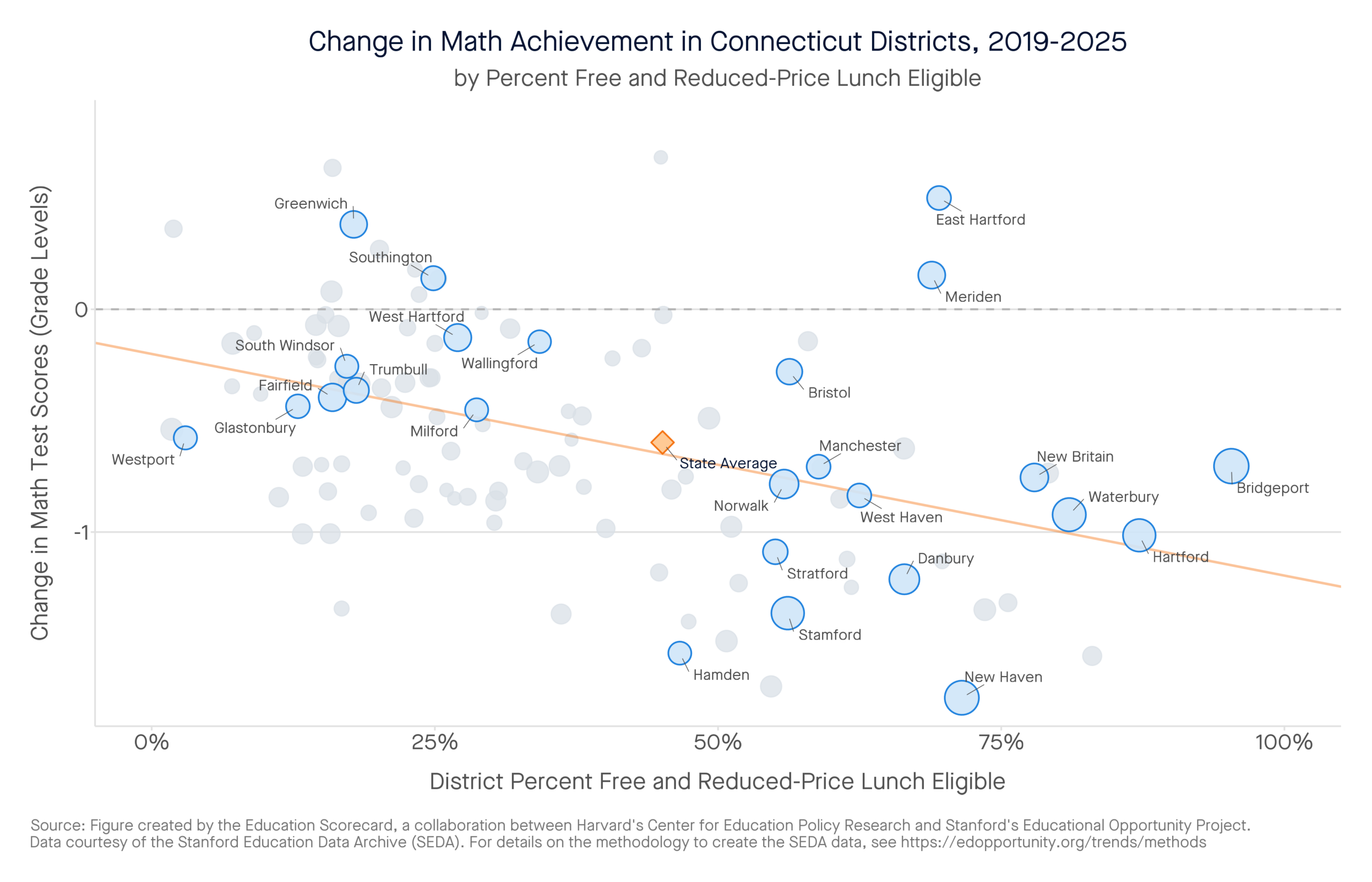
- In math, the average student is performing about .22 grade equivalents above their 2022 level, but .54 grade equivalents below 2019 levels. Some districts like New Haven, Hamden, Stamford, and Danbury continue to lag over a full grade equivalent behind 2019 levels.
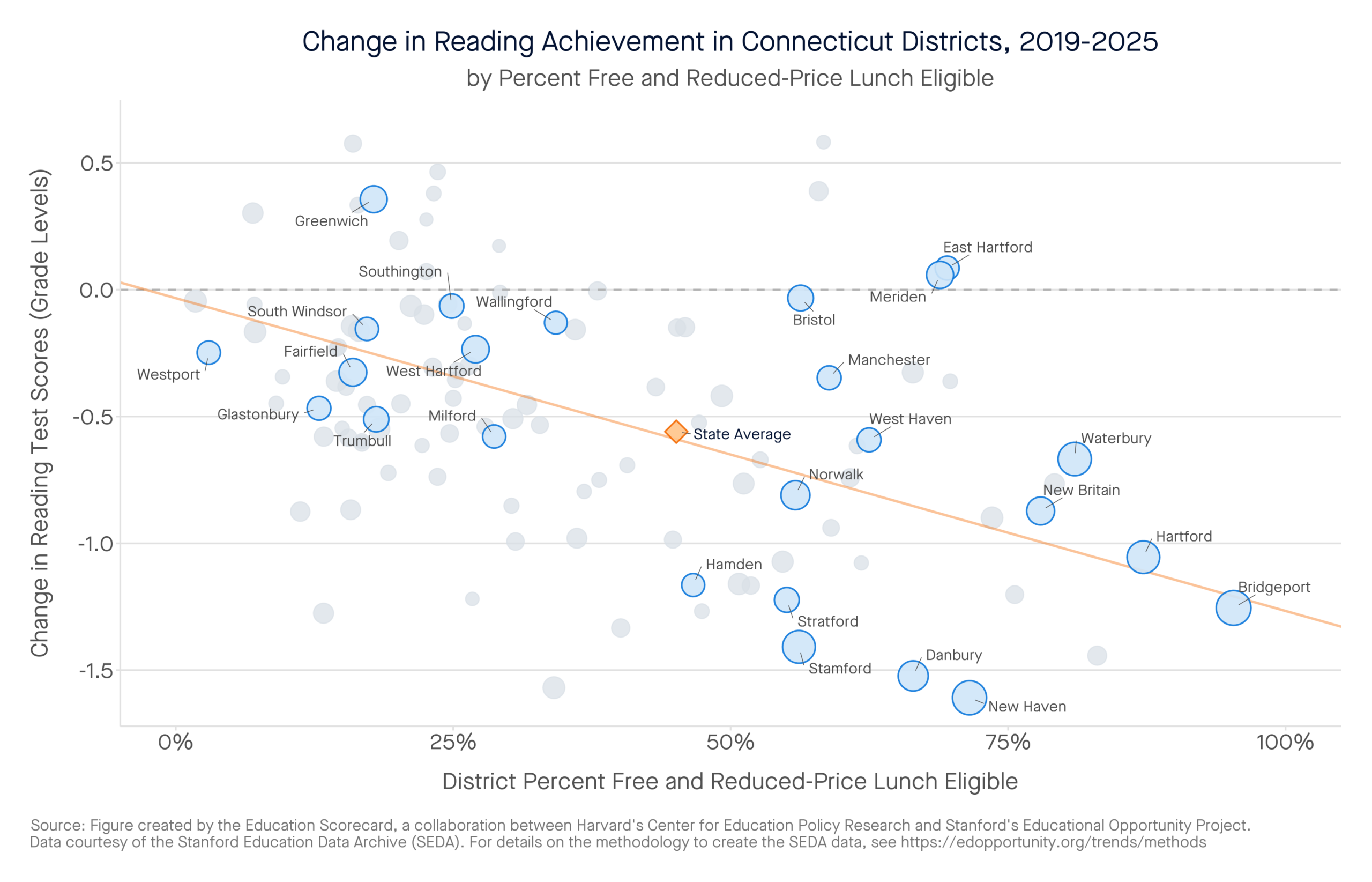
- In reading, the average student is performing around .01 grade equivalents below their 2022 level, but half a grade equivalent below 2019 levels. A number of districts like New Haven, Danbury, Stamford, Stratford, Bridgeport, and Hamden continue to slip and remain more than a full grade equivalent behind their 2019 levels.
- Several Connecticut districts are emerging as Districts on the Rise. These districts have shown unusual progress relative to similar districts in their own state. A core group of districts is excelling in both math and reading, with districts like East Hartford, Greenwich, Manchester, and Meriden outperforming their peers.
- Several other districts are rising relative to their peers in one subject—either math or reading. Bethel is leading the way in math performance, while Vernon and Windsor are leading the way in reading.
- Statewide, there is some good news on chronic absenteeism (students missing more than 10% of a school year), which has fallen from 23.7% in 2022 to 17.2% in 2025. However, chronic absence rates still remain almost 7 percentage points above pre-pandemic levels.
- Connecticut received about $1.7 billion in federal pandemic relief for K–12 schools—roughly $3,400 per student. Our analysis finds that the gains in many high-poverty districts were driven by this federal support. Unfortunately, many middle-poverty districts (those with 30 to 70 percent of students receiving federal lunch subsidies) received little federal aid. Now that the federal relief is gone, Connecticut should focus school improvement dollars on the middle and higher poverty districts that remain behind their 2019 levels.
“The pandemic was the mudslide that followed seven years of erosion in student achievement,” said Professor Tom Kane, faculty director of the Center for Education Policy Research at Harvard University. “The ‘learning recession’ started a decade ago, after policymakers switched off the early warning system of test-based accountability and social media took over children’s lives. In this report, we highlight the work of a small group of state leaders who have started digging out by changing how students learn to read, and 108 local school districts that are finding ways to get students learning again. The recovery of U.S. education has begun. But it’s up to the rest of us to spread it.”
District on the Rise: East Hartford Public Schools
Among Connecticut’s Districts on the Rise in both math and reading, East Hartford Public Schools (EHPS) stands out for building a culture of transparency, accountability, and coherent instructional improvement. Inspired by the NYPD’s CompStat model, Superintendent Anderson holds five to seven STAT Meetings per year that convene all school and department leaders as the central office presents system-level data publicly enabling schools to identify shared challenges, learn from peers, and avoid siloed efforts. Schools also lead three data-intensive Student Achievement Meetings per year with central office staff, with the superintendent present at every one to signal that data analysis is a district-wide priority. Monthly district leadership team meetings calibrate instructional expectations and align the feedback given during learning walks across the district. On instruction, EHPS has aligned curriculum and assessment practices grounded in the science of reading and problem-based learning math and recently expanded its instructional coaching team from elementary-only to PreK–8 across all buildings—creating a common through line in instruction, assessment, and needs-analysis. At the middle school level, formative assessment data and teacher observations drive the formation of small Math Lab classes of eight to ten students built directly into the school day. On attendance, the district participates in Connecticut’s state-funded Learner Engagement and Attendance Program (LEAP), which supports home visits to re-engage chronically absent students—with statewide analysis showing an 8-percentage-point attendance increase for PK–5 students and a 16-point increase for grades 6–12 students nine months after the first visit. Most EHPS schools are also staffed with a dedicated Bilingual Family Support Specialist to address non-academic barriers and connect families to food banks, health centers, and community services. STAT meeting data revealed that personal phone calls from staff—just 10 minutes a day to reach five families—produced measurably better attendance outcomes than automated calls, a finding that shaped district practice. For the full case study, click here.
“Our work is centered around the coherence of clarity, accountability, and measurement,” said Thomas Anderson, Superintendent of East Hartford Public Schools. “We believe that accountability isn’t a negative term; it’s a commitment we make to the students and families we serve every day.”