PRESS RELEASE
May 13, 2026
Contact: Sam Stockwell
samuel_stockwell@gse.harvard.edu
617.495.0342
Washington Ranks 27th in Math and 23rd in Reading Recovery Among States, with Districts on the Rise Emerging Across the State
Reading scores have continued to fall since 2022, and chronic absenteeism remains among the furthest from pre-pandemic levels of any state in the country.
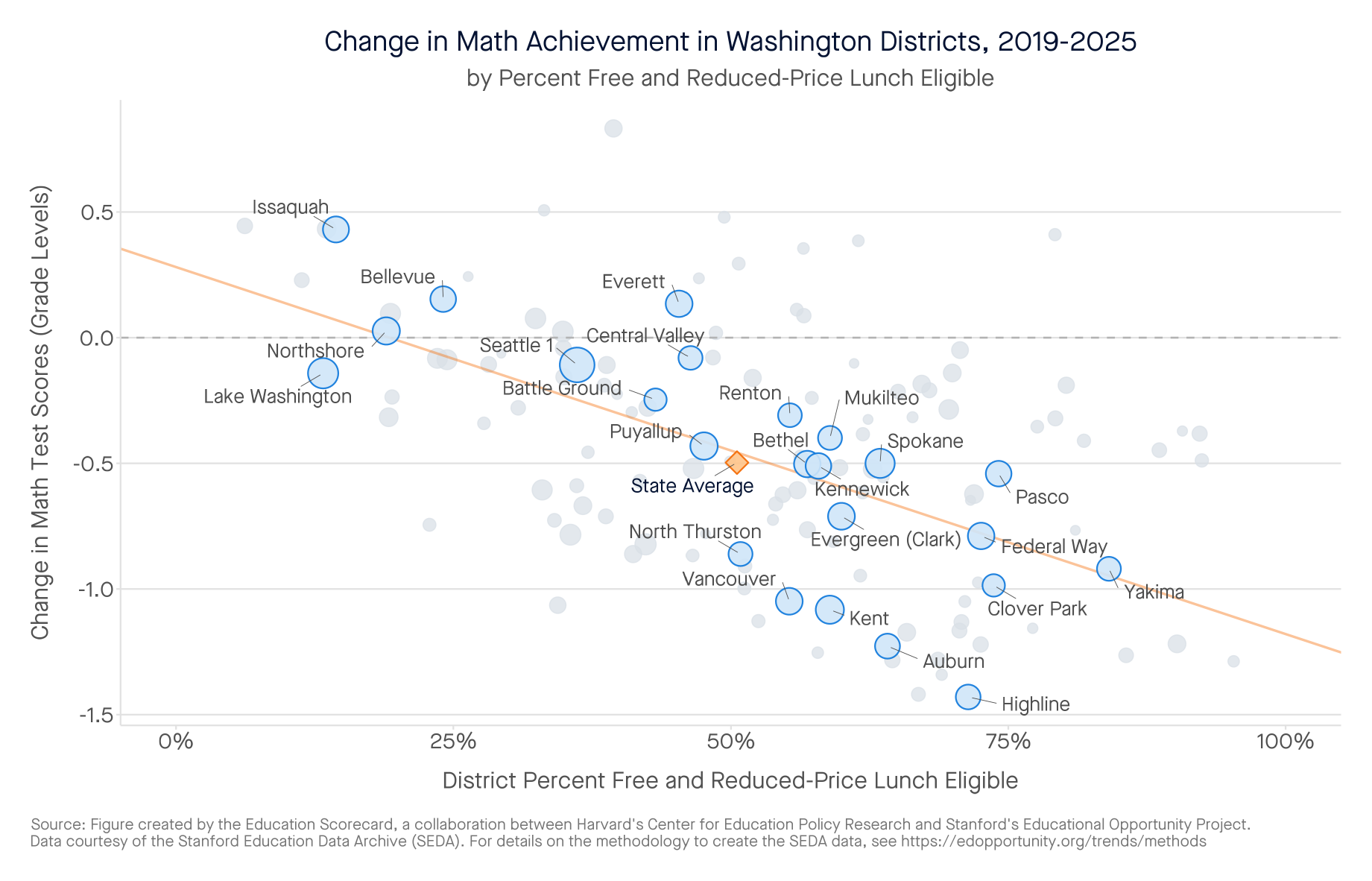
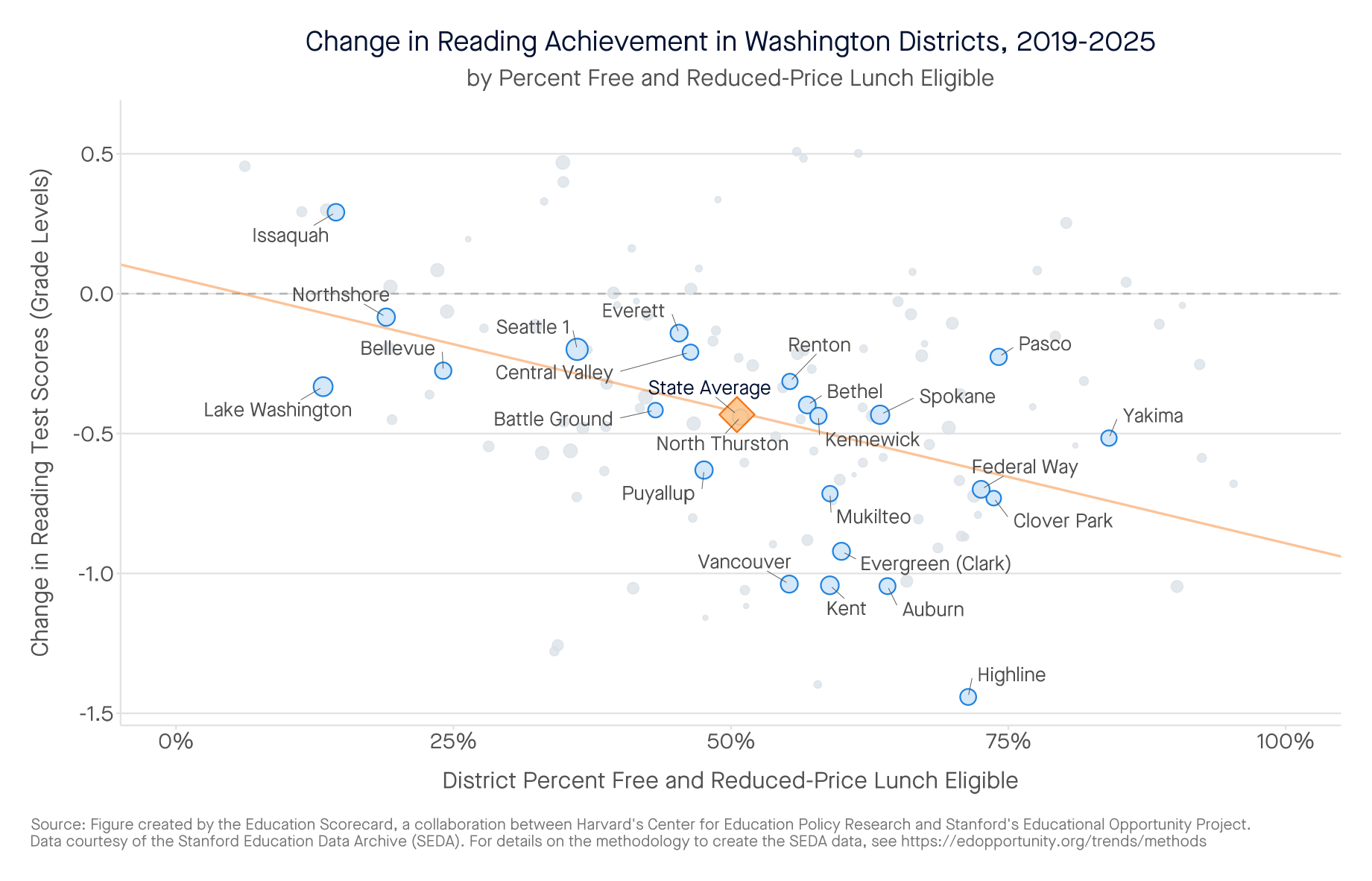
Highline, Auburn, and Kent—a cluster of South King County districts serving tens of thousands of students—lag behind 2019 levels in both math and reading.
Pasco and Issaquah are outperforming their peers in both math and reading.
(May 13, 2026) In its fourth year, the Education Scorecard (a collaboration between the Center for Education Policy Research at Harvard University, The Educational Opportunity Project at Stanford University, and faculty at Dartmouth College) is issuing its annual report on district-level student growth in math and reading.
The latest report provides a high-resolution picture of where Washington students’ academic recovery stands, combining state test results for roughly 35 million grade 3–8 students nationwide with national assessment data to describe changes in local communities. Here’s what we found in Washington:
- Washington ranks 27th out of 38 states in academic growth in math and 23rd out of 35 states in reading between 2022 and 2025.
- In math, the average student is performing about .07 grade equivalents above their 2022 level, but about half a grade equivalent below 2019 levels. Still, some districts like Highline, Auburn, and Kent continue to lag behind 2019 levels.
- In reading, the average student is performing about .15 grade equivalents below their 2022 level, and about .43 grade equivalents below 2019 levels. A number of districts like Highline, Auburn, and Kent continue to slip and remain behind their 2019 levels.
- Several Washington districts are emerging as Districts on the Rise. These districts have shown unusual progress relative to similar districts in their own state. A core group of districts is excelling in both math and reading, with districts like Pasco and Issaquah outperforming their peers.
- Several other districts are rising relative to their peers in one subject—either math or reading. Moses Lake, Everett, and Tahoma are leading the way in math performance, while Kelso, Sumner-Bonney Lake, and Oak Harbor are leading the way in reading.
- Statewide, there is some good news on chronic absenteeism (students missing more than 10% of a school year), which has fallen from almost 33% in 2022 to about 27% in 2025. However, chronic absence rates still remain about 12 percentage points above pre-pandemic levels.
- Washington received about $2.89 billion in federal pandemic relief for K–12 schools—roughly $2,700 per student. Our analysis finds the gains in many high-poverty districts were driven by this federal support. Unfortunately, many middle-poverty districts (those with 30 to 70 percent of students receiving federal lunch subsidies) received little federal aid. Now that the federal relief is gone, Washington should focus school improvement dollars on the middle and higher poverty districts that remain behind their pre-pandemic levels.
“The pandemic was the mudslide that followed seven years of erosion in student achievement,” said Professor Tom Kane, faculty director of the Center for Education Policy Research at Harvard University. “The ‘learning recession’ started a decade ago, after policymakers switched off the early warning system of test-based accountability and social media took over children’s lives. In this report, we highlight the work of a small group of state leaders who have started digging out by changing how students learn to read, and 108 local school districts that are finding ways to get students learning again. The recovery of U.S. education has begun. But it’s up to the rest of us to spread it.”
District on the Rise: Central Valley School District
Among Washington’s Districts on the Rise in both math and reading, Central Valley School District (CVSD) stands out for scaling a truly system-wide instructional model across all 29 schools. The district operates Professional Learning Communities as its districtwide instructional operating system, with teachers collaborating on late-start Thursday mornings using data protocols designed to produce concrete changes in instructional practice rather than generic discussion. PLCs examine individual, class-level, and grade-level student data and share differentiated strategies—and in 2025–26, the Board of Directors launched a “SIPs and PLCs in Action” initiative placing board members inside PLC teams and monitoring School Improvement Plan progress across all 29 schools. The district’s 29 schools are organized into three Learning Communities (Western, Central, and Eastern), each anchored by a comprehensive high school and its feeder schools, with cross-school meetings designed to close learning gaps at the elementary-to-middle and middle-to-high transitions. On math, CVSD invested in Bridges in Mathematics for K–5, an inquiry-based, activity-based curriculum using visual models and hands-on experiences to build algebraic fluency—with the explicit insight that 8th-grade Smarter Balanced math is algebra-heavy and that strong K–5 conceptual foundations give students multiple inroads before they are tested on it. Every elementary building has a Bridges content expert drawn from early-adopter staff for real-time teacher support, and the district reports reduced elementary behavior incidents attributed to higher student engagement with experiential learning. Instructional coherence is treated as a district responsibility: CVSD is building a Guaranteed and Viable Curriculum tied to Washington state standards and developed by district teachers, with clear role boundaries between curriculum builders, classroom teachers, interventionists, and building connections coaches. Professional development participation grew from 5,612 to 6,108 participants between 2021–22 and 2024–25, with certificated staff PD classes nearly doubling from 123 to 235. A pyramid MTSS model ensures all students access Tier 1 core instruction, with every elementary school running dedicated intervention time staffed by teachers trained in LETRS for literacy and Math Recovery for early math. For the full case study, click here.
“Recognition by the Education Scorecard affirms the work happening in our classrooms every day,” said Dr. John Parker, Superintendent of Central Valley School District. “While we’re proud of that progress, we remain focused on continuously refining our practices so every student benefits. Our success is the result of intentional, system-wide work—grounded in strong, data-driven Professional Learning Communities, guaranteed and viable curriculum, consistent professional development and a relentless focus on each student’s individual needs. We’ve built a system where educators are supported to do their best work through collaboration, clear instructional frameworks and sustained learning. That coherence across our district is what’s driving stronger outcomes and meaningful gains for all learners.”