PRESS RELEASE
May 13, 2026
Contact: Sam Stockwell
samuel_stockwell@gse.harvard.edu
617.495.0342
Indiana Ranks 29th in Math Recovery but 6th in Reading Among States, with Districts on the Rise Emerging Across the State
Indiana’s reading recovery ranks among the best in the nation, while math gains remain modest and well below 2019 levels.
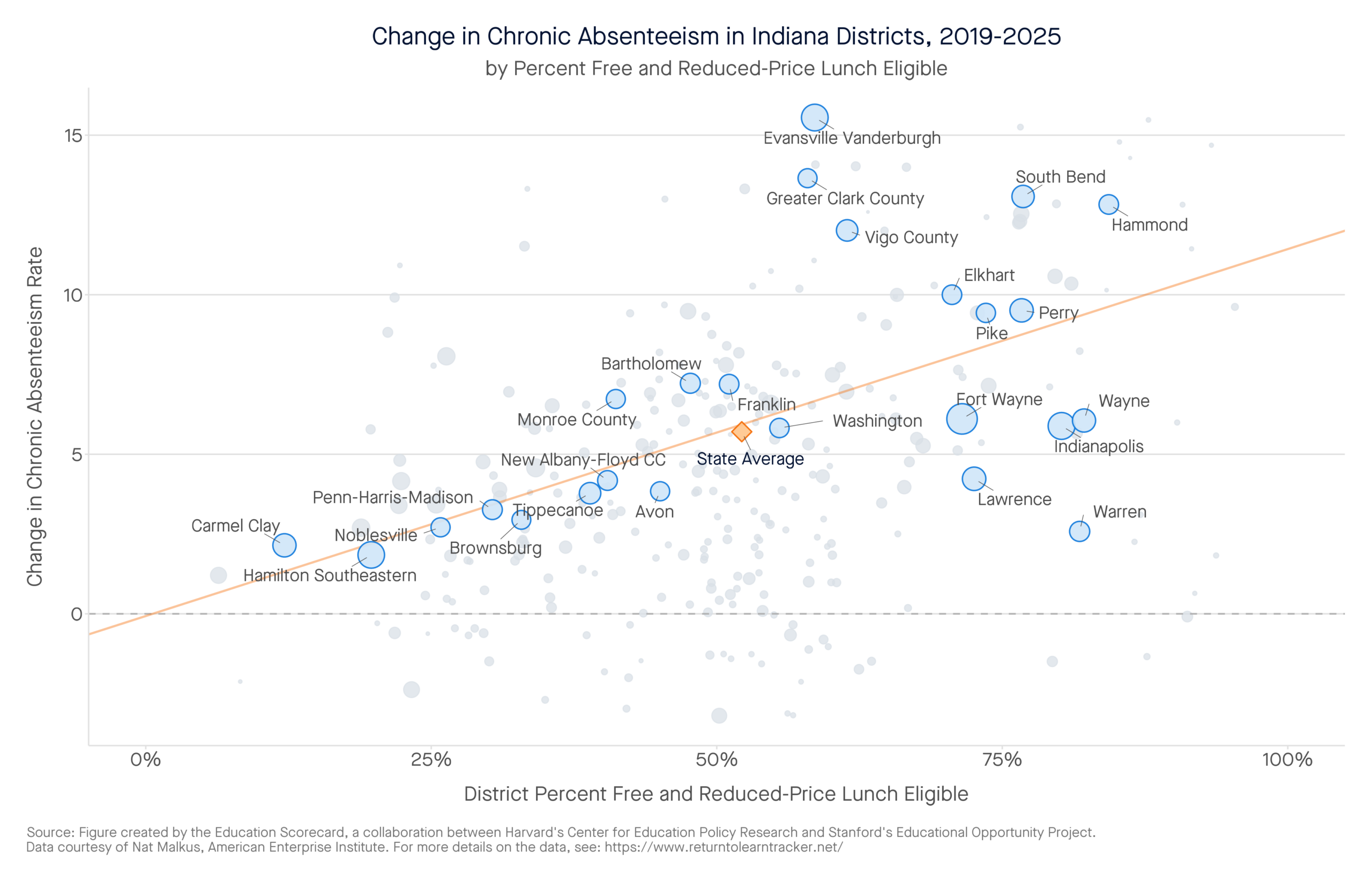
Chronic absenteeism has fallen but remains more than 6 percentage points above pre-pandemic levels.
Districts like School City of East Chicago, Community Schools of Frankfort, East Noble, Duneland, MSD Southwest Allen County, and Middlebury Community are outperforming their peers in both math and reading.
(May 13, 2026) In its fourth year, the Education Scorecard (a collaboration between the Center for Education Policy Research at Harvard University, The Educational Opportunity Project at Stanford University, and faculty at Dartmouth College) is issuing its annual report on district-level student growth in math and reading.
The latest report provides a high-resolution picture of where Indiana students’ academic recovery stands, combining state test results for roughly 35 million grade 3–8 students nationwide with national assessment data to describe changes in local communities. Here’s what we found:
Indiana:
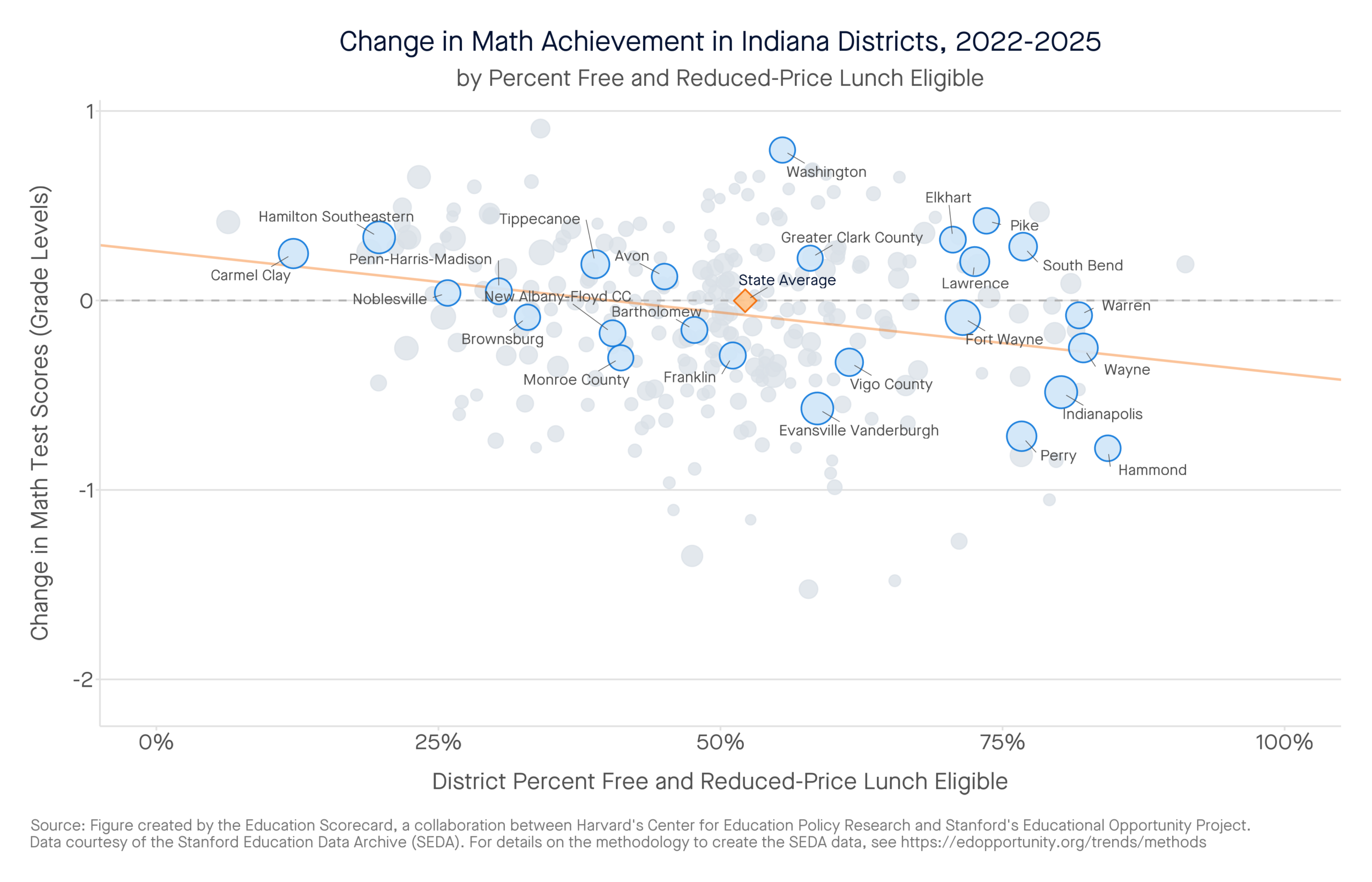
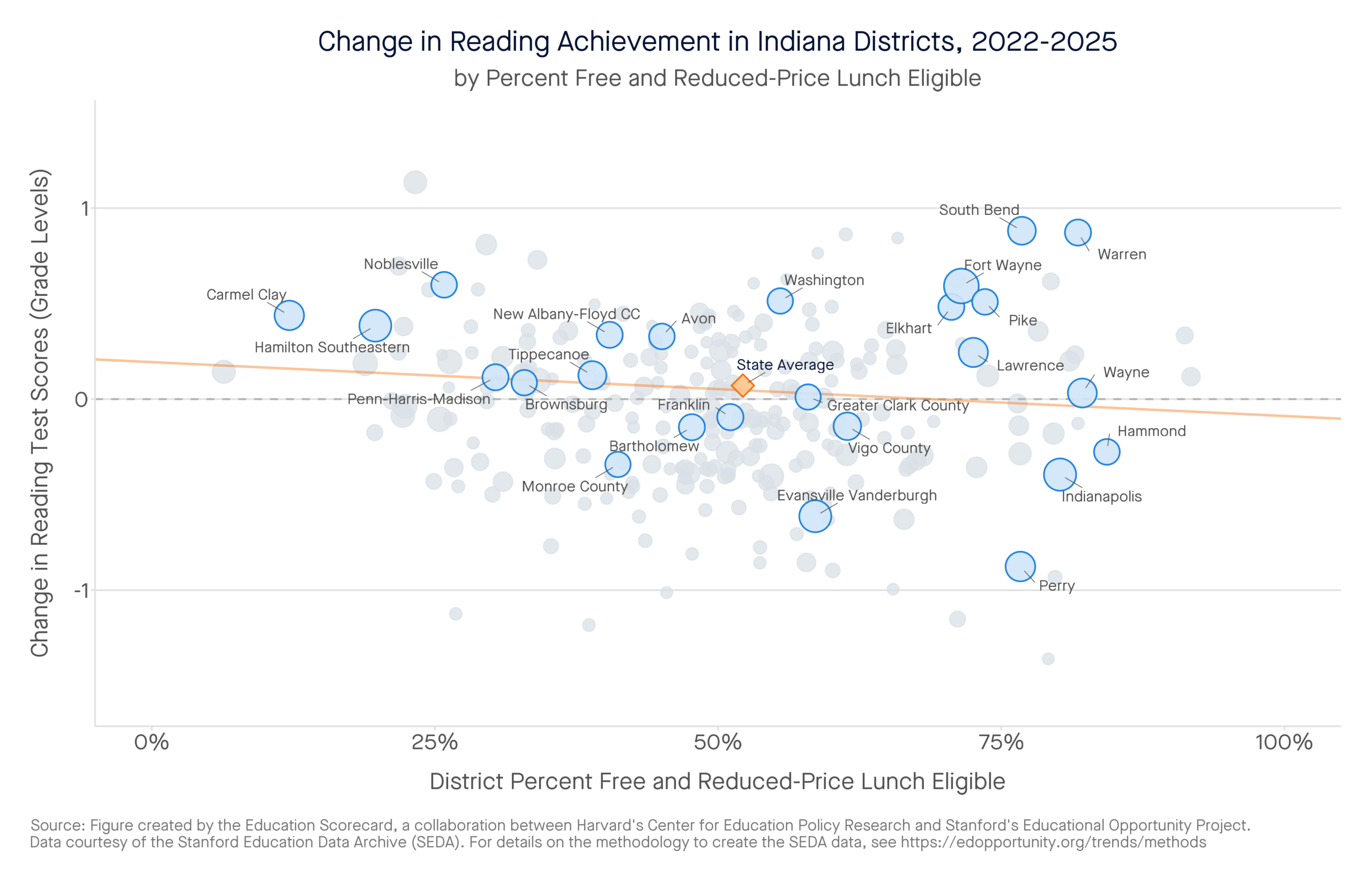
- Indiana ranks 29th out of 38 states in academic growth in math and 6th out of 35 states in reading between 2022 and 2025.
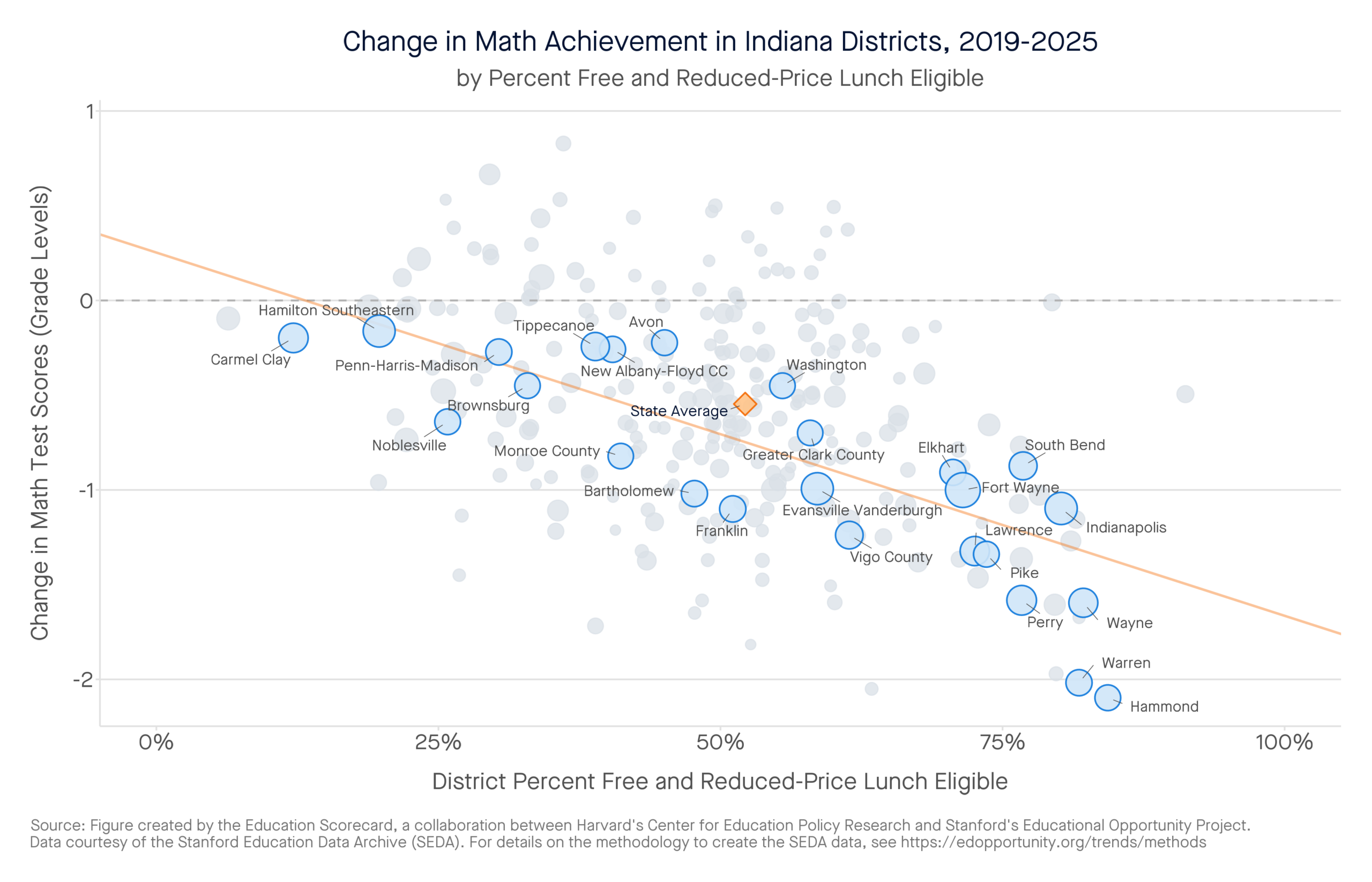
- In math, the average student is performing about .04 grade equivalents above their 2022 level, but around half a grade equivalent below 2019 levels. Some districts like SC Hammond, MSD Warren, MSD Wayne, and Perry continue to lag significantly behind 2019 levels.
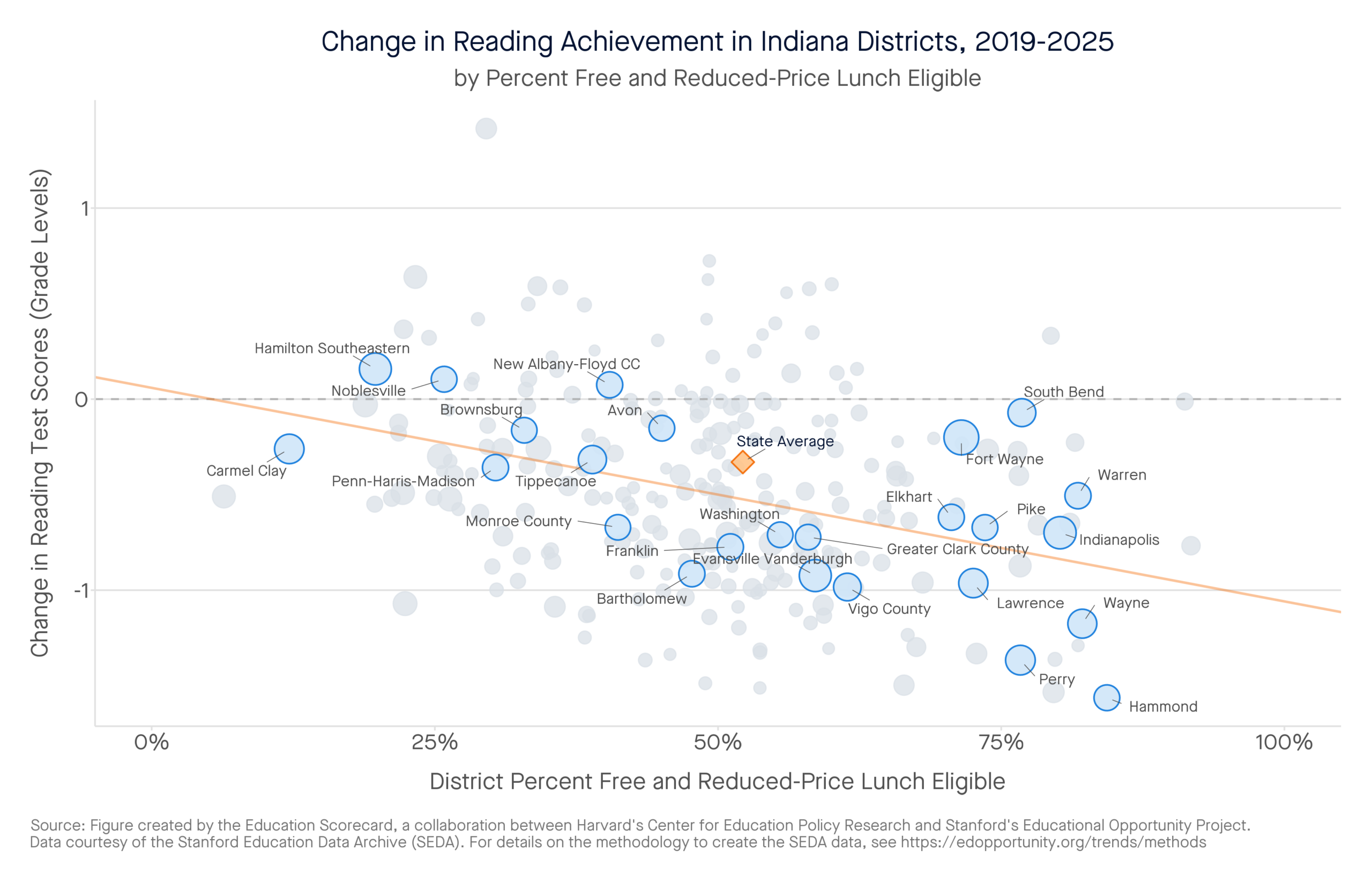
- In reading, the average student is performing about .09 grade equivalents above their 2022 level, and around .31 grade equivalents below 2019 levels. A number of districts like SC Hammond, Perry, and MSD Wayne continue to slip and remain significantly behind their 2019 levels.
- Several Indiana districts are emerging as Districts on the Rise. These districts have shown unusual progress relative to similar districts in their own state. A core group of districts is excelling in both math and reading, with districts like School City of East Chicago, Community Schools of Frankfort, East Noble Corporation, Duneland School Corporation, MSD Southwest Allen County, and Middlebury Community outperforming their peers.
- Several other districts are rising relative to their peers in one subject—either math or reading. Goshen, Huntington, La Porte, Plymouth, and Sunman-Dearborn are leading the way in math performance, while Fort Wayne, Hamilton Southeastern, Mooresville Consolidated, Munster, Wawasee, and Noblesville are leading the way in reading.
- Statewide, there is some good news on chronic absenteeism (students missing more than 10% of a school year), which has fallen from 22.4% in 2022 to 17.8% in 2025. However, chronic absence rates still remain over 6 percentage points above pre-pandemic levels.
- Indiana received about $3.1 billion in federal pandemic relief for K–12 schools—roughly $3,000 per student. Our analysis finds that the gains in many high-poverty districts were driven by this federal support. Unfortunately, many middle-poverty districts (those with 30 to 70 percent of students receiving federal lunch subsidies) received little federal aid. Now that the federal relief is gone, Indiana should focus school improvement dollars on the middle and higher poverty districts that remain behind their pre-pandemic levels.
“The pandemic was the mudslide that followed seven years of erosion in student achievement,” said Professor Tom Kane, faculty director of the Center for Education Policy Research at Harvard University. “The ‘learning recession’ started a decade ago, after policymakers switched off the early warning system of test-based accountability and social media took over children’s lives. In this report, we highlight the work of a small group of state leaders who have started digging out by changing how students learn to read, and 108 local school districts that are finding ways to get students learning again. The recovery of U.S. education has begun. But it’s up to the rest of us to spread it.”
District on the Rise: School City of East Chicago
Among Indiana’s Districts on the Rise excelling in both math and reading, School City of East Chicago (SCEC) stands out for building a coherent, centrally directed instructional system that leaves little to chance at the school level. The district adopted a K–12 instructional framework defining shared look-fors for every classroom, tied to walkthroughs, coaching, and evaluation through a yearlong district-designed walkthrough plan—first focusing on classroom environment, then on high-leverage practices like Checking for Understanding, with all evidence captured in the Standards for Success platform. A tiered teacher support model (Tiers 1–3) sets districtwide criteria for observation frequency, coaching intensity, and which staff are responsible at each level, with Tier 3 including intensive co-planning and co-teaching led by administrators and coaches. Elementary instructional coaches were restructured into centrally directed, content-specific roles—math coaches and Science of Reading coaches—and PLC work was standardized through a district template requiring teams to analyze student data, flag students near proficiency, and plan concrete next steps. On literacy, the district moved all elementary and middle schools to explicit, systematic phonics instruction, added Heggerty for phonemic awareness, and adopted Reading Horizons intervention labs for in-day structured reading support. Acadience literacy screening and progress monitoring drive five-week intervention cycles grouped by skill, with EL and special education leaders selecting subgroup-specific interventions centrally rather than leaving those decisions to individual schools. At the high school level, every department adopted literacy across the curriculum, and the district created algebra and math labs alongside an Early Bird Academy for middle schoolers that enriches proficient students and allows early high school credit-earning. Wraparound supports are organized around a “Triple A” framework—Academics, Attendance, and Attitude—with community engagement liaisons and Bilingual Family Outreach Coordinators in every building to ensure language is not a barrier in SCEC’s majority-bilingual community. Critically, the district used ESSER primarily to fund training, coaching, and intervention programs designed to transition to other federal funding streams, deliberately avoiding permanent staffing expansions—and built “grow your own” pathways so that ESSER-funded professional learning produced licensed teachers and coaches the district can sustain long term. For the full case study, click here.
“We are proud of our collective efforts to increase our students’ proficiency in 3rd Grade reading and our graduation rate of 90%,” said Dr. Stephen D. Bournés, Superintendent of School City of East Chicago. “We are using this successful foundation as forward momentum.”