PRESS RELEASE
May 13, 2026
Contact: Sam Stockwell
samuel_stockwell@gse.harvard.edu
617.495.0342
Georgia Ranks 34th in Math Recovery and 21st in Reading Among States, with Districts on the Rise Emerging Across the State
Math scores have flatlined since 2022 and remain nearly half a grade level below 2019 levels.
Chronic absenteeism remains more than 7 percentage points above pre-pandemic levels despite improvement.
Districts like Atlanta, Baldwin, Ben Hill, Marietta, and McDuffie are outperforming their peers in both math and reading.
(May 13, 2026) In its fourth year, the Education Scorecard (a collaboration between the Center for Education Policy Research at Harvard University, The Educational Opportunity Project at Stanford University, and faculty at Dartmouth College) is issuing its annual report on district-level student growth in math and reading.
The latest report provides a high-resolution picture of where Georgia students’ academic recovery stands, combining state test results for roughly 35 million grade 3–8 students nationwide with national assessment data to describe changes in local communities. Here’s what we found:
Georgia:
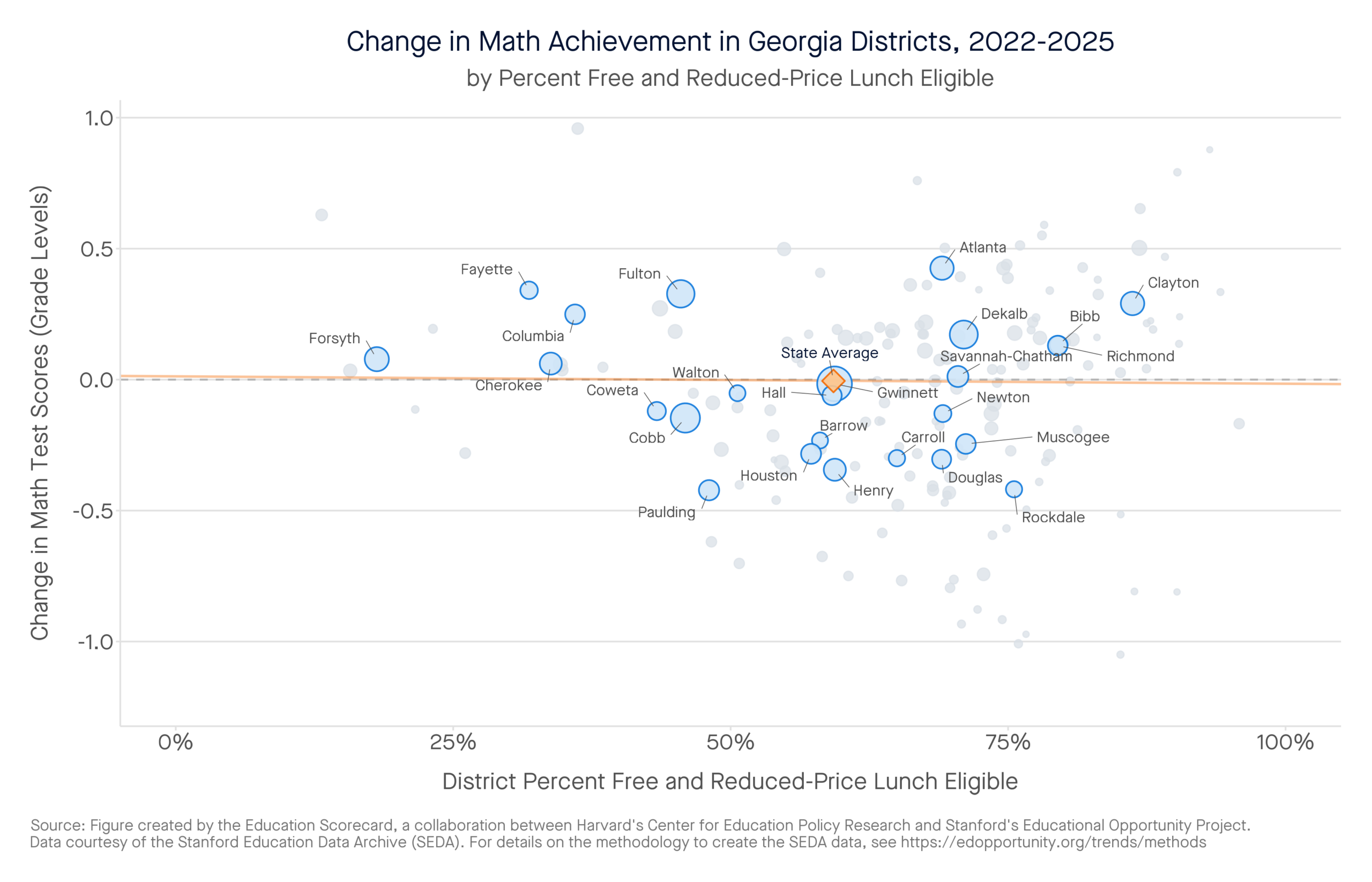
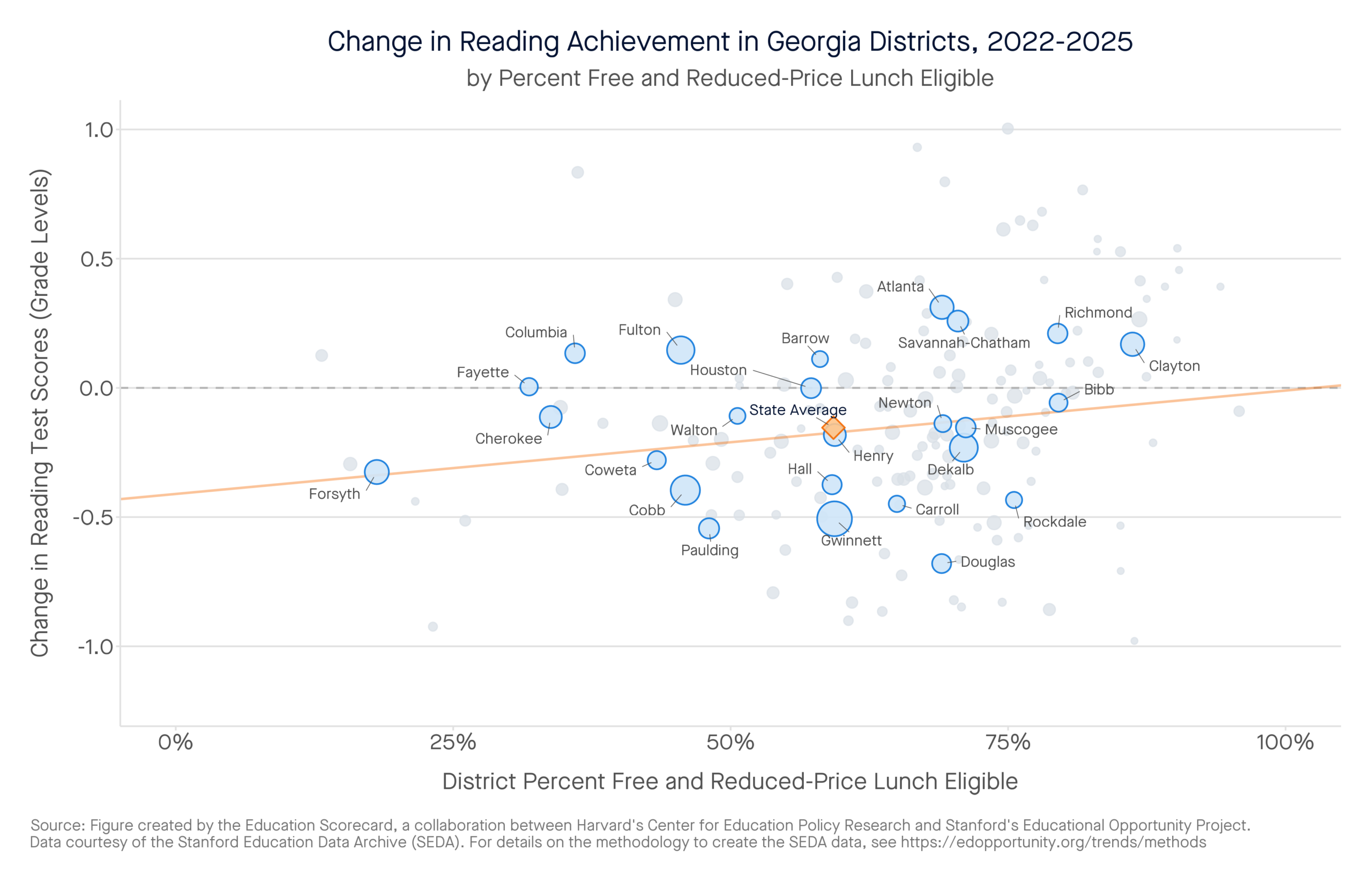
- Georgia ranked 34th out of 38 states in academic growth in math and 21st out of 35 states in reading between 2022 and 2025.
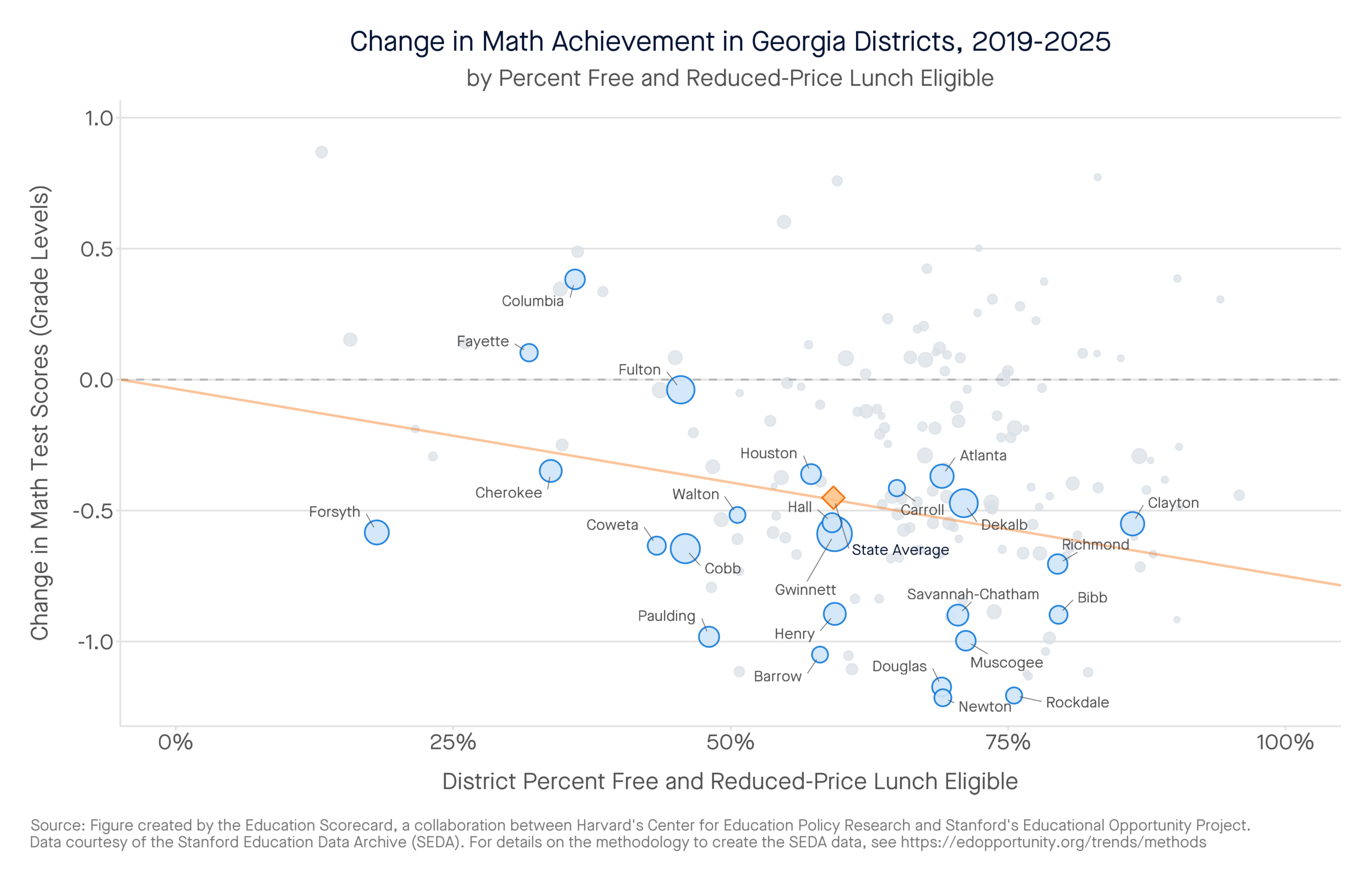
- In math, the average student is performing almost exactly at their 2022 level (-.001 grade equivalents), but about .45 grade equivalents below 2019 levels. Some districts like Rockdale, Bibb, Newton, Muscogee, and Douglas continue to lag significantly behind 2019 levels.
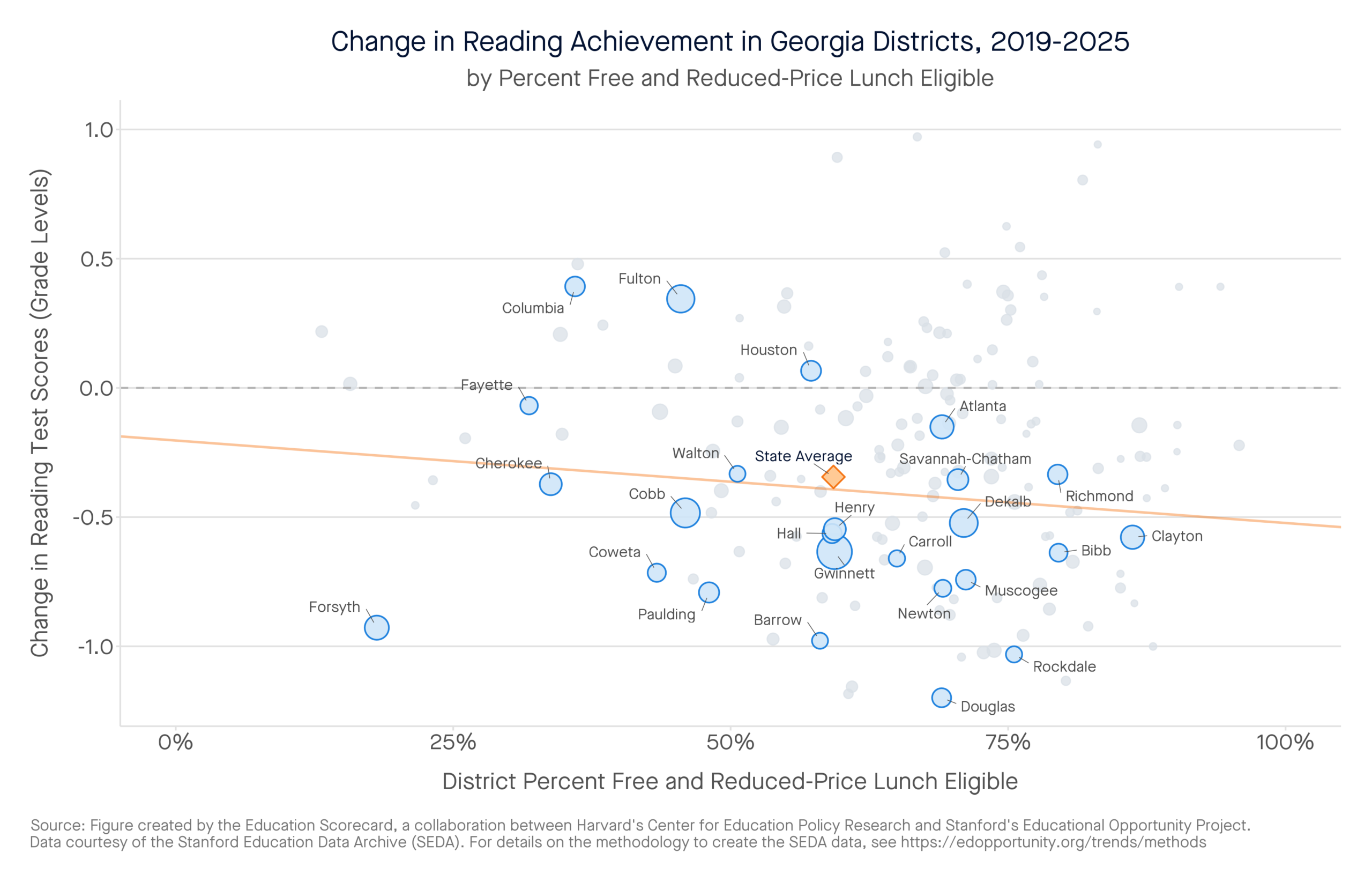
- In reading, the average student is performing about .14 grade equivalents below their 2022 level, and about .33 grade equivalents below 2019 levels. A number of districts like Forsyth, Douglas, Rockdale, and Barrow continue to slip and remain significantly behind their 2019 levels.
- Several Georgia districts are emerging as Districts on the Rise. These districts have shown unusual progress relative to similar districts in their own state. A core group of districts is excelling in both math and reading, with districts like Atlanta, Baldwin, Ben Hill, Marietta, and McDuffie outperforming their peers.
- Several other districts are rising relative to their peers in one subject—either math or reading. Cook, Dalton, Dougherty, Floyd, and Pierce are leading the way in math performance, while Colquitt, Elbert, Jones, Peach, and Franklin are leading the way in reading.
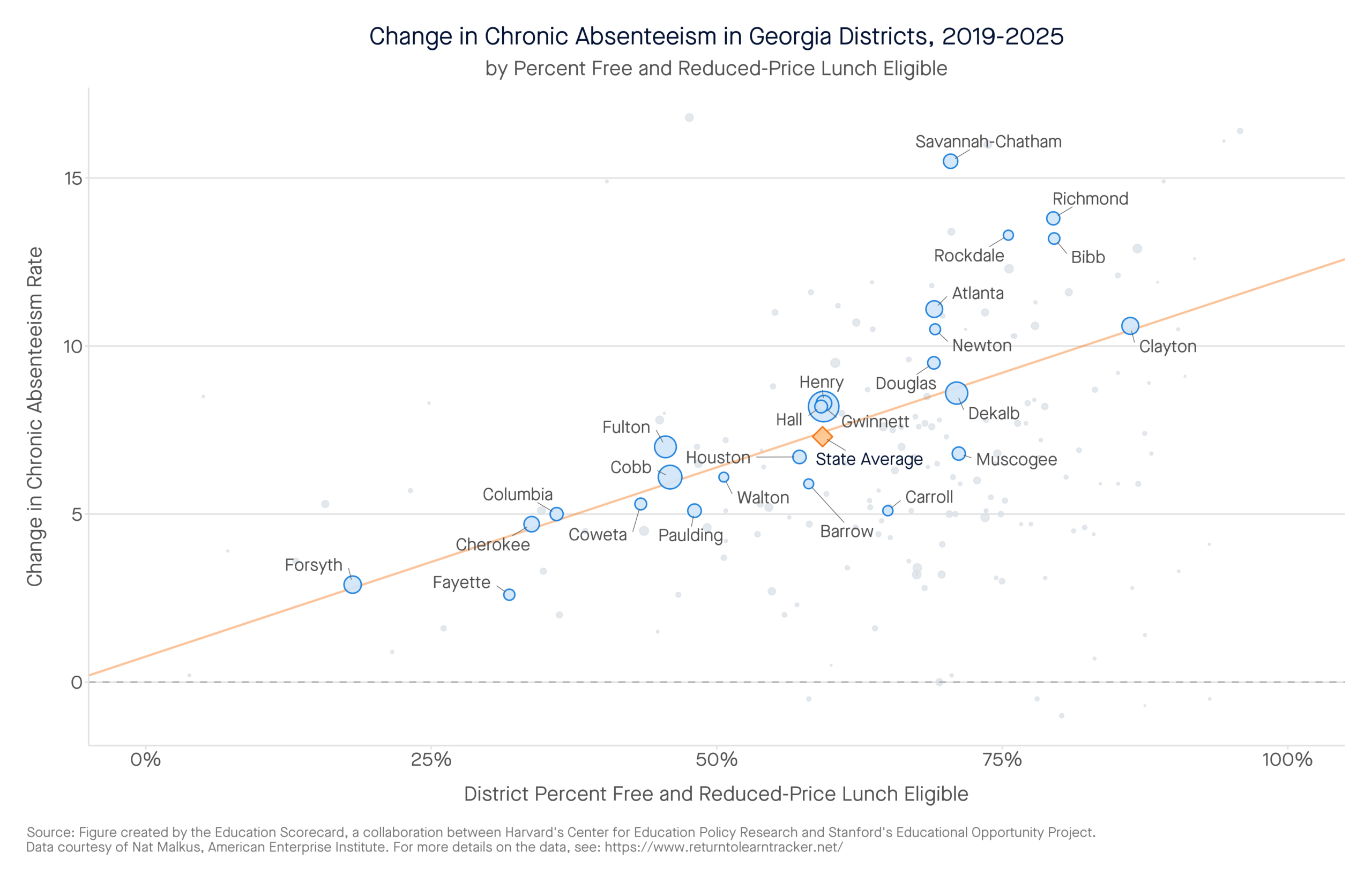
- Statewide, there is some good news on chronic absenteeism (students missing more than 10% of a school year), which has fallen from 24.4% in 2022 to 20% in 2025. However, chronic absence rates remain over 7 percentage points above pre-pandemic levels.
- Georgia received about $6.6 billion in federal pandemic relief for K–12 schools—roughly $3,800 per student. Our analysis finds that the gains in many high-poverty districts were driven by this federal support. Unfortunately, many middle-poverty districts (those with 30 to 70 percent of students receiving federal lunch subsidies) received little federal aid. Now that the federal relief is gone, Georgia should focus school improvement dollars on the middle and higher poverty districts that remain behind their pre-pandemic levels.
“The pandemic was the mudslide that followed seven years of erosion in student achievement,” said Professor Tom Kane, faculty director of the Center for Education Policy Research at Harvard University. “The ‘learning recession’ started a decade ago, after policymakers switched off the early warning system of test-based accountability and social media took over children’s lives. In this report, we highlight the work of a small group of state leaders who have started digging out by changing how students learn to read, and 108 local school districts that are finding ways to get students learning again. The recovery of U.S. education has begun. But it’s up to the rest of us to spread it.”
District on the Rise: Atlanta Public Schools
Among Georgia’s Districts on the Rise in both math and reading, Atlanta Public Schools (APS) stands out for building a coherent instructional system anchored by tight curriculum alignment, layered coaching, and a data infrastructure that drives decisions from the district level down to individual classrooms. The district has committed to increasing 3rd grade ELA proficiency and 8th grade math proficiency by 20% by 2030 and is working toward those goals through sustained Tier 1 investment. In literacy, APS uses Benchmark Advance and HMH Into Reading with a fidelity-first implementation model, supported by a three-tier coaching structure: Instructional Coaches receive monthly professional learning aligned to the instructional framework, Literacy Coaches receive monthly science-of-reading training, and principals and assistant principals engage in monthly content-specific learning to guide teacher support. A partnership with the Atlanta Speech School’s Rollins Center for Language & Literacy provides APS elementary ELA teachers with summer training in phonics, language development, and early literacy intervention—with 80% of participants improving their language-centered practice. In math, APS uses Carnegie Math for middle school and C-Gage Math for high school, balanced with state-developed instructional materials and individualized teacher judgment. Data is triangulated across NWEA MAP, MasteryConnect (for standards-specific insights), and the newly implemented Amira ISIP Assess for foundational literacy, with district leaders meeting weekly with principals to review student performance and identify needed supports. A school tiering system based on the Learning Leader Framework differentiates quarterly support for schools, with lower-performing schools receiving additional coaching, walk-throughs, lesson modeling, and PLC support. APS Power Up summer programming, free and fully accessible with meals and transportation, placed more than half of 2025 attendees on track to meet math and ELA growth goals—with elementary students at highest academic need meeting growth targets at higher rates than non-participants in ELA. The district’s investment in people is equally notable: a 90% teacher retention rate, 110 instructional coaches across every elementary school, and a Master Teacher Leader role that gives top educators a reduced teaching load to coach peers in real time without leaving the classroom. For the full case study, click here.
“It’s not just about the numbers for us, it’s bigger than the numbers,” said Dr. Bryan Johnson, Superintendent of Atlanta Public Schools. “This is about kids and their future, their ability to thrive and to find their voice. And so, for us, all of those things make the work urgent and important.”