PRESS RELEASE
May 13, 2026
Contact: Sam Stockwell
samuel_stockwell@gse.harvard.edu
617.495.0342
Virginia Ranks 10th in Reading Recovery Among States, with Districts on the Rise Emerging Across the Commonwealth
Virginia’s reading recovery ranks in the top third nationally, but students remain nearly .7 grade equivalents below 2019 levels.
Chronic absenteeism has fallen sharply and is among the closest to pre-pandemic levels of any state in the country.
Charlottesville City, Richmond City, Roanoke County, Smyth County, and Danville City are leading the way in reading recovery relative to their peers.
(May 13, 2026) In its fourth year, the Education Scorecard (a collaboration between the Center for Education Policy Research at Harvard University, The Educational Opportunity Project at Stanford University, and faculty at Dartmouth College) is issuing its annual report on district-level student growth in math and reading.
The latest report provides a high-resolution picture of where Virginia students’ academic recovery stands, combining state test results for roughly 35 million grade 3–8 students nationwide with national assessment data to describe changes in local communities. Here’s what we found in Virginia:
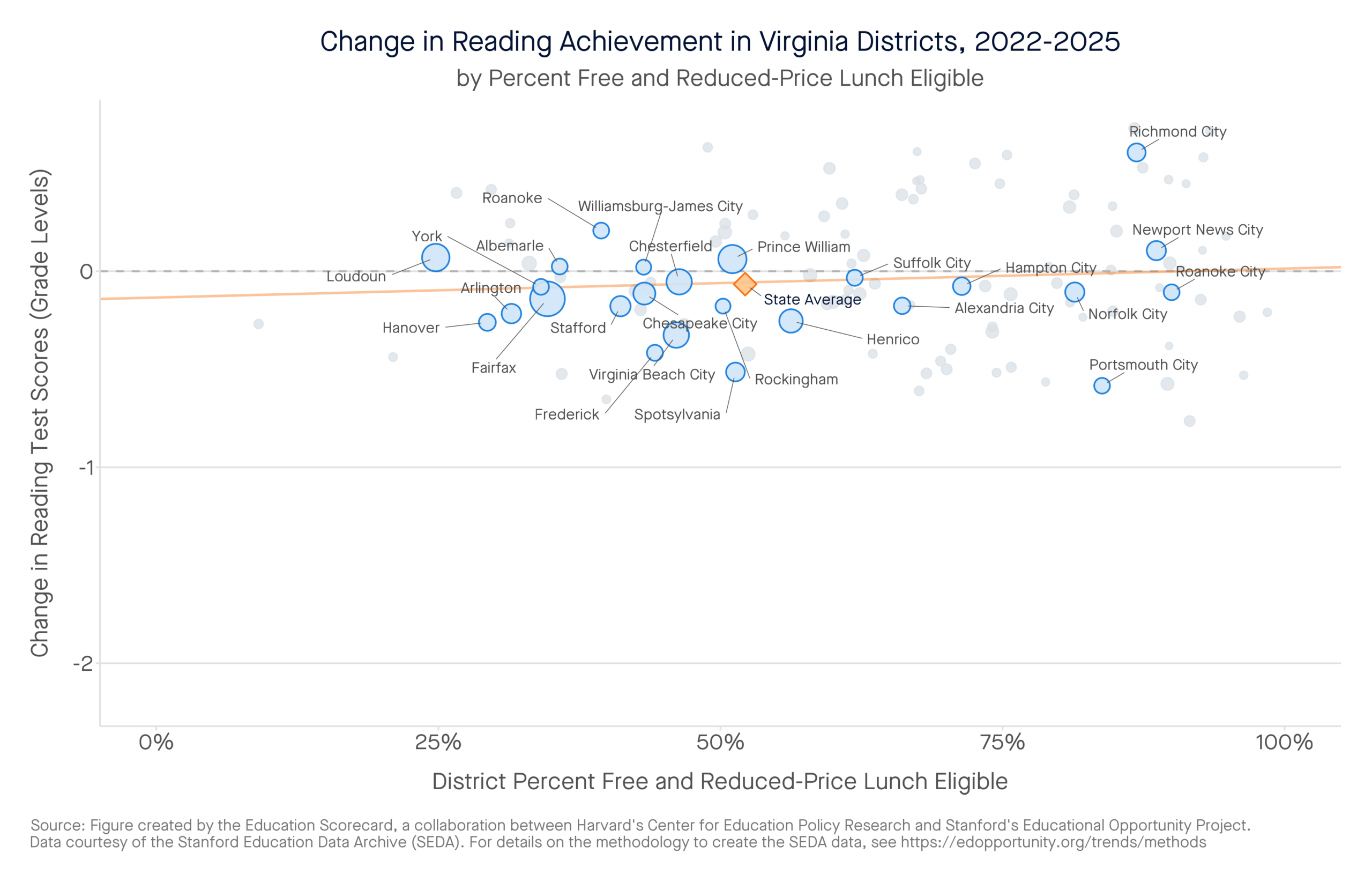
- Virginia ranks 10th out of 35 states in academic growth in reading between 2022 and 2025.
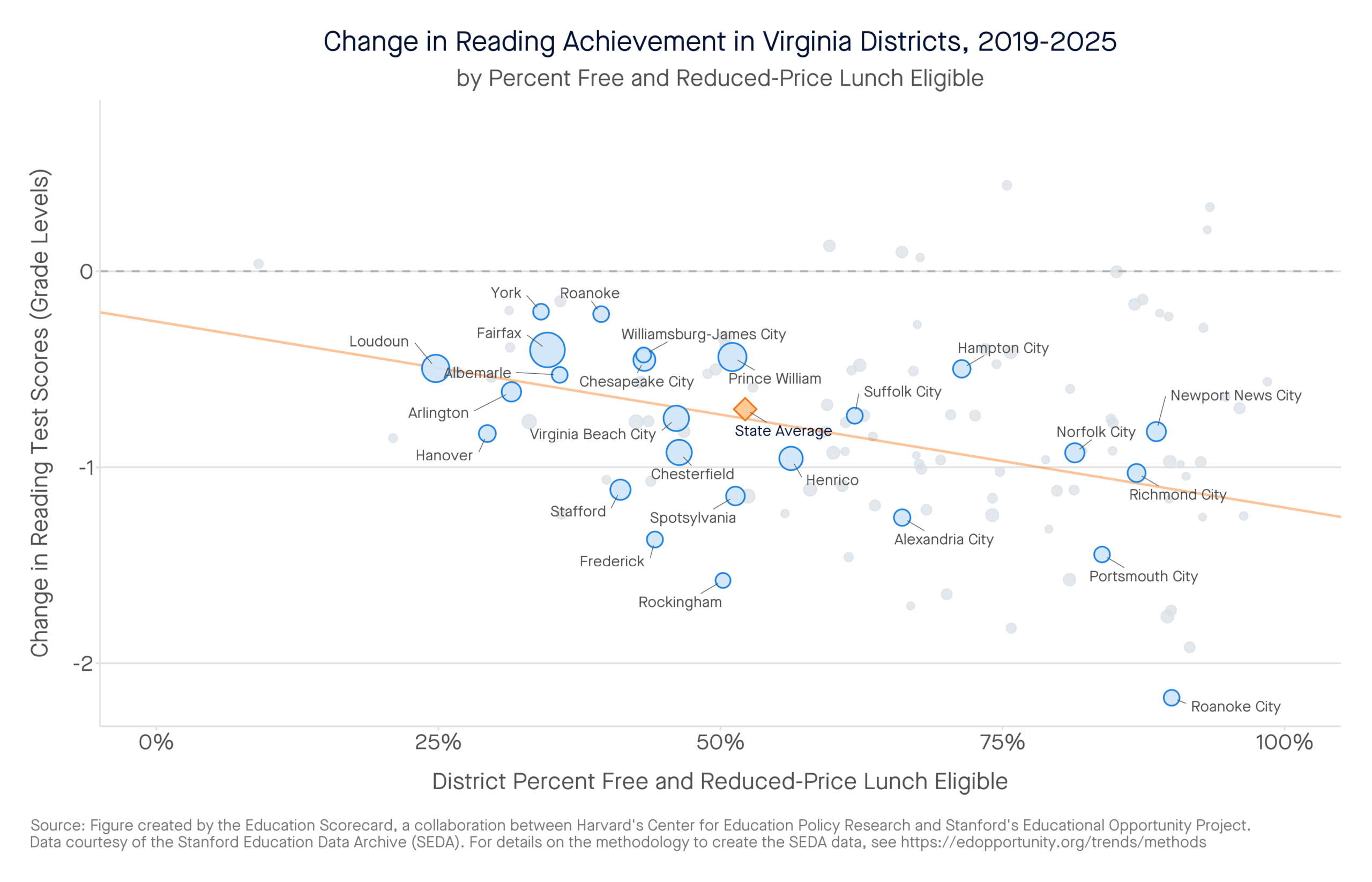
- In reading, the average student is performing about .04 grade equivalents below their 2022 level, and about .68 grade equivalents below 2019 levels. A number of districts like Roanoke City, Portsmouth City, and Frederick continue to slip and remain behind their 2019 levels.
- Several Virginia districts are emerging as Districts on the Rise. These districts have shown unusual progress relative to similar districts in their own state. Charlottesville City, Richmond City, Roanoke County, Smyth County Public Schools, and Danville City are leading the way in reading performance.
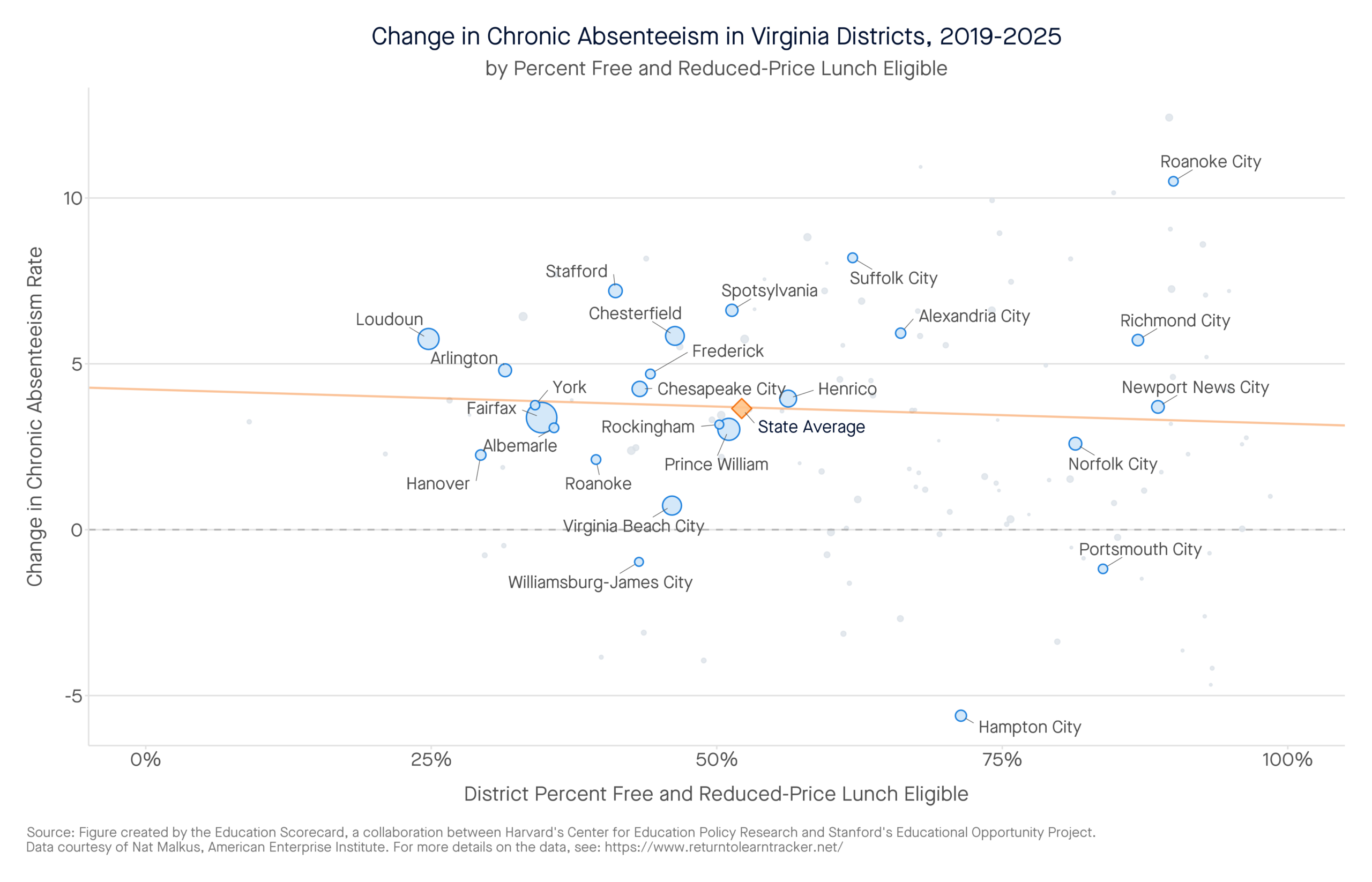
- Statewide, there is some good news on chronic absenteeism (students missing more than 10% of a school year), which has fallen from over 20% in 2022 to around 14% in 2025. However, chronic absence rates still remain 3 percentage points above pre-pandemic levels.
- Virginia received about $3.29 billion in federal pandemic relief for K–12 schools—roughly $2,600 per student. Our analysis finds the gains in many high-poverty districts were driven by this federal support. Unfortunately, many middle-poverty districts (those with 30 to 70 percent of students receiving federal lunch subsidies) received little federal aid. Now that the federal relief is gone, Virginia should focus school improvement dollars on the middle and higher poverty districts that remain behind their pre-pandemic levels.
“The pandemic was the mudslide that followed seven years of erosion in student achievement,” said Professor Tom Kane, faculty director of the Center for Education Policy Research at Harvard University. “The ‘learning recession’ started a decade ago, after policymakers switched off the early warning system of test-based accountability and social media took over children’s lives. In this report, we highlight the work of a small group of state leaders who have started digging out by changing how students learn to read, and 108 local school districts that are finding ways to get students learning again. The recovery of U.S. education has begun. But it’s up to the rest of us to spread it.”
District on the Rise: Roanoke County Public Schools
Among Virginia’s reading Districts on the Rise, Roanoke County Public Schools (RCPS) stands out for building a coherent instructional culture through a stakeholder-developed strategic framework and a curriculum approach designed to outlast any individual leader. The district’s C-Change Framework—built from feedback collected from teachers, principals, students, and community members—organizes the division’s work around five pillars: Instructional Balance, Classroom and School Climate, Learning Culture, Support Services, and Professional Growth. All staff are trained on the framework during onboarding, reinforced through 10 Leadership Academies per year attended by assistant principals, principals, and division leaders who then cascade targeted support to teachers. Rather than adopting a single curriculum, RCPS developed a Dynamic Curriculum Guide (K–10) aligned to Virginia’s Standards of Learning, integrating core content with enrichment and differentiated pathways—intentionally designed so teachers don’t have to learn new materials every time leadership changes. On literacy, the division made the notable decision to keep its youngest students in person during the pandemic using alternative classroom spaces, a choice leaders credit in part for current reading outcomes. A Division Literacy Plan grounded in the science of reading drives instruction across K–8, with individual reading plans for every student, site-based plans at every elementary and middle school, and a dedicated literacy coach at every middle school who co-teaches and models with ELA, special education, and content-area teachers. Data infrastructure is equally deliberate: MasteryConnect enables teachers to build and share assessments, monitor performance by standard, and analyze trends; PLCs meet regularly to review formative data and adjust instruction; and division-wide data meetings with principals and instructional leaders ensure timely mid-year adjustments rather than waiting for end-of-year results. The division also takes a proactive stance on strategic planning—deploying coaches and resources in response to identified needs before state data is even released, while balancing guidance with enough autonomy for high-performing schools to sustain their own momentum. For the full case study, click here.
“The C-Change Framework serves as the essential pillar for everything we do, providing a shared instructional language,” said Dr. Ken Nicely, Superintendent of Roanoke County Public Schools. “By centering our division on this shared mission, we ensure that every decision is filtered through a commitment to deeper learning and collaborative problem-solving. We’ve built a culture of shared ownership where teachers and division leaders alike are trained to analyze performance trends by standard and adjust instruction in real time. This disciplined approach allows us to direct targeted support and resources where they are needed most, ensuring that high-quality, evidence-based instruction remains consistent across every classroom in the division.”