PRESS RELEASE
May 13, 2026
Contact: Sam Stockwell
samuel_stockwell@gse.harvard.edu
617.495.0342
South Dakota Ranks 30th in Math and 31st in Reading Recovery Among States, with Reading Scores Declining Sharply Since 2022
Reading scores have fallen nearly .27 grade equivalents since 2022, leaving students about half a grade level below 2019 benchmarks.
Chronic absenteeism remains about 6 percentage points above pre-pandemic levels.
Pierre and Brandon Valley are outperforming their peers in both math and reading, while Aberdeen and Brookings are leading the way in math.
(May 13, 2026) In its fourth year, the Education Scorecard (a collaboration between the Center for Education Policy Research at Harvard University, The Educational Opportunity Project at Stanford University, and faculty at Dartmouth College) is issuing its annual report on district-level student growth in math and reading.
The latest report provides a high-resolution picture of where South Dakota students’ academic recovery stands, combining state test results for roughly 35 million grade 3–8 students nationwide with national assessment data to describe changes in local communities. Here’s what we found in South Dakota:
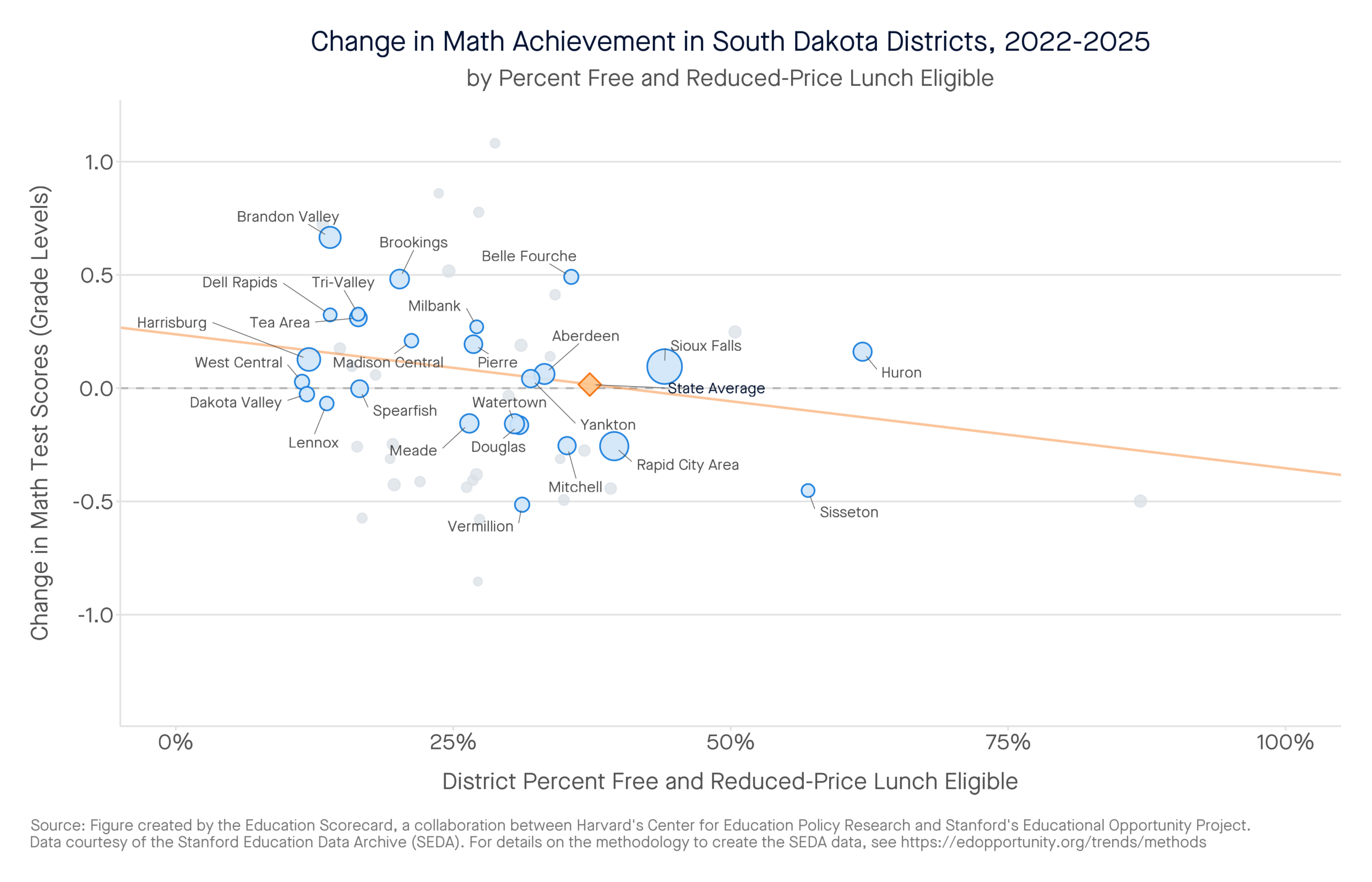
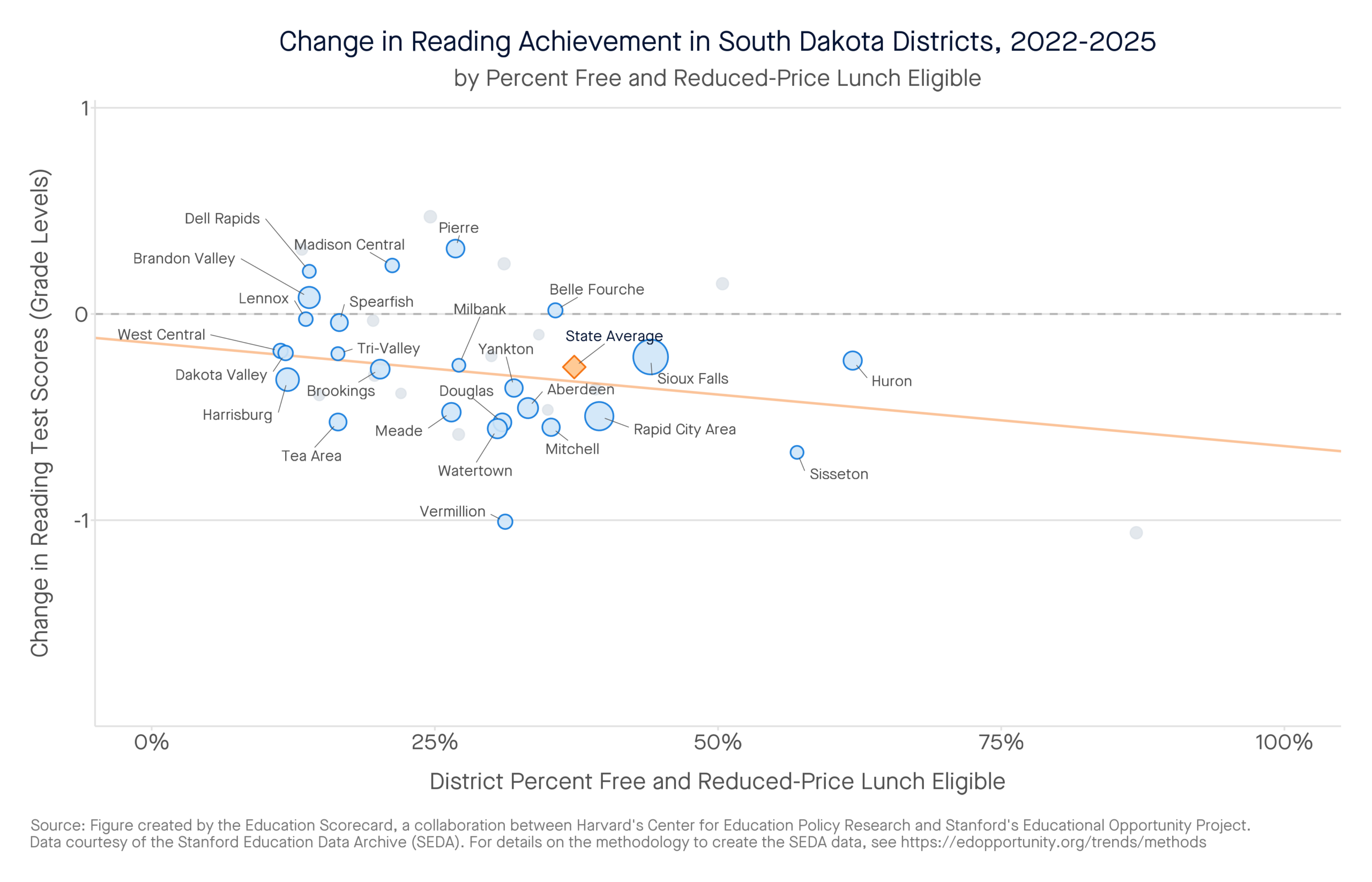
- South Dakota ranks 30th out of 38 states in academic growth in math and 31st out of 35 states in reading between 2022 and 2025.
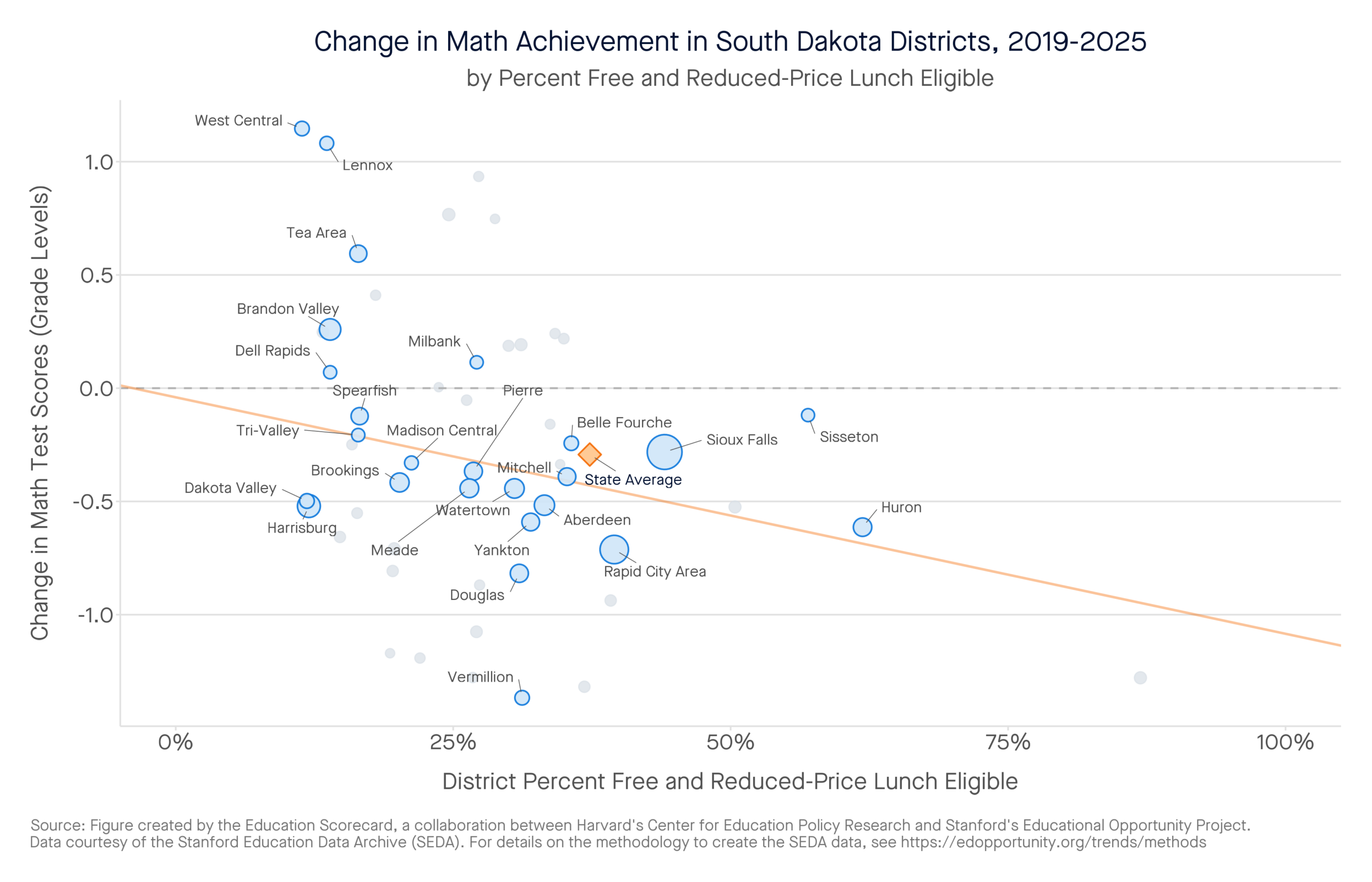
- In math, the average student is performing about .04 grade equivalents above their 2022 level, but .27 grade equivalents below 2019 levels. Still, some districts like Vermillion, Douglas, and Rapid City Area continue to lag behind 2019 levels.
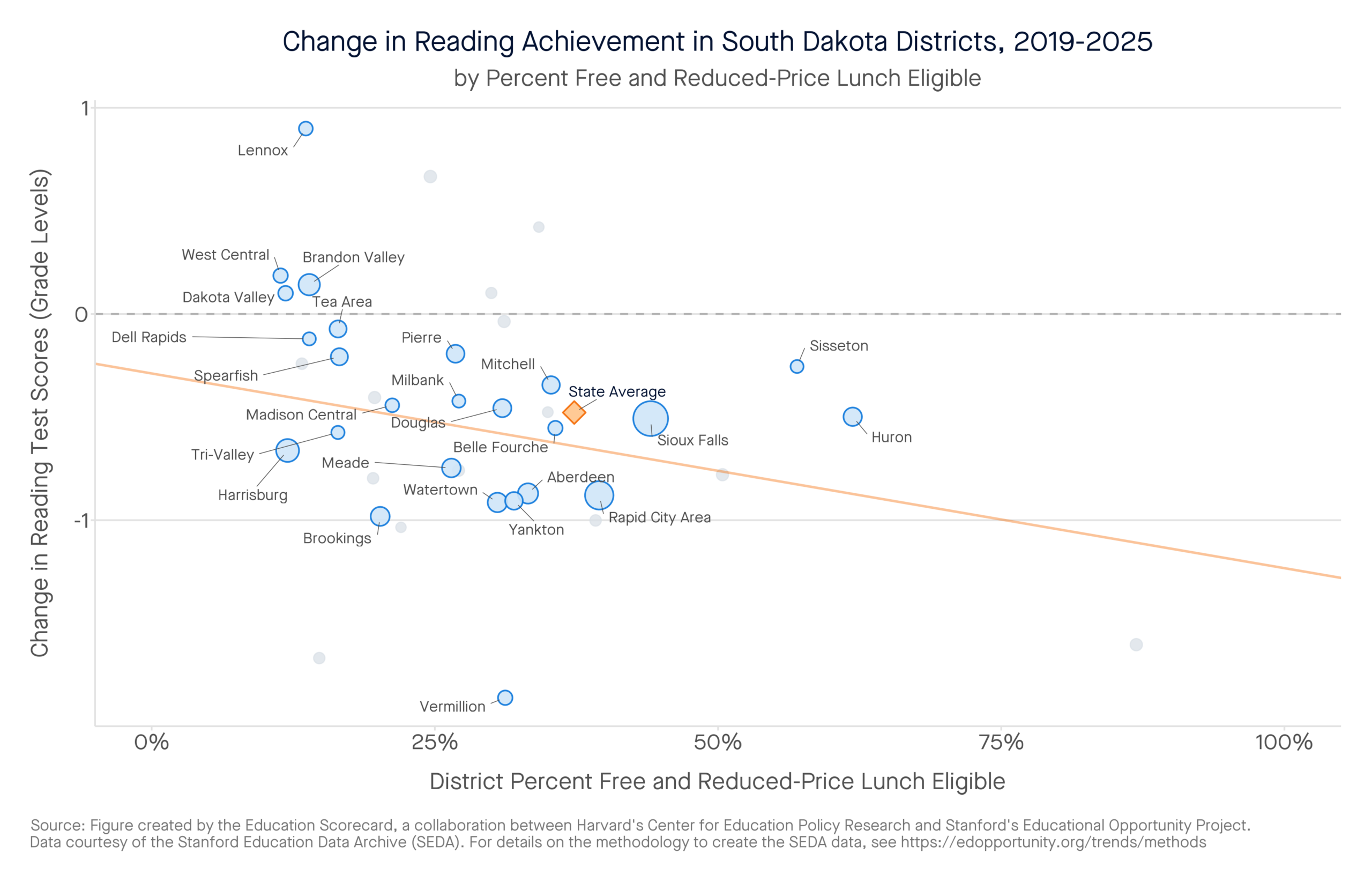
- In reading, the average student is performing about .27 grade equivalents below their 2022 level, and about half a grade equivalent below 2019 levels. A number of districts like Vermillion, Brookings, Watertown, and Yankton continue to slip and remain behind their 2019 levels.
- Several South Dakota districts are emerging as Districts on the Rise. These districts have shown unusual progress relative to similar districts in their own state. A core group of districts is excelling in both math and reading, with districts like Pierre School District 32-2 and Brandon Valley School District 49-2 outperforming their peers.
- Several other districts are rising relative to their peers in one subject. Aberdeen School District 06-1 and Brookings School District 05-1 are leading the way in math performance.
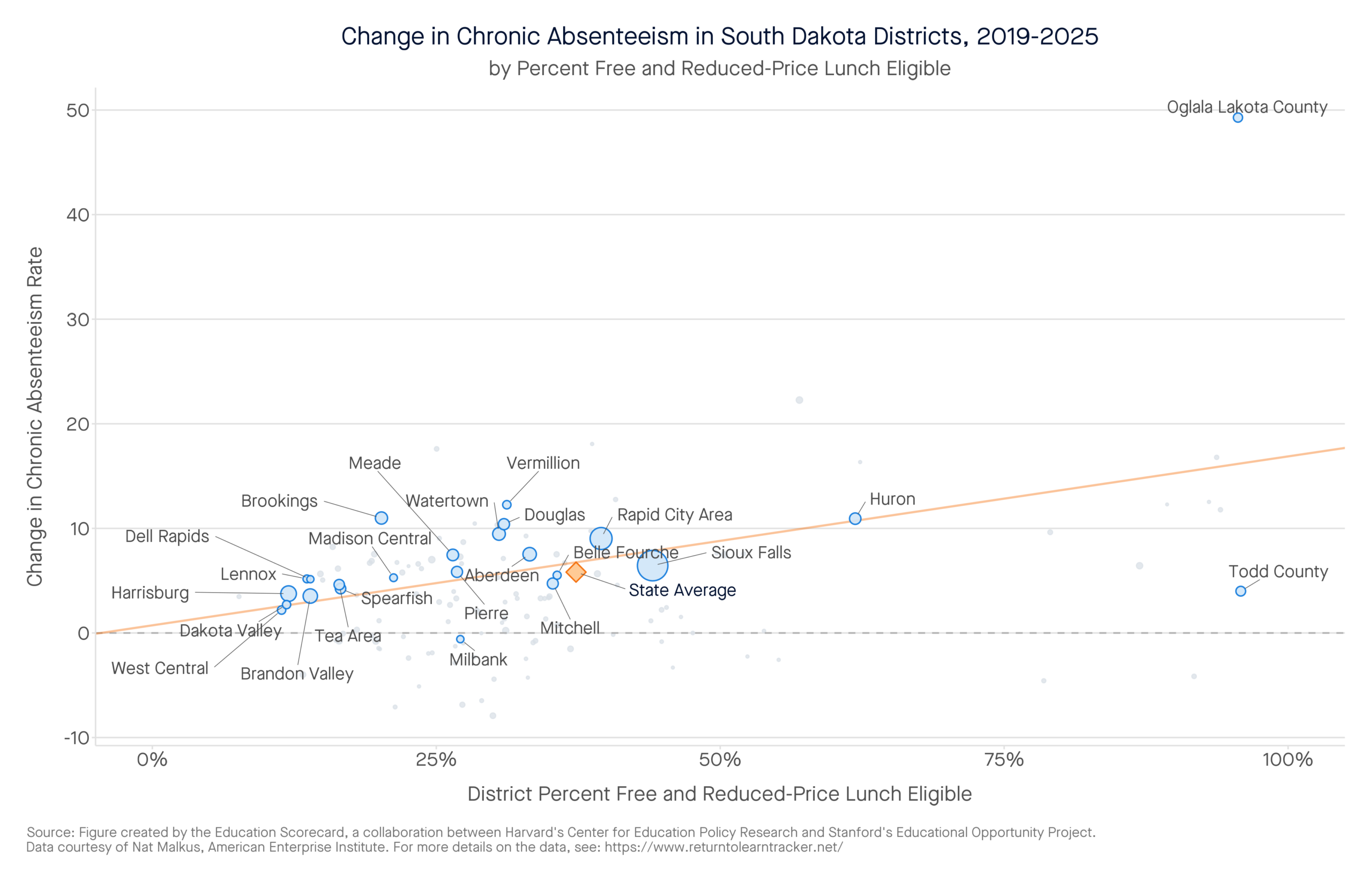
- Statewide, there is some good news on chronic absenteeism (students missing more than 10% of a school year), which has fallen from about 22% in 2022 to about 20% in 2025. However, chronic absence rates still remain about 6 percentage points above pre-pandemic levels.
- South Dakota received about $593 million in federal pandemic relief for K–12 schools—roughly $4,200 per student. Our analysis finds the gains in many high-poverty districts were driven by this federal support. Unfortunately, many middle-poverty districts (those with 30 to 70 percent of students receiving federal lunch subsidies) received little federal aid. Now that the federal relief is gone, South Dakota should focus school improvement dollars on the middle and higher poverty districts that remain behind their pre-pandemic levels.
“The pandemic was the mudslide that followed seven years of erosion in student achievement,” said Professor Tom Kane, faculty director of the Center for Education Policy Research at Harvard University. “The ‘learning recession’ started a decade ago, after policymakers switched off the early warning system of test-based accountability and social media took over children’s lives. In this report, we highlight the work of a small group of state leaders who have started digging out by changing how students learn to read, and 108 local school districts that are finding ways to get students learning again. The recovery of U.S. education has begun. But it’s up to the rest of us to spread it.”
District on the Rise: Pierre School District
Among South Dakota’s Districts on the Rise, Pierre School District stands out for building a fully embedded, system-wide approach to instruction and intervention that has driven gains in both math and reading. Six to seven years ago, the district moved beyond a superficial use of the Professional Learning Communities (PLC) model to embed the process in every building, with principals engaged in structured data analysis cycles grounded in the four essential PLC questions and a districtwide emphasis on responding quickly when students struggle. Staff triangulate multiple data sources—NWEA MAP, Acadience, IXL, and state assessments—to drive instructional decisions and match students to interventions, with students moving fluidly between intervention groups throughout the year based on continuous progress monitoring. On literacy, the district led a multi-year transition from balanced literacy to a science-of-reading approach, investing in systemwide professional learning and training staff in Orton-Gillingham, Heggerty, and Barton for students with the greatest reading needs, before adopting Open Court Reading and Amplify as its core curricula in fall 2025. Elementary master schedules protect common planning time and include a dedicated daily intervention block, with all available staff—including trained aides and tutors—deployed for targeted small-group instruction. The district also used ESSER funds with unusual fiscal discipline: hiring short-term interventionists and attendance specialists with explicit sunset plans, avoiding long-term staffing commitments tied to temporary funding. For the full case study, click here.
“We are incredibly proud of our school board, administrative team, teachers, and support staff for their accomplishments,” said Dr. Kelly Glodt, Superintendent of Pierre School District. “Our student achievement results reflect a shared commitment to continuous improvement and a belief that every student can learn and succeed at high levels. Our staff has embraced a growth mindset and remained dedicated to the Professional Learning Communities process, using collaboration and data to continually strengthen instruction and improve outcomes for students. Most importantly, this recognition is a reflection of a team that genuinely cares for kids, believes in their potential, and works every day to provide the high-quality education every student deserves.”