PRESS RELEASE
May 13, 2026
Contact: Sam Stockwell
samuel_stockwell@gse.harvard.edu
617.495.0342
Missouri Ranks 26th in Math and 28th in Reading Recovery Among States
Reading scores have continued to fall since 2022, leaving students nearly .66 grade equivalents below 2019 levels.
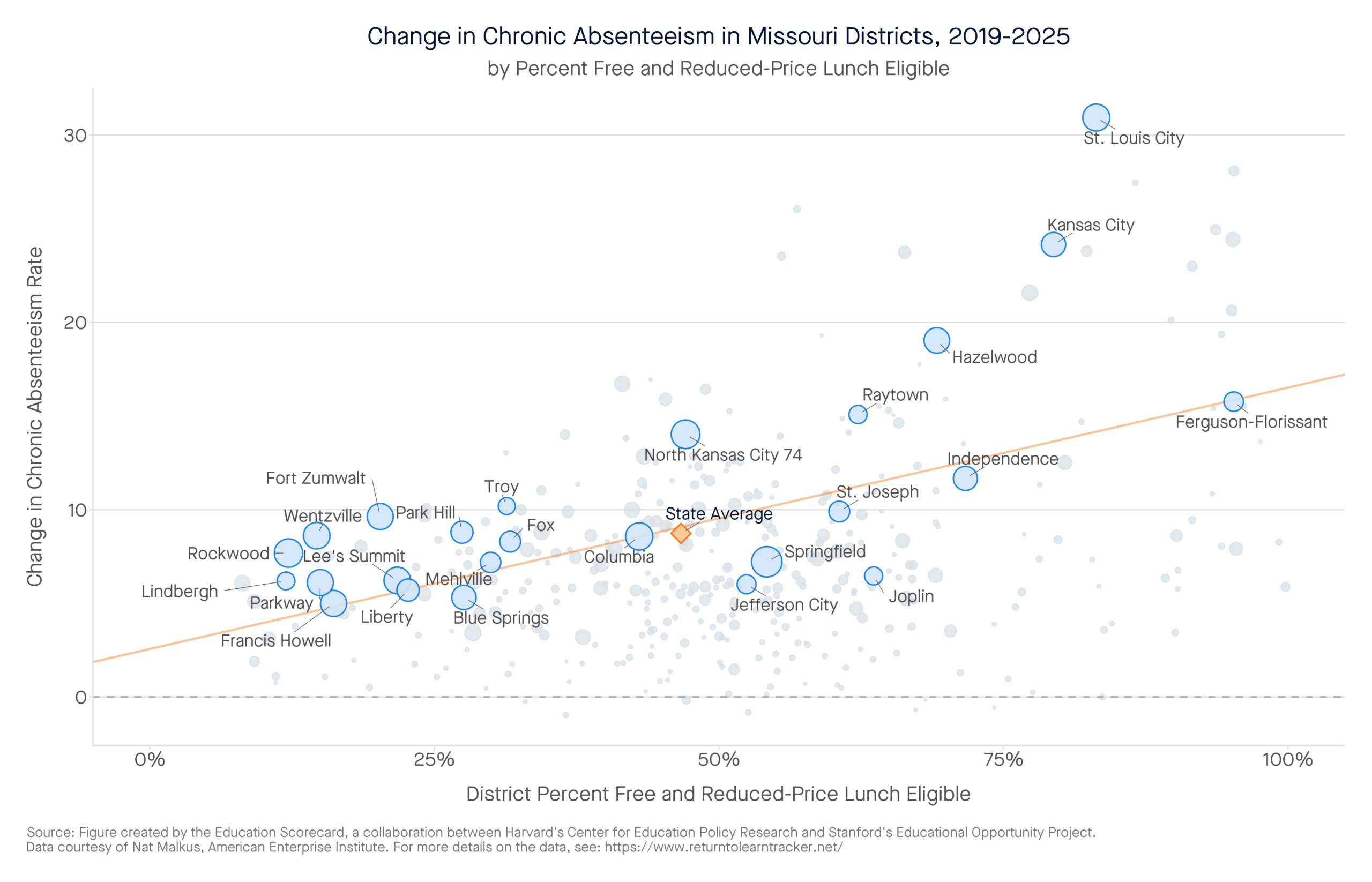
Chronic absenteeism remains 9 percentage points above pre-pandemic levels despite modest improvement.
Riverview Gardens and Normandy Schools Collaborative—among Missouri’s highest-need districts—are emerging as reading leaders relative to their peers.
(May 13, 2026) In its fourth year, the Education Scorecard (a collaboration between the Center for Education Policy Research at Harvard University, The Educational Opportunity Project at Stanford University, and faculty at Dartmouth College) is issuing its annual report on district-level student growth in math and reading.
The latest report provides a high-resolution picture of where Missouri students’ academic recovery stands, combining state test results for roughly 35 million grade 3–8 students nationwide with national assessment data to describe changes in local communities. Here’s what we found:
Missouri:
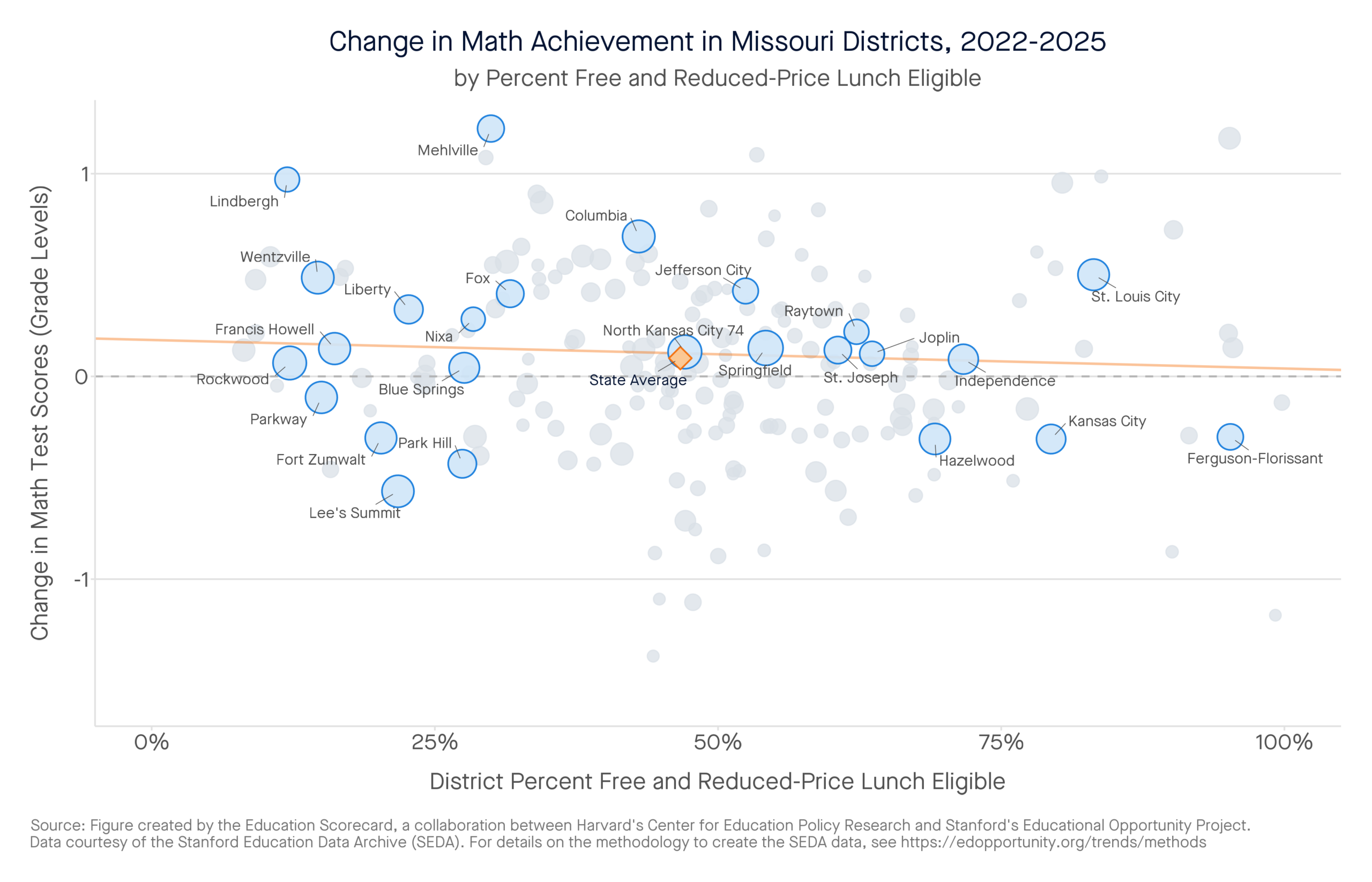
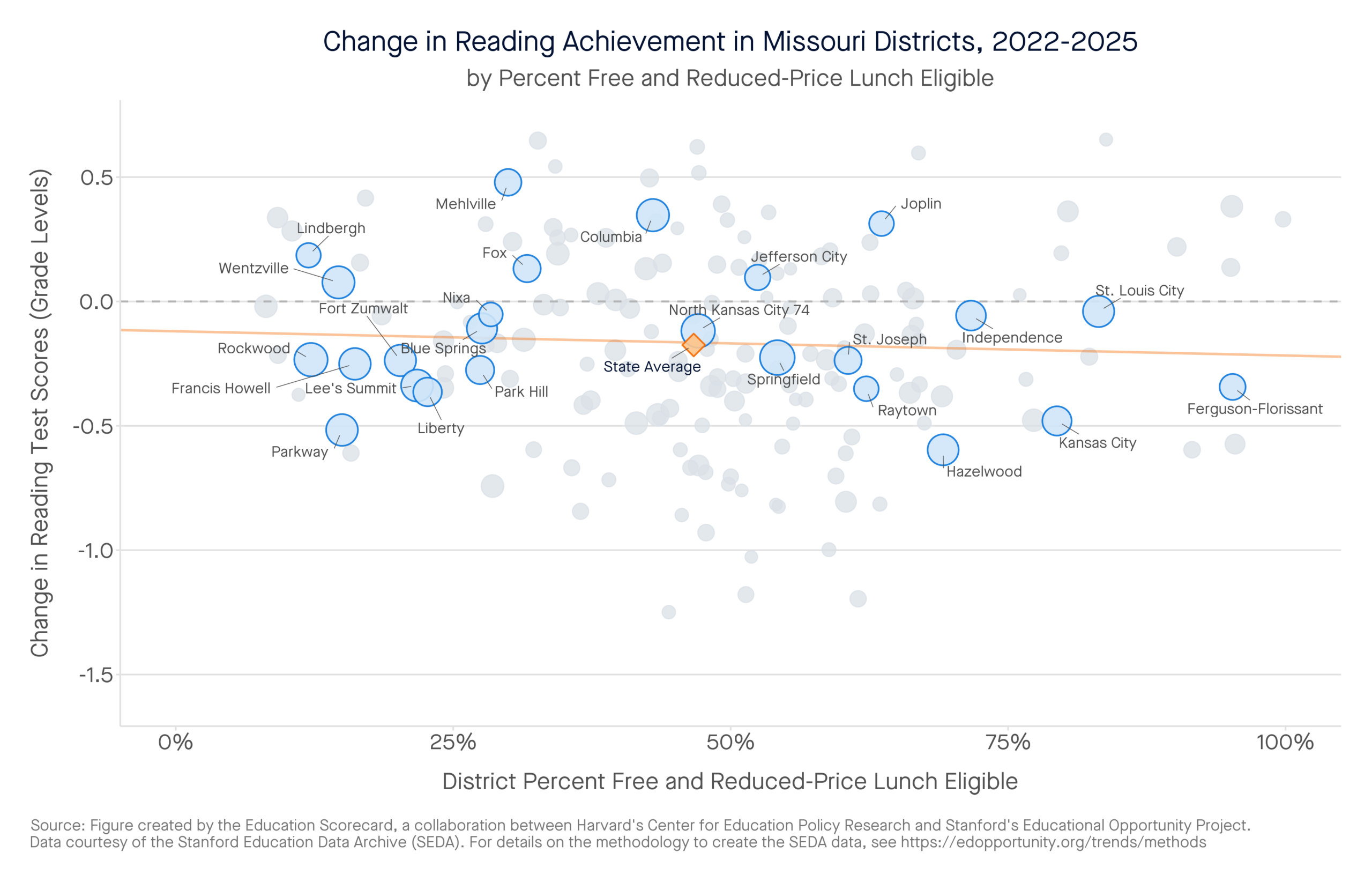
- Missouri ranks 26th out of 38 states in academic growth in math and 28th out of 35 states in reading between 2022 and 2025.
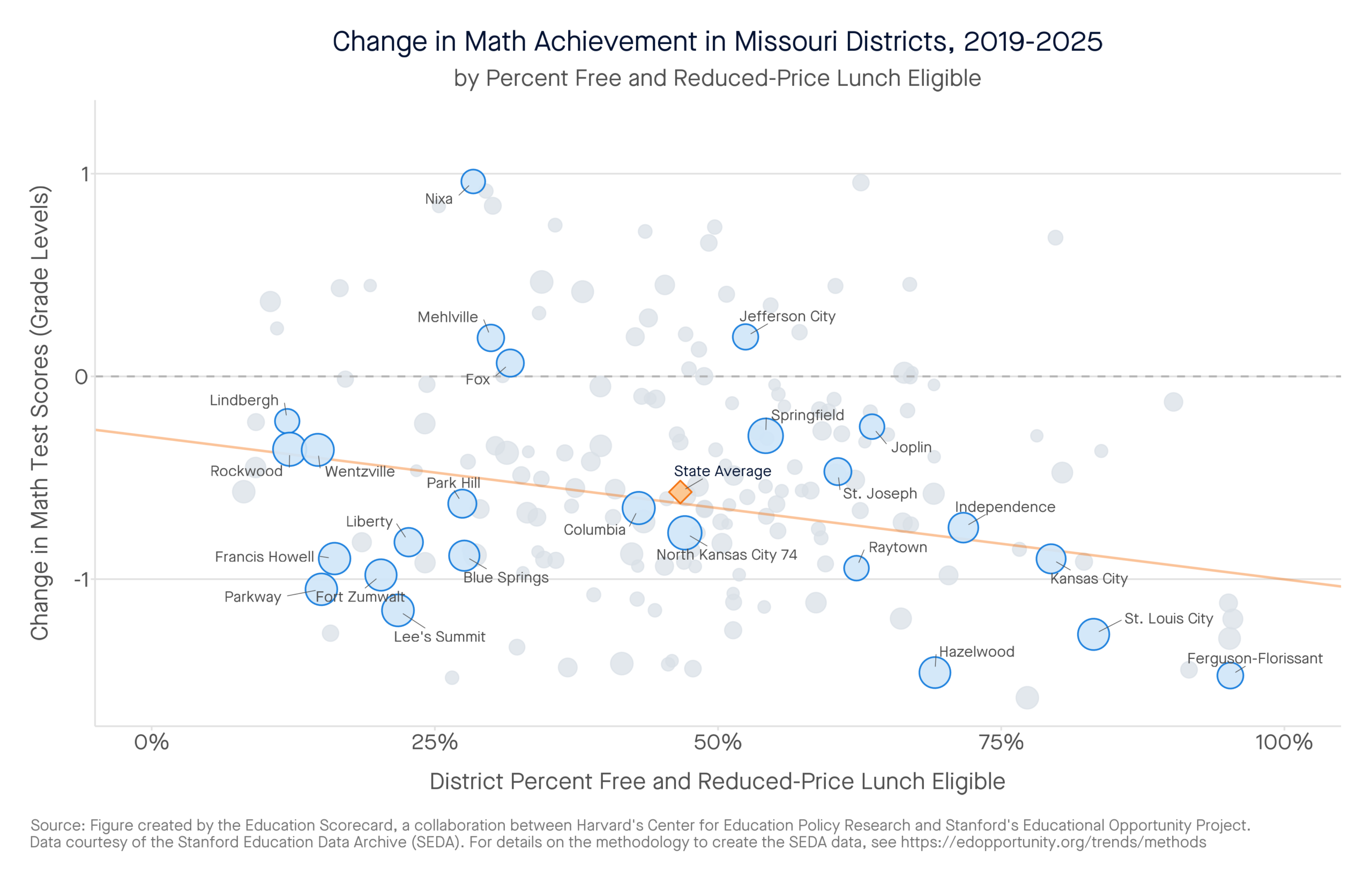
- In math, the average student is performing .08 grade equivalents above their 2022 level, but .58 grade equivalents below 2019 levels. Some districts like Hazelwood, St. Louis City, and Ferguson-Florissant R-II continue to lag over a full grade equivalent behind 2019 levels.
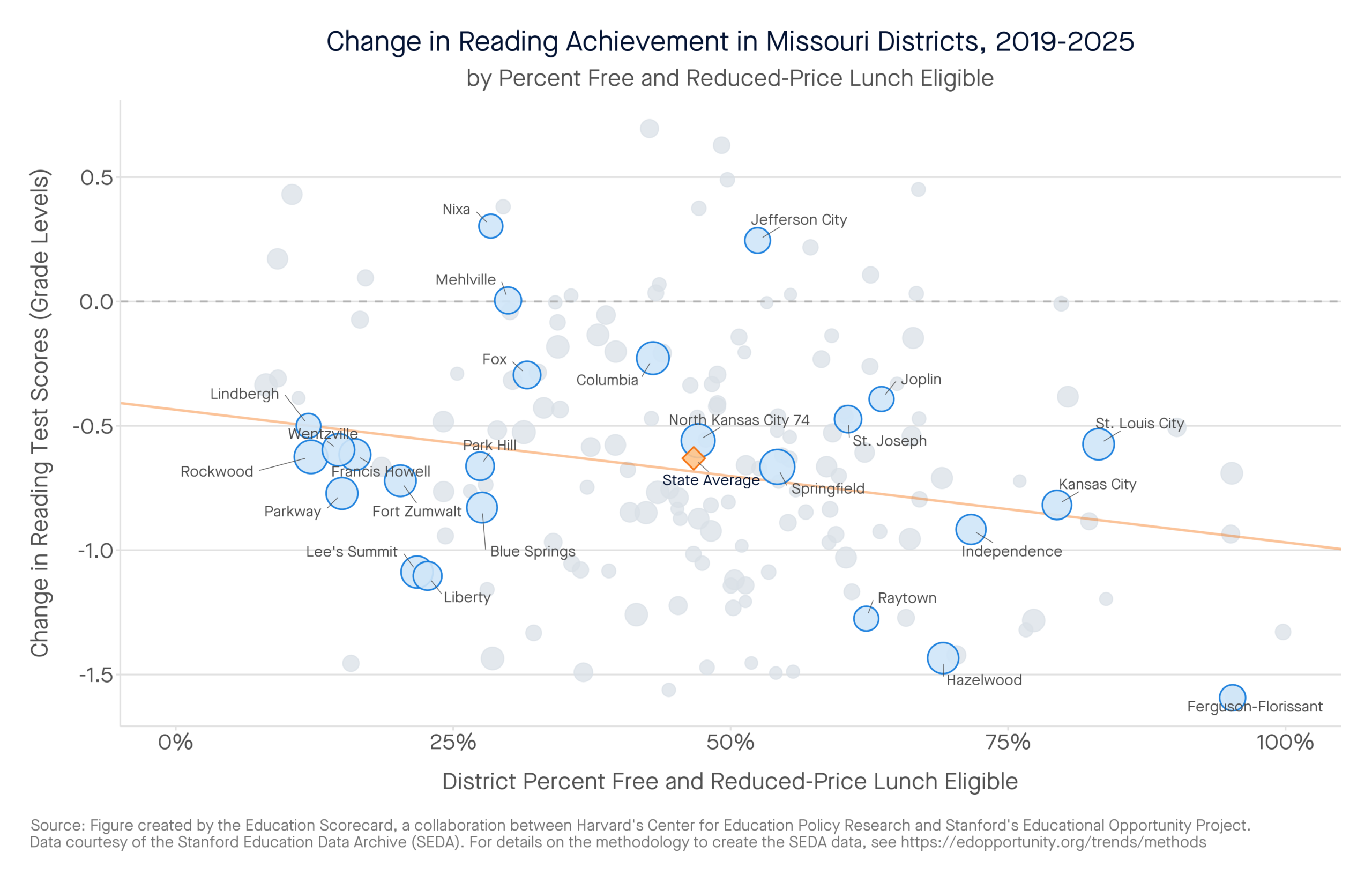
- In reading, the average student is performing about .2 grade equivalents below their 2022 level, and .66 grade equivalents below 2019 levels. A number of districts like Hazelwood, Ferguson-Florissant R-II, and Raytown C-2 continue to slip and remain over a full grade equivalent behind their 2019 levels.
- Several Missouri districts are emerging as Districts on the Rise. These districts have shown unusual progress relative to similar districts in their own state. A core group of districts is excelling in both math and reading, with districts like Sikeston R-6, Jefferson City, and Marshfield R-I outperforming their peers.
- Several other districts are rising relative to their peers in one subject—either math or reading. Wentzville R-IV, Hannibal 60, Union R-XI, and Ozark R-VI are leading the way in math performance, while Riverview Gardens, Normandy Schools Collaborative, and Joplin Schools are leading the way in reading.
- Statewide, there is some good news on chronic absenteeism (students missing more than 10% of a school year), which has fallen from almost 24% in 2022 to around 21% in 2025. However, chronic absence rates still remain 9 percentage points above pre-pandemic levels.
- Missouri received about $3.04 billion in federal pandemic relief for K–12 schools—roughly $3,400 per student. Our analysis finds that the gains in many high-poverty districts were driven by this federal support. Unfortunately, many middle-poverty districts (those with 30 to 70 percent of students receiving federal lunch subsidies) received little federal aid. Now that the federal relief is gone, Missouri should focus school improvement dollars on the middle and higher poverty districts that remain behind their pre-pandemic levels.
“The pandemic was the mudslide that followed seven years of erosion in student achievement,” said Professor Tom Kane, faculty director of the Center for Education Policy Research at Harvard University. “The ‘learning recession’ started a decade ago, after policymakers switched off the early warning system of test-based accountability and social media took over children’s lives. In this report, we highlight the work of a small group of state leaders who have started digging out by changing how students learn to read, and 108 local school districts that are finding ways to get students learning again. The recovery of U.S. education has begun. But it’s up to the rest of us to spread it.”
District on the Rise: Sikeston R-6 School District
Among Missouri’s Districts on the Rise, Sikeston R-6 School District stands out for building a model of instructional ownership that starts with teachers and runs through every corner of the district. For over a decade, Sikeston has maintained its own curriculum, and over the last four years teachers have driven that development through a four-stage cycle—Planning and Writing, Reviewing (including vertical team and community feedback), Board Adoption, and annual Revising—guided by Dr. Janie Pyle. All units require essential questions, big ideas, Tier 3 vocabulary, and research-based teaching activities, and building leaders are responsible for aligning the “Written,” “Taught,” and “Assessed” curriculum across every course. Teachers develop assessments aligned to MAP Growth and Missouri’s End-of-Course questions, with results reviewed in weekly data team meetings to determine immediate instructional next steps. To ensure curriculum improvements could actually reach students, the district implemented its Champion Teaching initiative—based on Doug Lemov’s framework for student engagement and high accountability—training not only nearly all teachers and administrators but also bus drivers, secretaries, and support staff, creating the consistent, district-wide culture they call “The Sikeston Way.” That structured environment reduces disruption and maximizes instructional minutes for small-group and explicit whole-group instruction. On interventions, the district employs dedicated Title Teachers as reading and math interventionists in Title I schools, incentivized LETRS training through the state’s Read, Lead, Exceed initiative, and was selected as the only district in Missouri to host a Star Academy—a nearly $1 million “school within a school” for at-risk eighth graders using project-based learning tied to local trades—which enrolled 80 students in its first year. A Career and Tech Center serving eleven sending schools, aligned with the Sikeston Chamber of Commerce, rounds out the district’s workforce pipeline. For the full case study, click here.
“In Sikeston, we believe that academic success is impossible without first protecting the learning environment through strong classroom management and high expectations for student engagement,” said Shannon Holifield, Superintendent of Sikeston R-6 School District. “By empowering our teachers to own the curriculum development process and their classrooms, we have created a unified ‘Sikeston Way’ that ensures every student has access to rigorous, standards-aligned instruction and high expectations for behavior.”