PRESS RELEASE
May 13, 2026
Contact: Sam Stockwell
samuel_stockwell@gse.harvard.edu
617.495.0342
Alabama Ranks 10th in Math Recovery and 13th in Reading Among States, Among the Top Performers in the Nation
Alabama is one of only two states performing above 2019 levels in math.
Chronic absenteeism has fallen below pre-pandemic levels—a remarkable achievement.
Districts like Birmingham City, Coffee County, and Muscle Shoals City are outperforming their peers in both math and reading.
(May 13, 2026) In its fourth year, the Education Scorecard (a collaboration between the Center for Education Policy Research at Harvard University, The Educational Opportunity Project at Stanford University, and faculty at Dartmouth College) is issuing its annual report on district-level student growth in math and reading.
The latest report provides a high-resolution picture of where Alabama students’ academic recovery stands, combining state test results for roughly 35 million grade 3–8 students nationwide with national assessment data to describe changes in local communities. Here’s what we found:
Alabama:
- Alabama ranked 10th out of 38 states in academic growth in math and 13th out of 35 states in reading between 2022 and 2025.
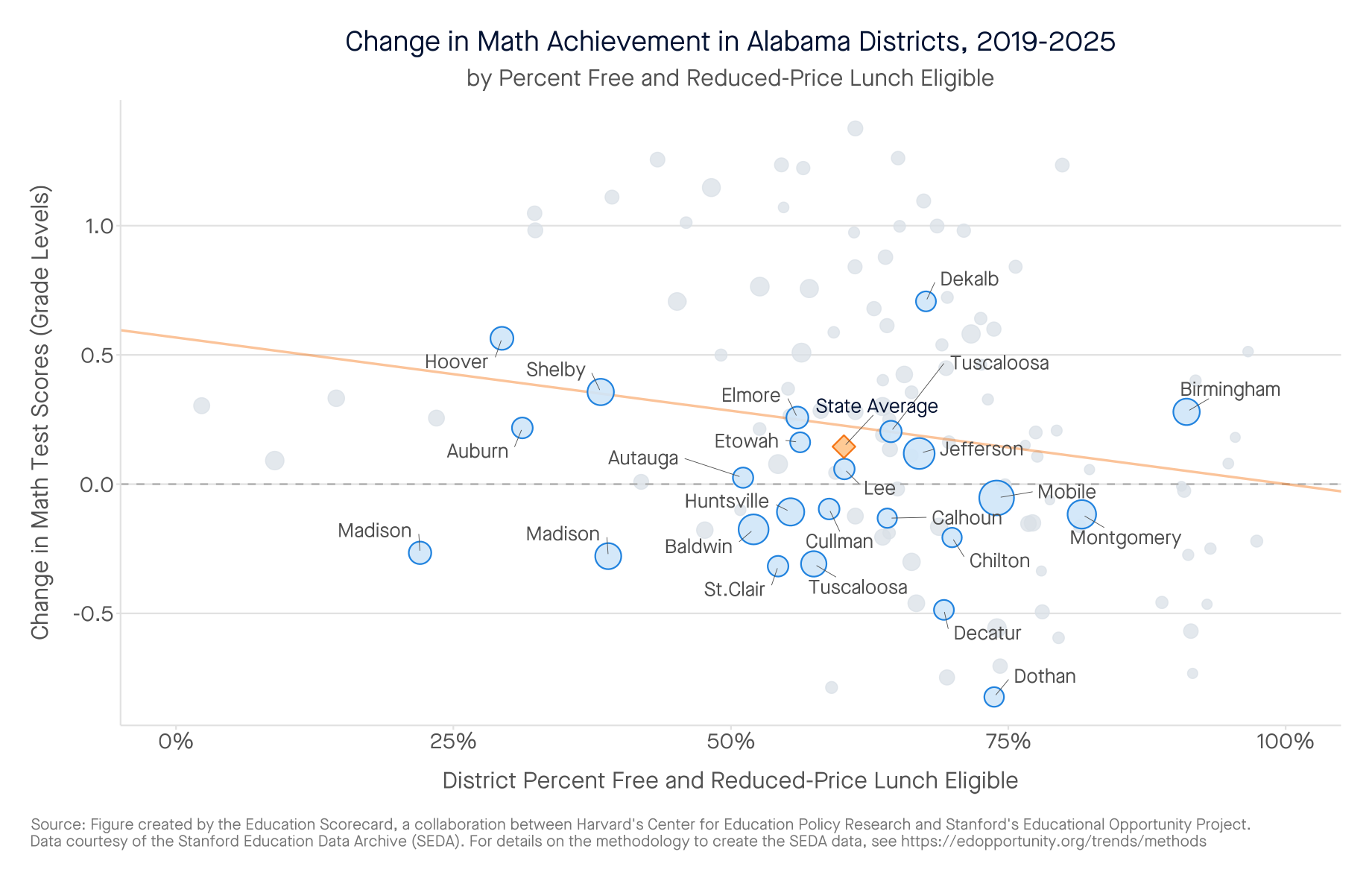
- In math, the average student is performing almost .27 grade equivalents above their 2022 level, and almost .15 grade equivalents above 2019 levels. Alabama is one of two states performing above 2019 levels in math. Yet, some districts like Dothan City, Decatur City, Tuscaloosa, and St. Clair continue to lag behind 2019 levels.
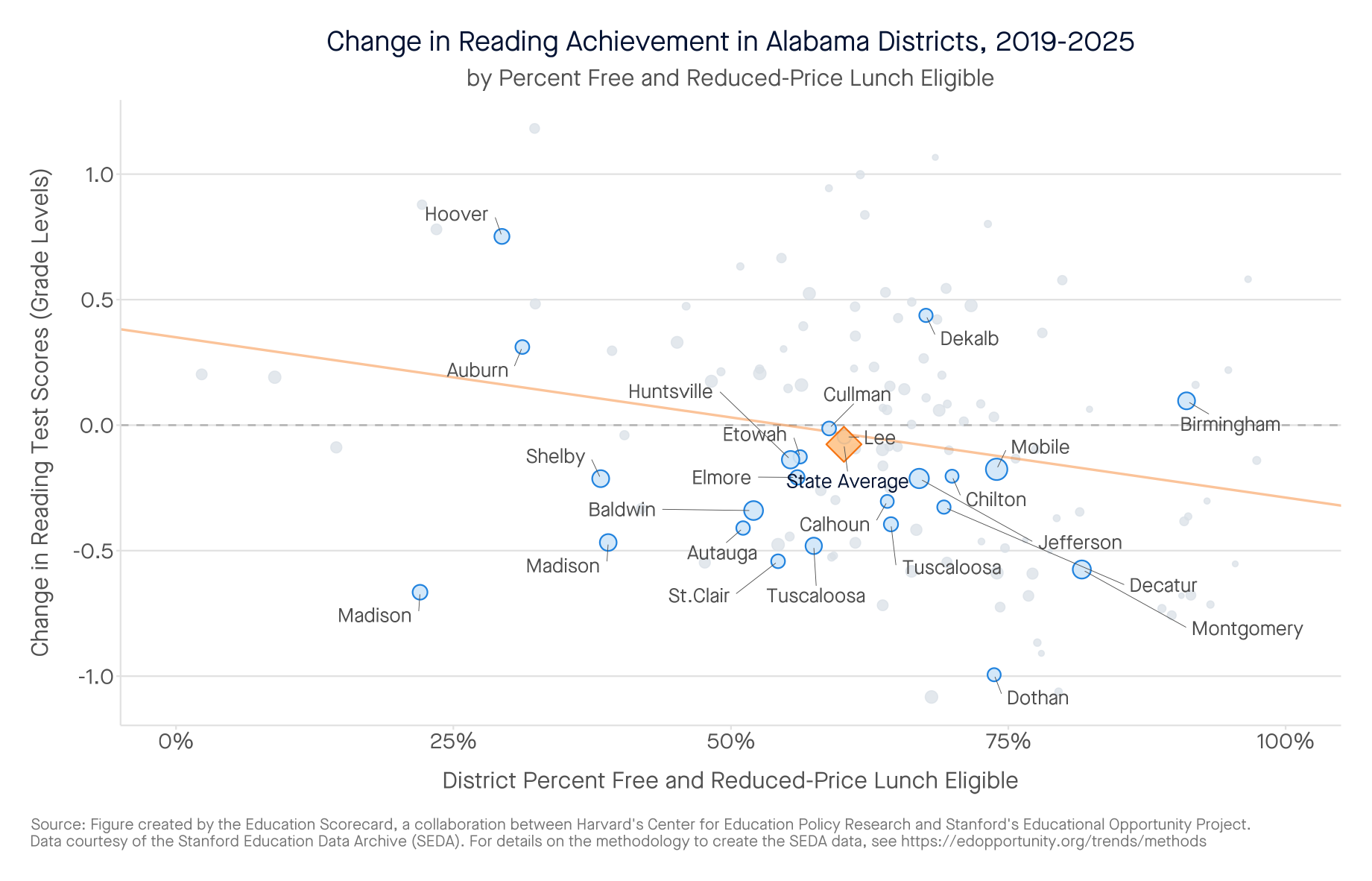
- In reading, the average student is performing .07 grade equivalents below their 2022 level, and .076 grade equivalents below 2019 levels. A number of districts like Dothan City, Madison City, and Montgomery continue to slip and remain behind their 2019 levels.
- Several Alabama districts are emerging as Districts on the Rise. These districts have shown unusual progress relative to similar districts in their own state. A core group of districts is excelling in both math and reading, with districts like Birmingham City, Coffee County, and Muscle Shoals City outperforming their peers.
- Several other districts are rising relative to their peers in one subject—either math or reading. Franklin, Geneva, and Marion Counties are leading the way in math performance, while Cullman City, Homewood City, Hoover City, and Houston County are leading the way in reading.
- Statewide, there is some good news on chronic absenteeism (students missing more than 10% of a school year), which has fallen from 17.7% in 2022 to 12% in 2025—lower than pre-pandemic levels of 15.6%.
- Alabama received about $3.1 billion in federal pandemic relief for K–12 schools—roughly $4,200 per student. Our analysis finds that the gains in many high-poverty districts were driven by this federal support. Unfortunately, many middle-poverty districts (those with 30 to 70 percent of students receiving federal lunch subsidies) received little federal aid. Now that the federal relief is gone, Alabama should focus school improvement dollars on the middle and higher poverty districts that remain behind their 2019 levels.
“The pandemic was the mudslide that followed seven years of erosion in student achievement,” said Professor Tom Kane, faculty director of the Center for Education Policy Research at Harvard University. “The ‘learning recession’ started a decade ago, after policymakers switched off the early warning system of test-based accountability and social media took over children’s lives. In this report, we highlight the work of a small group of state leaders who have started digging out by changing how students learn to read, and 108 local school districts that are finding ways to get students learning again. The recovery of U.S. education has begun. But it’s up to the rest of us to spread it.”
District on the Rise: Tuscaloosa City Schools
Among Alabama’s Districts on the Rise, Tuscaloosa City Schools (TCS) stands out for the discipline of its strategy: for over five years, the district has maintained the same four instructional priorities—K–12 literacy, K–12 numeracy, school culture and climate, and college and career readiness—refining and deepening them annually rather than introducing new initiatives. That stability is matched by alignment from the board of education through school leadership to classroom practice, with board members engaging directly with academic data and visiting classrooms to reinforce the connection between governance and instruction. The district expanded literacy coaches and specialists from K–3 into middle and high schools, built the same staffing model for math, and prioritized skilled personnel over technology purchases throughout—more than 90% of its summer learning budget goes to people, not programs. Data infrastructure is equally deliberate: Project Success meetings provide regular, structured reviews between school and system leadership teams to identify emerging issues in real time, while monthly Problem Solving Team meetings bring together parents, teachers, coaches, and social workers around individual students until they are back on track. Summer learning has been a signature investment since 2017, growing to 4,000 students at its peak—full-day, 22-day programs adding roughly 165 instructional hours annually, staffed by the district’s strongest teachers assigned intentionally to students with the greatest need. Data shows students who attend halt the typical summer slide, and 33% of current assistant principals and 25% of principals first led summer learning programs. To address attendance, TCS operates the New Heights Community Resource Center, a district-owned facility where external partners provide mental health services, food assistance, language translation, and employment services at minimal cost in exchange for serving district families—and launched “The Zone,” a geographically targeted initiative concentrating wraparound services in data-identified neighborhoods. For the full case study, click here.
“Our progress in TCS is driven by the powerful combination of committed educators and a clear, focused strategic plan,” said Dr. Mike Daria, Superintendent of Tuscaloosa City Schools. “Together, we are a system unwavering in our commitment to ensuring ‘each and every’ student achieves success.”
“The success of Tuscaloosa City Schools is the result of sustained focus, aligned leadership, and an unwavering belief that every student can achieve at high levels,” said Dr. James Pope, Deputy Superintendent of Teaching and Learning. “By committing to a consistent strategy around literacy, numeracy, school culture, and college and career readiness, and by investing deeply in our people, we have built a system that responds to student needs in real time. Our progress reflects not a single initiative, but a disciplined approach to continuous improvement that ensures each and every student in every school has access to high-quality instruction and the support they need to succeed.”
Additional Spotlights:
Birmingham School District—For the full case study, click here.
DeKalb County School District—For the full case study, click here.