PRESS RELEASE
May 13, 2026
Contact: Sam Stockwell
samuel_stockwell@gse.harvard.edu
617.495.0342
Wisconsin Ranks 33rd in Math and 30th in Reading Recovery Among States, with Districts on the Rise Emerging Across the State
Reading scores have continued to fall since 2022, and math recovery has barely moved, leaving students more than half a grade level below 2019 levels in reading.
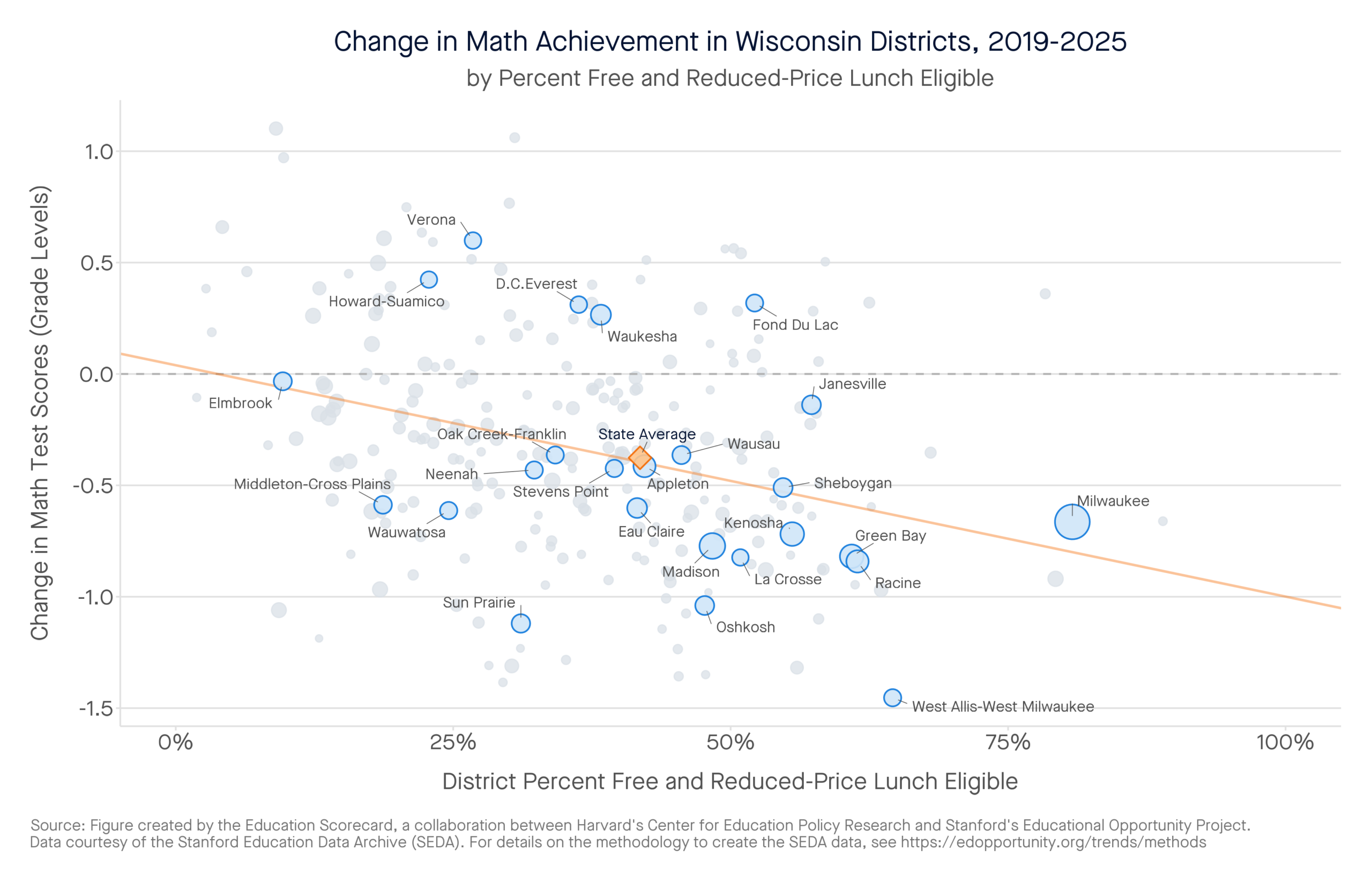
Several districts including Sun Prairie Area, Oshkosh Area, and West Allis-West Milwaukee lag more than a full grade level behind 2019 math benchmarks.
Fond du Lac, Cedarburg, and Waukesha are outperforming their peers in both math and reading, while Racine Unified is emerging as a reading leader.
(May 13, 2026) In its fourth year, the Education Scorecard (a collaboration between the Center for Education Policy Research at Harvard University, The Educational Opportunity Project at Stanford University, and faculty at Dartmouth College) is issuing its annual report on district-level student growth in math and reading.
The latest report provides a high-resolution picture of where Wisconsin students’ academic recovery stands, combining state test results for roughly 35 million grade 3–8 students nationwide with national assessment data to describe changes in local communities. Here’s what we found in
Wisconsin:
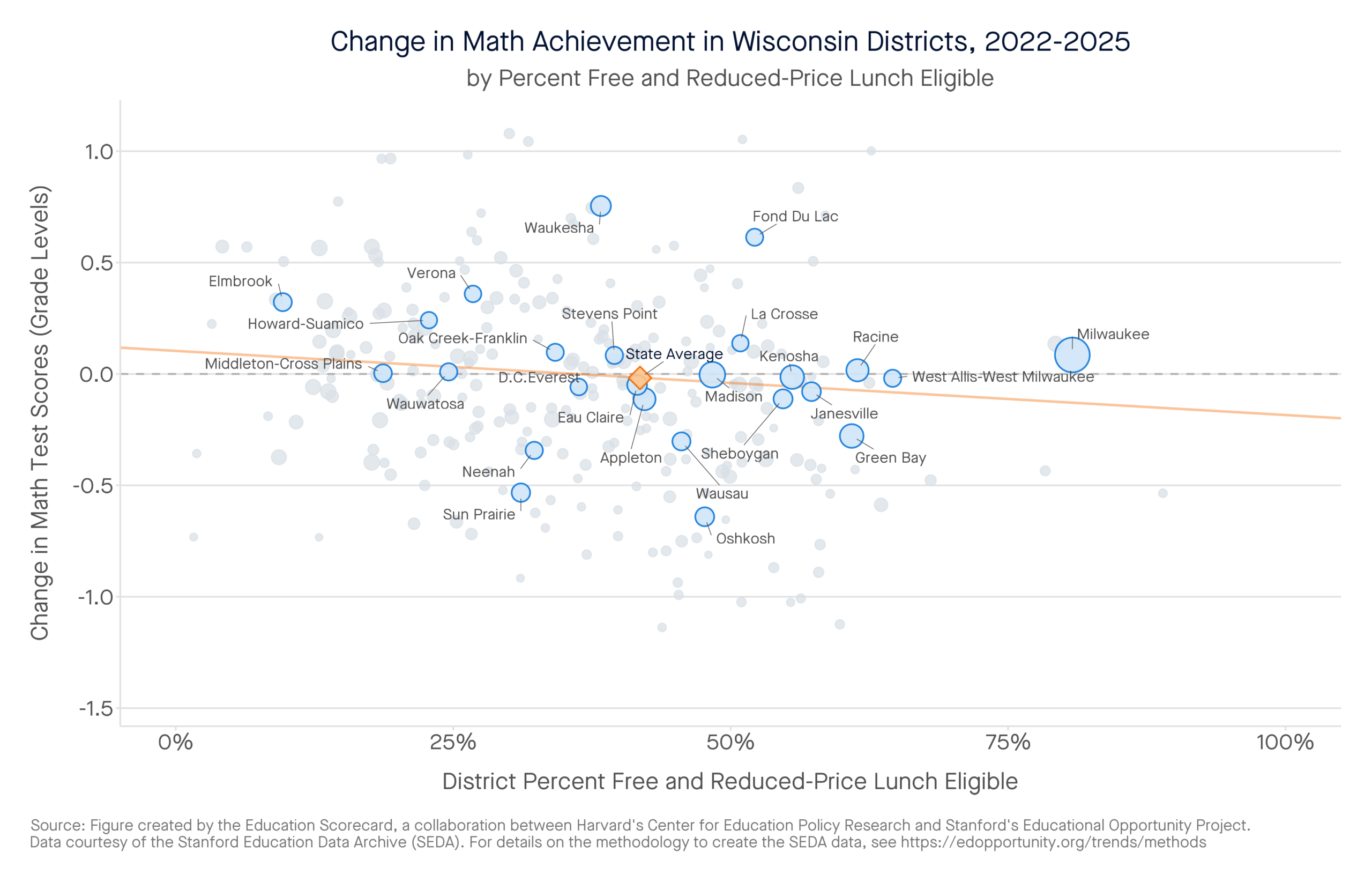
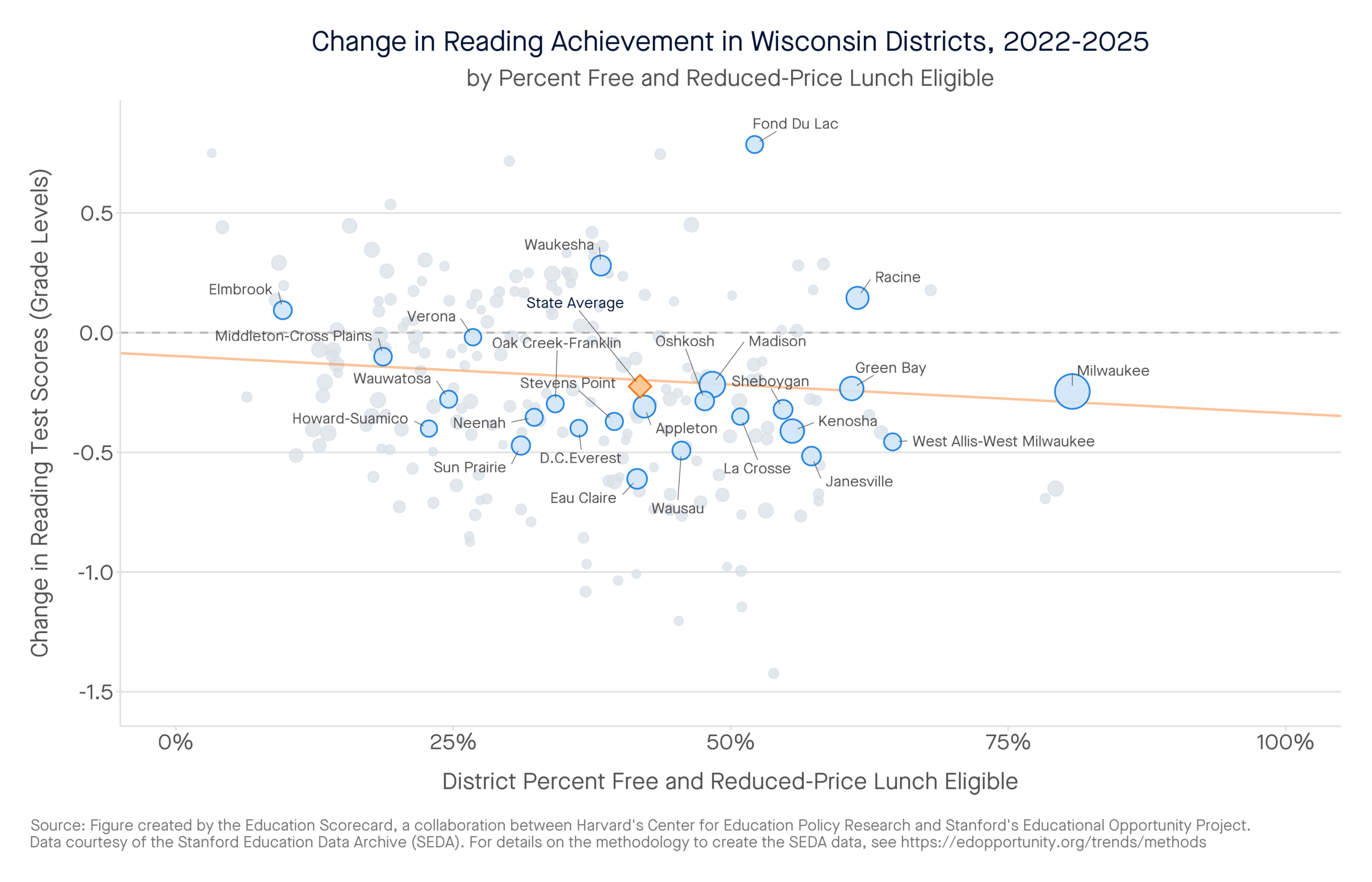
- Wisconsin ranks 33rd out of 38 states in academic growth in math and 30th out of 35 states in reading between 2022 and 2025.
- In math, the average student is performing just above 2022 levels but still remains .35 grade equivalents below their 2019 level. Some districts like Sun Prairie Area, Oshkosh Area, and West Allis-West Milwaukee continue to lag more than a full grade equivalent behind 2019 levels.
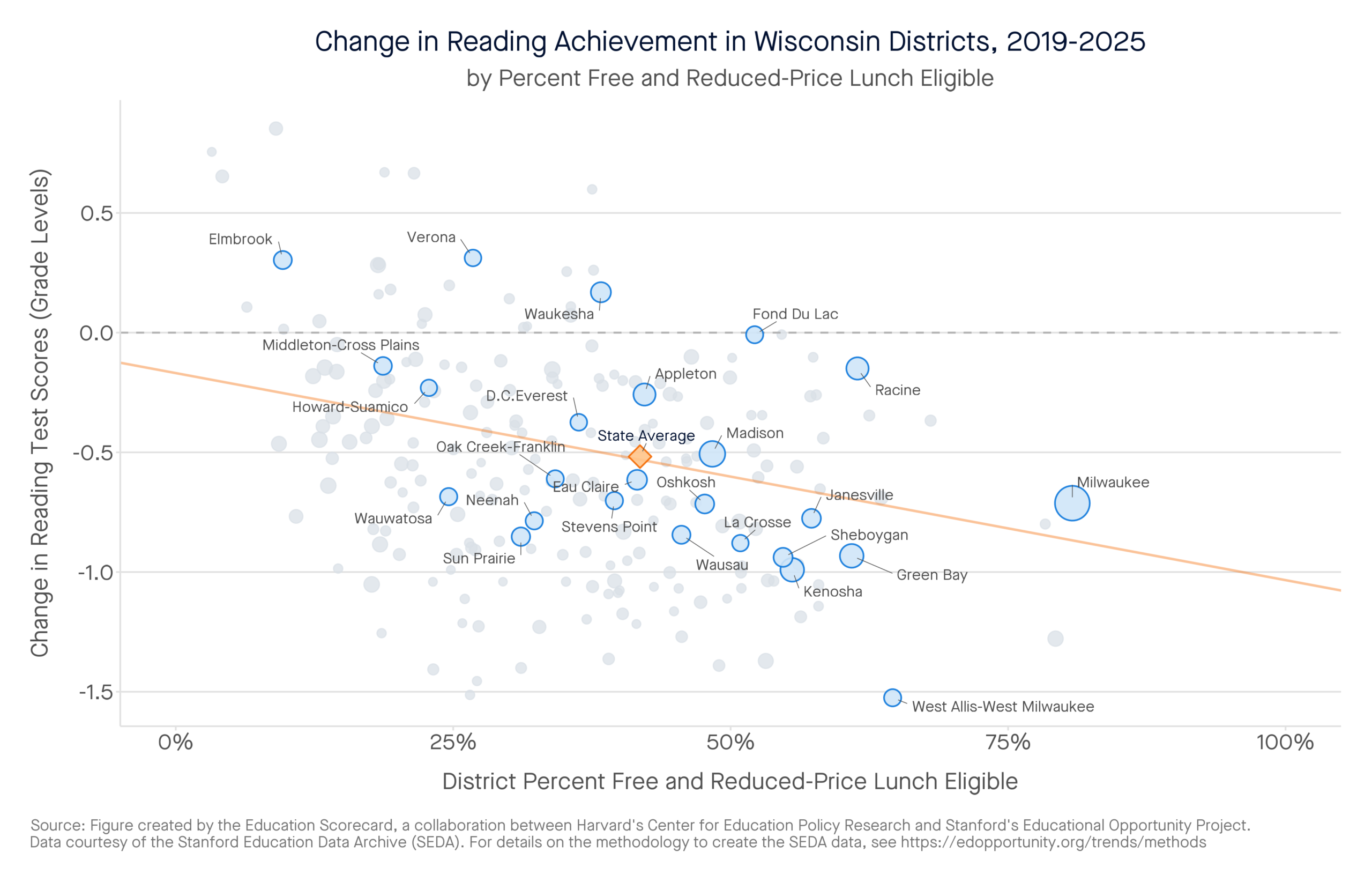
- In reading, the average student is performing .24 grade equivalents below their 2022 level, and .53 grade equivalents below 2019 levels. A number of districts like Kenosha, Green Bay Area, and Sheboygan Area continue to slip and remain nearly a full grade equivalent behind their 2019 levels.
- Several Wisconsin districts are emerging as Districts on the Rise. These districts have shown unusual progress relative to similar districts in their own state. A core group of districts is excelling in both math and reading, with districts like Fond du Lac, Cedarburg, and Waukesha outperforming their peers.
- Several other districts are rising relative to their peers in one subject—either math or reading. Hamilton, Elmbrook, and Verona Area are leading the way in math performance, while Racine Unified and West De Pere are leading the way in reading.
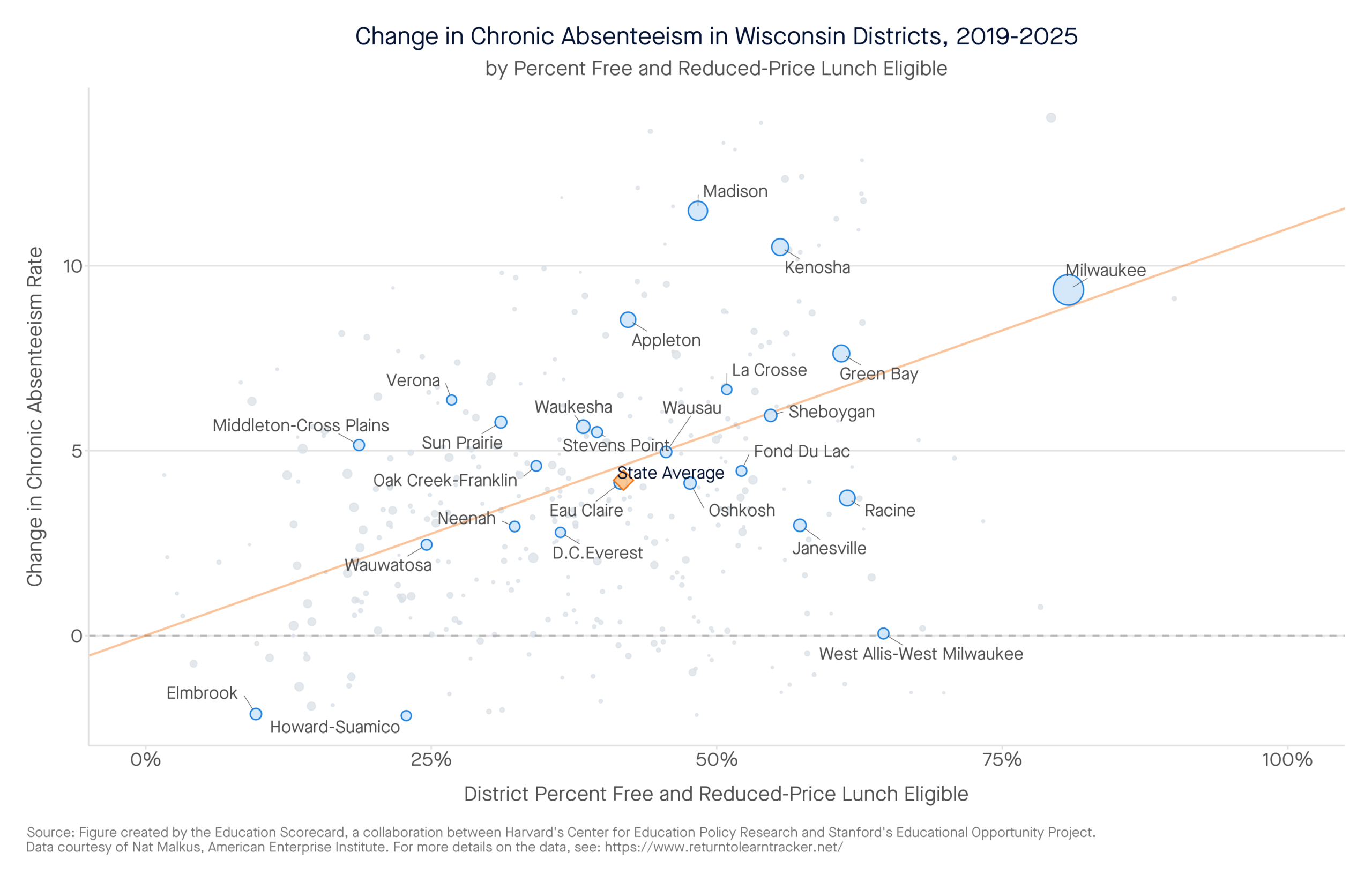
- Statewide, there is some good news on chronic absenteeism (students missing more than 10% of a school year), which has fallen from 22% in 2022 to 17% in 2025. However, chronic absence rates still remain five percentage points above pre-pandemic levels.
- Wisconsin received about $2.4 billion in federal pandemic relief for K–12 schools—roughly $2,900 per student. Our analysis finds that the gains in many high-poverty districts were driven by this federal support. Unfortunately, many middle-poverty districts (those with 30 to 70 percent of students receiving federal lunch subsidies) received little federal aid. Now that the federal relief is gone, Wisconsin should focus school improvement dollars on the middle and higher poverty districts that remain behind their pre-pandemic levels.
“The pandemic was the mudslide that followed seven years of erosion in student achievement,” said Professor Tom Kane, faculty director of the Center for Education Policy Research at Harvard University. “The ‘learning recession’ started a decade ago, after policymakers switched off the early warning system of test-based accountability and social media took over children’s lives. In this report, we highlight the work of a small group of state leaders who have started digging out by changing how students learn to read, and 108 local school districts that are finding ways to get students learning again. The recovery of U.S. education has begun. But it’s up to the rest of us to spread it.”
District on the Rise: Fond du Lac School District
Among Wisconsin’s Districts on the Rise, Fond du Lac School District (FDLSD) stands out for building a coherent instructional system anchored by strong leadership development, high-quality curriculum, and a year-round community ecosystem. The district transformed the principal role from building manager to instructional leader by creating Teachers on Special Assignment (TOSAs)—credentialed educators who handle administrative responsibilities and student behavior at every elementary school, freeing principals to spend time in classrooms and lead 70-minute weekly data-driven instruction meetings with grade-level teams. Those DDI meetings, divided by grade band so principals can rotate through classroom visits, require teachers to present formative and summative assessment data aligned to state standards and identify specific skill gaps and instructional adjustments. Instructional coherence is reinforced through district-wide curriculum adoption: Amplify CKLA and Amplify ELA for K–8 literacy, Bridges in Mathematics for K–5, Illustrative Math for grades 6–8, and Reveal Math for high school, supported by intensive summer retreats for six to seven school-based team leaders per building who disseminate training to their colleagues. The results have been striking—all 13 elementary and middle schools now meet or exceed expectations, and the district’s one previously underperforming school now ranks in the top 1% of Wisconsin schools for student growth. Beyond the school day, the district has built a genuine year-round learning ecosystem: the local Boys & Girls Club, supported by a 21st Century Learning Center Grant, hires district teachers to lead summer instruction using the same curriculum and i-Ready tracking system students use during the year. In the 2025 summer session, 92% of attending students improved their reading i-Ready score and 95% improved in math. For the full case study, click here.
“We’ve made a fundamental shift in the role of the principal from a building manager to a true instructional leader,” said Matt Steinbarth, Superintendent of Fond du Lac School District. “By creating the Teacher on Special Assignment (TOSA) positions to handle daily administrative tasks and behavior support, we freed our principals to be where they matter most: in the classroom and at the data table. We refuse to let the summer slide undo the hard work our students and teachers put in during the school year. Through our partnership with the Boys & Girls Club, we’ve created a seamless, year-round learning ecosystem that provides our most vulnerable students with the consistent, high-dosage academic support they need to return in the fall ready to learn, not just catch up.”