PRESS RELEASE
May 13, 2026
Contact: Sam Stockwell
samuel_stockwell@gse.harvard.edu
617.495.0342
Nevada Ranks 23rd in Math and 16th in Reading Recovery Among States, with Clark County Emerging as a District on the Rise
Clark County—one of the largest school districts in the nation—is outperforming its peers.
Students remain more than a third of a grade level below 2019 levels in both math and reading.
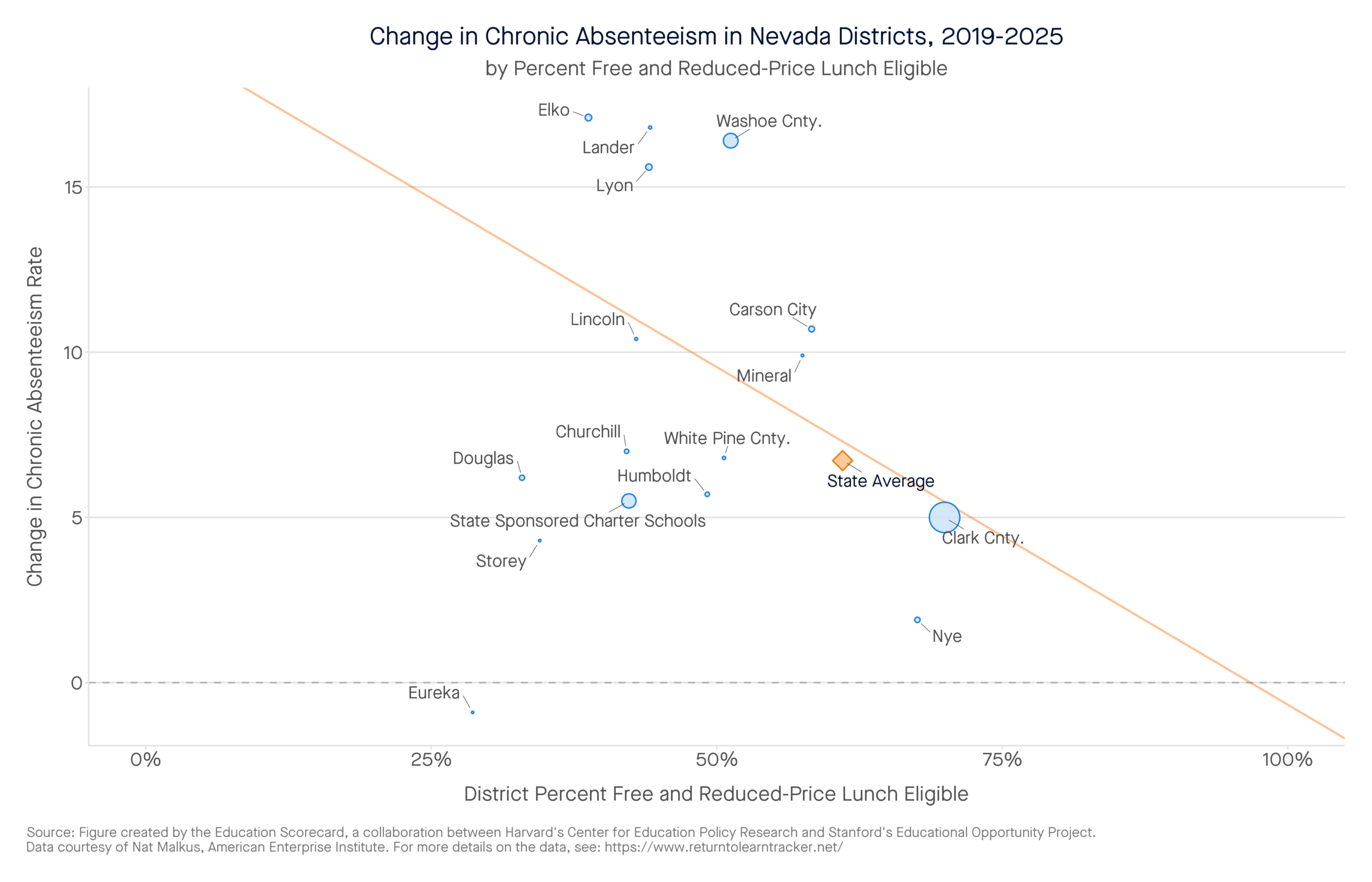
Chronic absenteeism has fallen sharply from 36% in 2022 but remains more than 6 percentage points above pre-pandemic levels.
(May 13, 2026) In its fourth year, the Education Scorecard (a collaboration between the Center for Education Policy Research at Harvard University, The Educational Opportunity Project at Stanford University, and faculty at Dartmouth College) is issuing its annual report on district-level student growth in math and reading.
The latest report provides a high-resolution picture of where Nevada students’ academic recovery stands, combining state test results for roughly 35 million grade 3–8 students nationwide with national assessment data to describe changes in local communities. Here’s what we found:
Nevada:
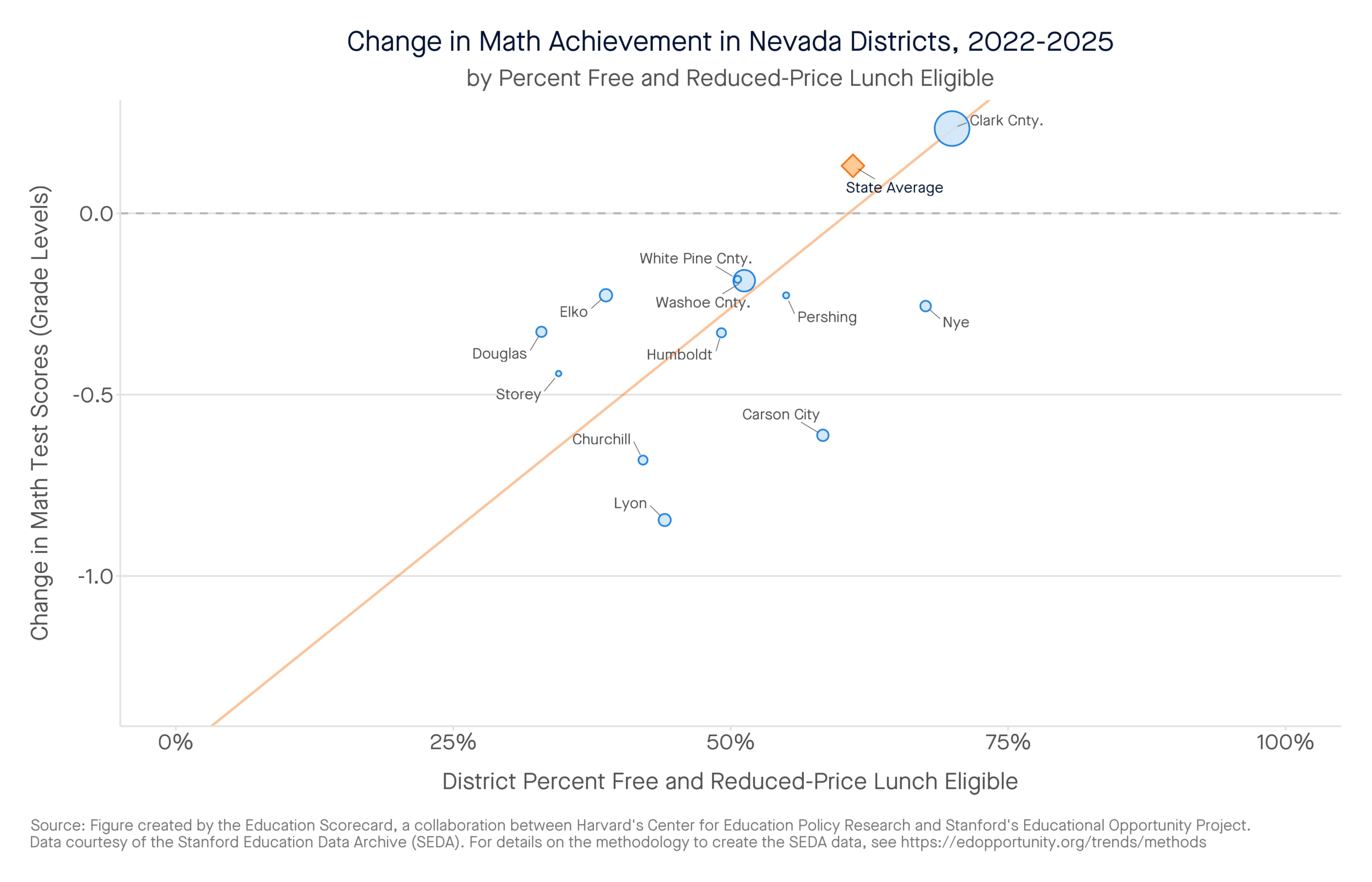
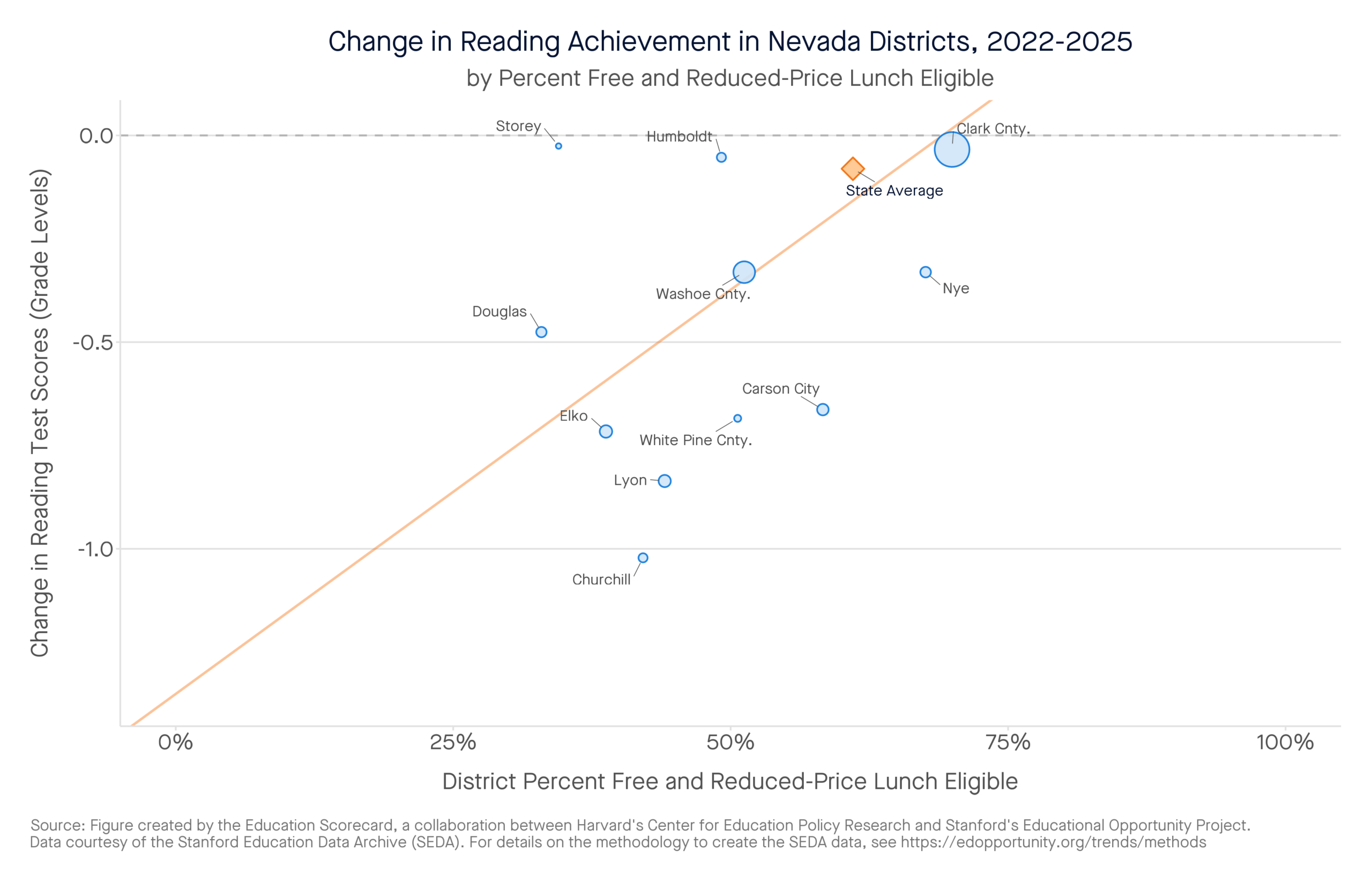
- Nevada ranks 23rd out of 38 states in academic growth in math and 16th out of 35 states in reading between 2022 and 2025.
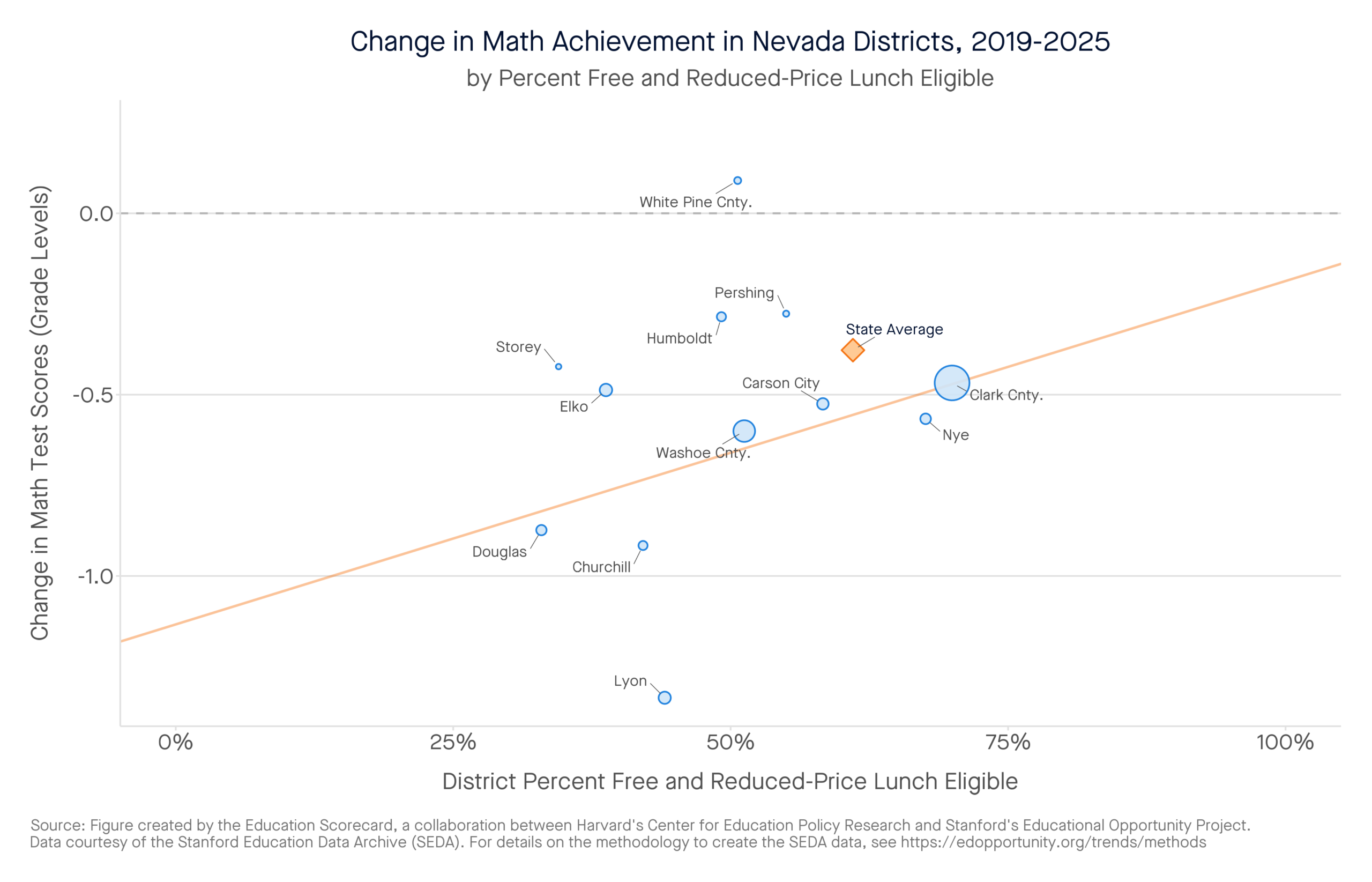
- In math, the average student is performing about .13 grade equivalents above their 2022 level, but around .37 grade equivalents below 2019 levels. Still, some districts like Lyon, Churchill, and Douglas continue to lag behind 2019 levels.
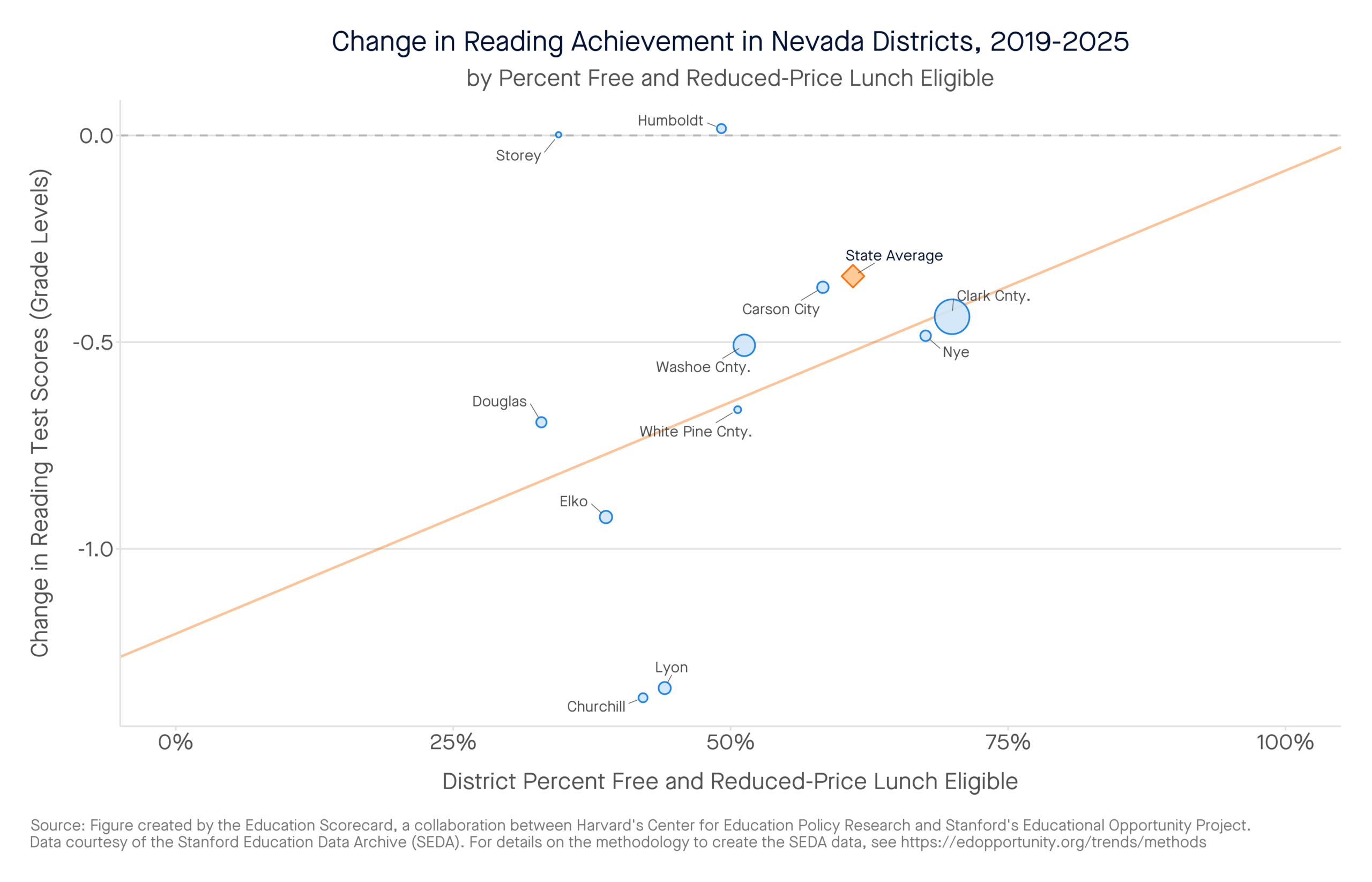
- In reading, the average student is performing .08 grade equivalents below their 2022 level, and .34 grade equivalents below 2019 levels. A number of districts like Churchill, Lyon, and Elko continue to slip and remain far behind their 2019 levels.
- Clark County is emerging as a District on the Rise, having shown unusual progress relative to similar districts in Nevada.
- Statewide, there is some good news on chronic absenteeism (students missing more than 10% of a school year), which has fallen from 36% in 2022 to around 25% in 2025. However, chronic absence rates still remain over 6 percentage points above pre-pandemic levels.
- Nevada received about $1.67 billion in federal pandemic relief for K–12 schools—roughly $3,400 per student. Our analysis finds that the gains in many high-poverty districts were driven by this federal support. Unfortunately, many middle-poverty districts (those with 30 to 70 percent of students receiving federal lunch subsidies) received little federal aid. Now that the federal relief is gone, Nevada should focus school improvement dollars on the middle and higher poverty districts that remain behind their pre-pandemic levels.
“The pandemic was the mudslide that followed seven years of erosion in student achievement,” said Professor Tom Kane, faculty director of the Center for Education Policy Research at Harvard University. “The ‘learning recession’ started a decade ago, after policymakers switched off the early warning system of test-based accountability and social media took over children’s lives. In this report, we highlight the work of a small group of state leaders who have started digging out by changing how students learn to read, and 108 local school districts that are finding ways to get students learning again. The recovery of U.S. education has begun. But it’s up to the rest of us to spread it.”
Spotlight: Clark County School District
Clark County School District (CCSD)—one of the largest school districts in the United States—stands out among Nevada’s Districts on the Rise for building instructional coherence at extraordinary scale while treating that coherence as an equity strategy rather than a compliance exercise. The district built an implementation infrastructure around new Tier 1 materials that includes pacing guides and teacher clarity guides for every content area, with a “teacher decision points” tool to help teachers respond to student needs while maintaining grade-level rigor. Rollout was sequenced through the chain of supervision—supervisors first, then principals, then teacher leaders, then teachers—with roughly five dozen teacher and administrator task forces developing the curricular guidance documents so the tools teachers use daily were shaped by classroom practitioners. Teachers implement materials chosen by their colleagues through embedded review committees, not imposed by central office. On literacy, CCSD used ESSER funds to deliver science-of-reading professional learning to approximately 8,000 elementary educators before it was required by law, and Nevada’s Senate Bill 460 has since effectively codified the district’s approach. Every elementary school has a designated PreK–3 literacy specialist deployed as part of the school leadership team, providing on-site, job-embedded coaching that translates science-of-reading professional learning into daily Tier 1 instruction. The design preserves teacher autonomy within a structured framework, avoiding scripted instruction while building fidelity to what works. On attendance, the Bright Futures initiative sends district staff and leaders into the community to identify barriers individually—transportation gaps, food scarcity, family circumstances—shifting the posture of attendance work from punitive to supportive. Twelve family engagement centers offer free support in English and Spanish as a welcoming entry point for families into CCSD’s academic and wraparound services. The district also launched a public data dashboard giving parents, community members, and policymakers access to attendance, assessment, behavior, and performance data at every school, including class sizes and ESSER spending reported in multiple languages. For the full case study, click here.