PRESS RELEASE
May 13, 2026
Contact: Sam Stockwell
samuel_stockwell@gse.harvard.edu
617.495.0342
Iowa Ranks Last in Math Recovery Among All Measured States, with Reading Recovery in the Middle of the Pack
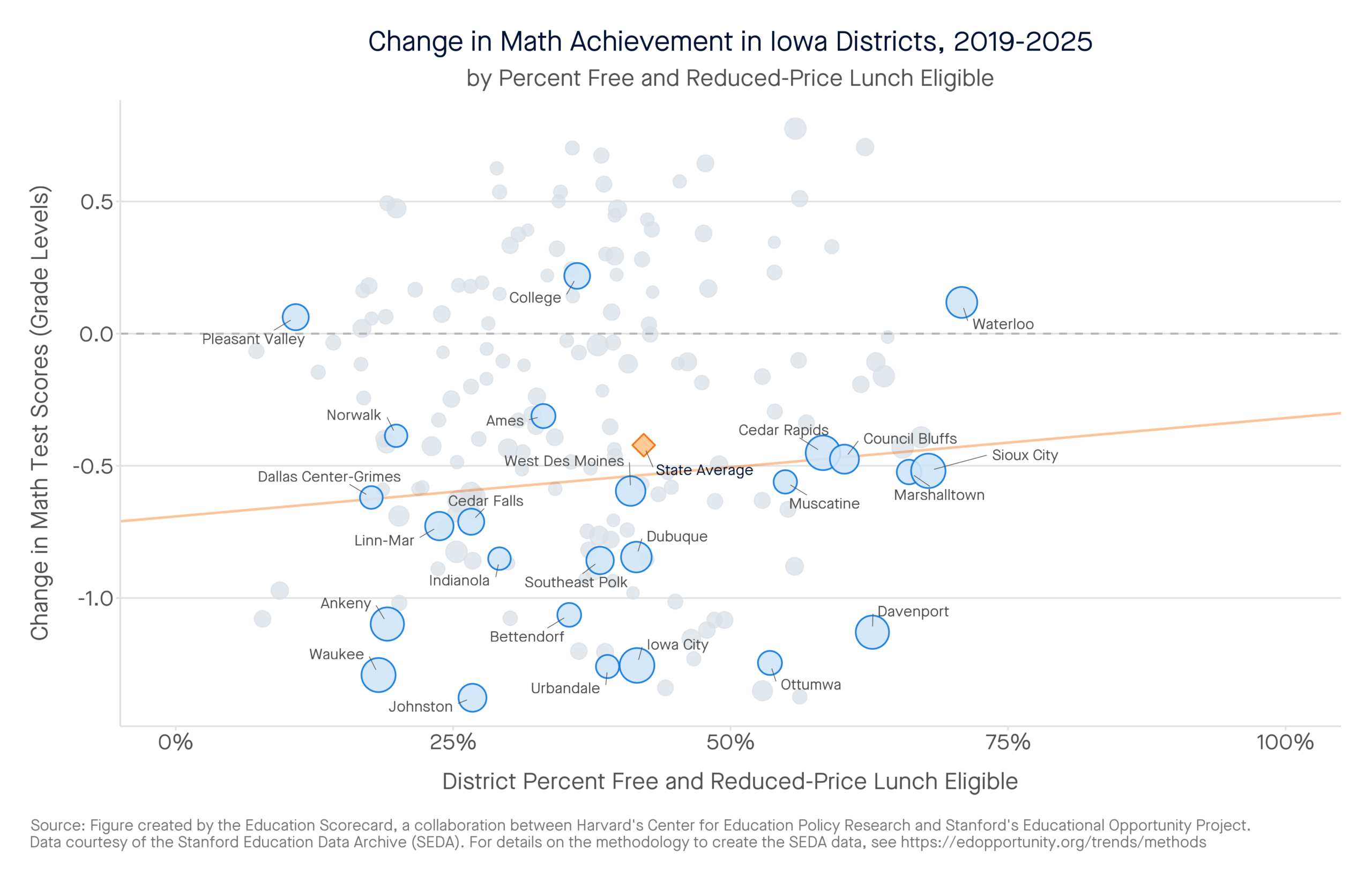
Math scores have fallen further since 2022, leaving students more than .4 grade equivalents below 2019 levels.
Several districts including Waukee, Ankeny, Johnston, and Bettendorf remain more than a full grade level behind 2019 benchmarks.
Districts like College Community and Pleasant Valley are outperforming their peers in both math and reading.
(May 13, 2026) In its fourth year, the Education Scorecard (a collaboration between the Center for Education Policy Research at Harvard University, The Educational Opportunity Project at Stanford University, and faculty at Dartmouth College) is issuing its annual report on district-level student growth in math and reading.
The latest report provides a high-resolution picture of where Iowa students’ academic recovery stands, combining state test results for roughly 35 million grade 3–8 students nationwide with national assessment data to describe changes in local communities. Here’s what we found:
Iowa:
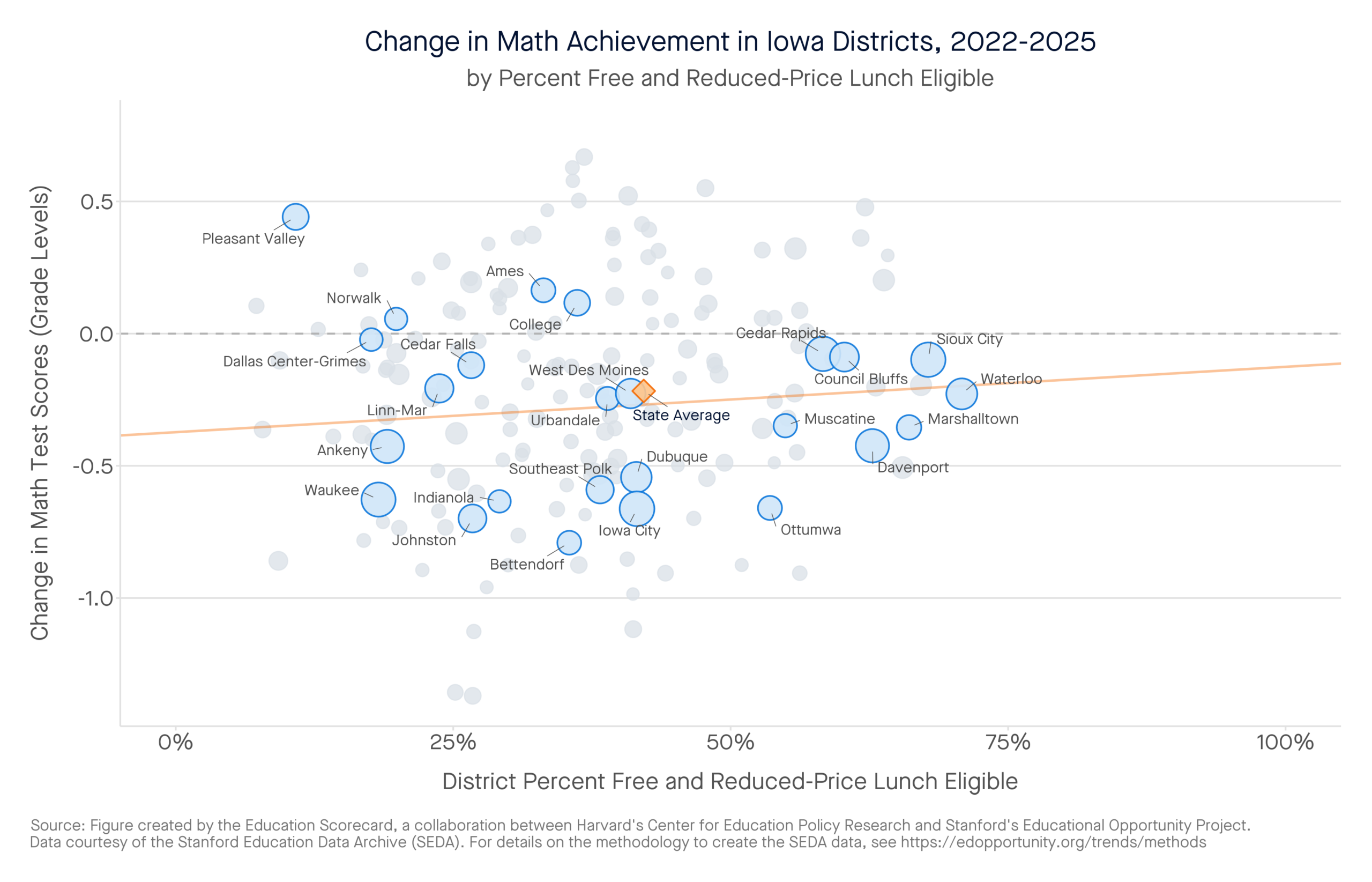
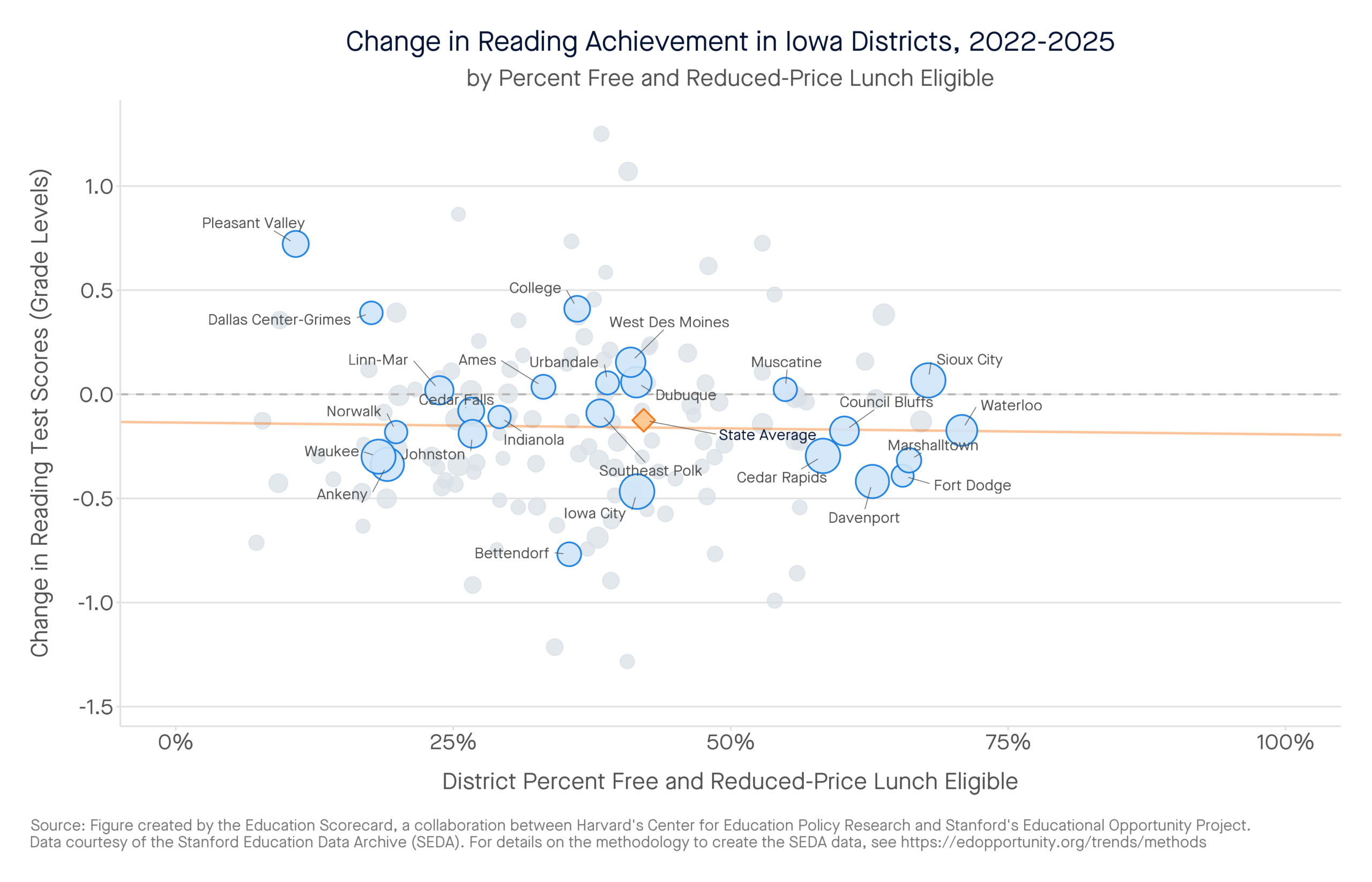
- Iowa ranks 38th out of 38 states in academic growth in math and 18th out of 35 states in reading between 2022 and 2025.
- In math, the average student is performing about .21 grade equivalents below their 2022 level, and about .42 grade equivalents below 2019 levels. Some districts like Waukee, Ankeny, Johnston, Iowa City, and Davenport continue to lag over a full grade equivalent behind 2019 levels.
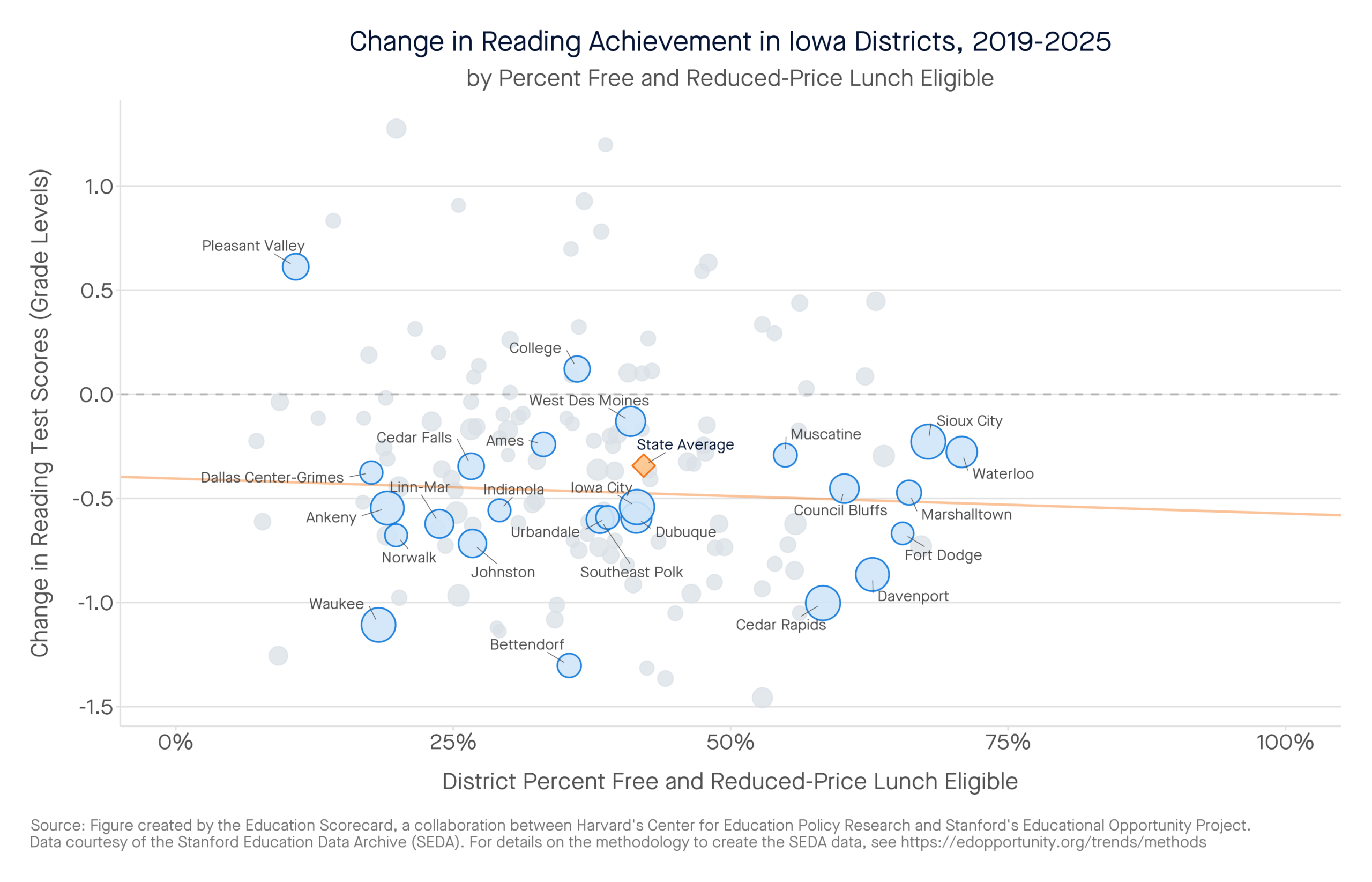
- In reading, the average student is performing .14 grade equivalents below their 2022 level, and .36 grade equivalents below 2019 levels. Several districts like Waukee, Bettendorf, and Cedar Rapids continue to slip and remain more than a full grade equivalent behind their 2019 levels.
- Several Iowa districts are emerging as Districts on the Rise. These districts have shown unusual progress relative to similar districts in their own state. A core group of districts is excelling in both math and reading, with districts like College Community and Pleasant Valley Community outperforming their peers.
- Several other districts are rising relative to their peers in one subject—either math or reading. Ames, Mason City, and Norwalk are leading the way in math performance, while Dallas Center-Grimes, Linn-Mar, and Sioux City are leading the way in reading.
- Statewide, there is some good news on chronic absenteeism (students missing more than 10% of a school year), which has fallen from almost 26% in 2022 to around 16% in 2025.
- Iowa received about $1.19 billion in federal pandemic relief for K–12 schools—roughly $2,400 per student. Our analysis finds that the gains in many high-poverty districts were driven by this federal support. Unfortunately, many middle-poverty districts (those with 30 to 70 percent of students receiving federal lunch subsidies) received little federal aid. Now that the federal relief is gone, Iowa should focus school improvement dollars on the middle and higher poverty districts that remain behind their pre-pandemic levels.
“The pandemic was the mudslide that followed seven years of erosion in student achievement,” said Professor Tom Kane, faculty director of the Center for Education Policy Research at Harvard University. “The ‘learning recession’ started a decade ago, after policymakers switched off the early warning system of test-based accountability and social media took over children’s lives. In this report, we highlight the work of a small group of state leaders who have started digging out by changing how students learn to read, and 108 local school districts that are finding ways to get students learning again. The recovery of U.S. education has begun. But it’s up to the rest of us to spread it.”
District on the Rise: College Community School District
Among Iowa’s Districts on the Rise in both math and reading, College Community School District stands out for building a coherent, whole-child system that extends from pre-kindergarten through career readiness. The district built a multi-year, systemwide MTSS framework ensuring all students are screened in math and literacy and receive targeted interventions through daily WIN (What I Need) blocks embedded in the school day, with each school’s CADRE leadership team regularly reviewing data, conducting MTSS self-assessments, and aligning action plans to building and district priorities. Instructional quality is anchored by tight alignment to state standards, a long-range curriculum review cycle, and the New Teacher Center’s Core Capabilities framework, with professional development driven by analysis of both student performance and staff implementation data—including coaching, structured planning tools, lesson studies, and classroom observation cycles. The district has proactively addressed rapid English learner growth through expanded EL staffing, an individualized newcomer pathway, and districtwide K–12 training on strategies for EL students. Special education has been strengthened through staffing realignment and a therapeutic classroom model serving students with social, emotional, and behavioral IEP needs across both comprehensive and special school settings. Family engagement is built in from the start: “Great Start Conferences” bring families to meet teachers individually before school begins, ParentSquare enables communication in over 100 languages, and resource centers provide food, clothing, and school supplies. The district has maintained chronic absenteeism rates well below the Iowa average—elementary rates often under 10%, a full 5 percentage points lower than the state average—a key driver of its academic gains. At the secondary level, a career academy and pathway system aligned to regional workforce needs, including agriculture, health sciences, aviation mechanics, building trades, culinary arts, and teaching, connects the district’s strong literacy and numeracy foundation to durable, career-ready skills. For the full case study, click here.
“I am immensely proud of our progress in meeting the evolving academic and transferable skill needs of our students,” said Dr. Doug Wheeler, Superintendent of Schools for the College Community School District. “Our entire team: administrators, teachers, and support staff is dedicated to accelerating student growth through a foundation of shared language, clear systems, and responsive collaboration. We have fostered an environment where student success is powered by the continuous growth, specialized expertise, and deep-seated dedication of our team with the support of our families and community.”